Get Full Government Meeting Transcripts, Videos, & Alerts Forever!
Get email alerts on the Supportive Housing topic
No spam. Unsubscribe anytime.
Multnomah County discusses Metro proposals to change Supportive Housing Services measure
Summary
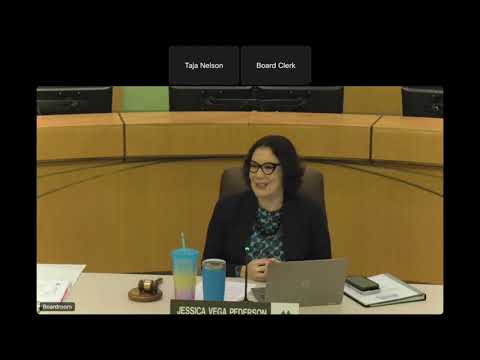
At a January Multnomah County Board work session, county officials and staff reviewed Metro proposals to change the Supportive Housing Services (SHS) measure, including proposals to index tax thresholds, reduce the tax rate in stepped phases and broaden allowable uses to include more affordable-housing investments.
At a January Multnomah County Board work session, county officials and staff reviewed Metro proposals to change the Supportive Housing Services (SHS) measure, including proposals to index tax thresholds, reduce the tax rate in stepped phases and broaden allowable uses to include more affordable-housing investments.
The discussion is consequential because SHS funds currently pay for shelter, supportive services and rent assistance across Multnomah County and its cities; proposed changes could shift the balance of services, alter local decision-making and affect how the region counts and measures progress. Chair Vega Peterson said the timing is urgent: “this is something that is gonna have deep, deep impact for Multnomah County.”
County staff described the core elements under consideration. Heather Lyons, senior policy advisor for Chair Vega Peterson on housing and homelessness, summarized the current SHS tax structure: “These taxes are a 1 percent tax on household income above 200,000 and individual income above 150,000 and a 1% profit tax on businesses with gross receipts higher than $5,000,000.” Metro’s proposals discussed at the stakeholder table include beginning to index the income threshold by CPI, a phased rate reduction (an initial cut to 0.9% in a near fiscal year and a later reduction to 0.75%), and a 20-year extension of the tax.
Governance was a central point of debate. County staff and several commissioners said the current oversight — split between the Supportive Housing Services Oversight Committee and the Tri-County Planning Body (TCPB) — is confusing and that a single oversight body would be simpler. Proposals differ dramatically on membership and authority: Metro’s draft governance body would be large and include multiple jurisdictions and non-governmental representatives; the counties’ counterproposal envisions a smaller, cross‑representative 13‑member body; cities have pushed for stronger city representation. County staff said the counties’ counterproposal would require co-creation of key performance measures (KPMs) with Metro and board approval by county governing bodies; Metro has preferred that the new oversight body develop KPMs without requiring county-board signoff.
Commissioners repeatedly emphasized preserving county authority over local implementation. Commissioner Julia Brim Edwards and others pressed for mechanisms that let each county set local implementation plans and budget priorities given differing local needs and funding pools. Several commissioners expressed concern that expanding the measure’s allowable uses to more generic “affordable housing” without protecting services for high-acuity participants could dilute the program’s original focus on people with complex, service‑intensive needs (referred to in presentations as “population A”). As one commissioner put it, affordable-housing investments must remain “in conversation with services so that each county is weighing, you know, how much money are we using towards shelter? How much are we using towards rent vouchers?” (attributed statement paraphrased to reflect the commissioners’ line of questioning).
Cities at the Metro Mayor’s Consortium recommended delaying a referral to voters while improving implementation and partnerships between jurisdictions; some city representatives suggested returning to voters later after refining the measure. County staff said cities pressed strongly for allowing more affordable-housing uses should a measure be placed on the ballot. County officials and commissioners offered a third position: allow affordable-housing uses in a narrowly defined way that preserves funding for the population the measure was designed to serve.
Metro’s timeline also prompted concern. County staff noted Metro needs a ballot-title notice by Feb. 28 if it wants a May ballot; staff pointed to a stakeholder meeting scheduled for “the 10th” as an upcoming forum to surface lingering questions. Commissioners asked staff to provide a short written summary of any consensus items and clear analyses of how proposed changes (indexing thresholds versus cutting the rate) would alter revenues and program impacts.
What’s next: staff said they will continue regional negotiations, provide financial impact scenarios to the board and attend Metro stakeholder meetings. Commissioners urged that any referral preserve county board role in setting measures and oversight and asked staff to return with a written summary of takeaways and a revenue-impact analysis before Metro’s next decision points.