Get Full Government Meeting Transcripts, Videos, & Alerts Forever!
Get email alerts on the Liquor Licenses And Outdoor Dining topic
No spam. Unsubscribe anytime.
Manhattan City committee reviews multiple liquor-license applications, flags FDNY/DOT roadbed waiver issues
Summary
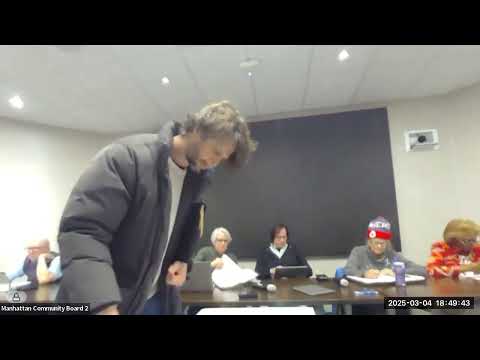
Donna, chair of the Manhattan City Community Board liquor‑licensing committee, opened the meeting and said the panel would hear applicants, take public comment and issue stipulations or recommendations.
Donna, chair of the Manhattan City Community Board liquor-licensing committee, opened the meeting and said the panel would hear applicants, take public comment and issue stipulations or recommendations.
The committee reviewed applications for roughly a dozen on-premise and previously-unlicensed locations, heard public comment on at least one neighborhood restaurant, and repeatedly raised a separate administrative issue: whether Department of Transportation (DOT) street-use approvals and Fire Department of New York (FDNY) emergency-lane waivers are sufficiently coordinated to allow roadway dining on narrow blocks.
The committee's process and immediate outcomes
Committee chair Donna (identified in the transcript as the meeting chair) explained the procedure at the start of the meeting: applicants present at a podium, committee questions, public comment, and then applicant responses. The committee said it will send stipulations (written conditions) to applicants that generally cover hours, no DJs/live music, limits on outdoor service and other neighborhood protections.
Several applicants presented basic operating plans and received the committee's standard follow-ups and promises of stipulations. Examples included: - Lab 2 Restaurant (88 West Street): owner Chi Minh Leung described a sushi-focused operation with about 20 seats (10 at the sushi counter and five tables) and Thursday–Saturday service generally running noon to 11:30 p.m.; the committee said the office will send stipulations reflecting the hours and other controls. - PST Health LLC doing business as Lifetime Natural Market (408 Sixth Avenue): Sasha Barnett represented a plan to open a second-floor dining area for about 48 diners with last seating around 8 p.m. and patrons out by roughly 10 p.m.; the committee requested the applicant bring the final operating details and noted the applicant's representative should ensure the owner appears if needed. - Pura (Poor) Foods LLC (ramen): attorney Samuel Ahn said the premises is roughly 2,000 square feet with about 45 seats, a nine-seat bar and a menu with ramen in a $14–$16 price range; hours described in the presentation were Sunday–Wednesday 11 a.m.–midnight and Thursday–Saturday later into the night. - Festive/Best & Co. upgrade: Andrew McCaughgan, co-owner/coo, said the business sought an upgrade to a full on-premise license and had negotiated with local residents; the committee discussed a cap on private events and asked the applicant to clarify a limit for evening private parties (the parties/guest cap under discussion was roughly 20–24 for events after 10 p.m.).
Public comment and contested applications
Multiple applicants drew public comment. Pauline Bethel, a resident who said she lives next door to one applicant, praised a long‑running local operator as “an asset to the neighborhood,” while other residents raised noise concerns about a different restaurant (see below).
Bonnie Restaurant LLC and complaints
Committee members recited prior complaints filed about Bonnie Restaurant’s operation since it opened. A committee member summarized that the board had received noise complaints (311 reports were referenced in the meeting record) and said the committee was uncomfortable advancing a license upgrade without clearer evidence that neighbors’ concerns had been addressed. The chair and other members said they would not simply enable a license expansion where verified, ongoing resident complaints exist.
Sushin / 68 Thompson (omakase) — BYOB and complimentary sake
The attorney for the applicant at 68 Thompson (David Gabei) and the owner (Jason) said the 13-seat omakase counter and small table seating operate quietly. The applicant told the committee the price point for the tasting menu was $68 and that the business had been operating without full liquor. Committee members raised two compliance topics: (1) a clarification that BYOB is not permitted under New York State rules once a commercial license is in place; and (2) a question about the sourcing and provision of complimentary sake, which a committee member noted should come from an authorized supplier. The applicant said they would correct paperwork and provide price-point information to the office.
Host on Howard (catering) and capacity questions
Host on Howard (21 Howard Street) told the committee it had hosted several events since opening and asked the committee to consider upgrading from beer-and-wine to full liquor and increasing an attendee cap (the operator said they had been working with the DOB on means of egress and plumbing and would present DOB/place-of-assembly documentation at the next hearing). The committee agreed to carry the matter to the next month so the applicant could bring those documents and to solicit community comment about larger occupancy at later hours.
Roadway, sidewalk and Open Streets dining: DOT/FDNY coordination
Committee members spent substantial time on a separate, recurring issue: whether roadway (roadbed) dining approvals can safely be allowed on narrow blocks when FDNY requires a 15-foot emergency travel lane and DOT approval must reflect that standard. Committee members and staff said the FDNY had circulated a memorandum describing the conditions under which it might consider waiving the 15-foot requirement but that the memo was not being consistently communicated to applicants or the community board.
The committee emphasized two practical problems: (1) DOT approvals and FDNY waivers are being issued without clear cross‑checks about where other roadbed seating exists on the same block, producing uncertainty about whether a 15-foot perpendicular offset between opposite roadbeds is being preserved; and (2) applicants cannot finalize Liquor Authority diagrams until the city confirms the final approved roadway footprint, which delays SLA submissions. The committee asked applicants with proposed roadbed dining to provide final DOT signs of approval and any FDNY waiver or conditions before the committee will endorse outside liquor‑service plans.
Decisions and administrative outcomes recorded at the meeting
- The committee instructed staff to prepare standard stipulations (hours, no DJs/live bands, noise levels, no unapproved outdoor seating, limits on sandwich-board placement) and to send those stipulations to multiple applicants; applicants were told that signing stipulations could allow the committee to waive a return appearance if the stipulation terms were accepted. - The committee waived appearances for a set of Open Streets / roadway applicants that had sent in drawings and agreed to stipulations. Those applicants (listed by the committee) included multiple Bond and Bleecker Street businesses that had submitted Open Streets drawings and agreed to the written stipulations. - For applicants not yet able to provide final DOT approvals or FDNY waivers for roadbed dining (notably several West Third Street applicants), the committee said it would withhold a recommendation for outdoor service until the city approvals were final. The committee placed at least one applicant’s request to increase event capacity (Host on Howard) on the calendar for the next month so the applicant could supply DOB/place-of-assembly documentation. - The committee signaled it would not recommend approval without mitigation where the board had received multiple verified neighborhood complaints (in one discussed case, the committee said it would “deny until” or otherwise ask for corrective action and proof the problems were resolved before supporting an upgrade).
What happens next
The committee asked applicants to supply final DOT/FDNY approvals when applicable, proof of DOB/place-of-assembly approvals where occupancy increases were requested, and price/ sourcing information where needed (for example, for complementary sake and for clarifying beverage price points). Where applicants sign stipulations and provide the requested city approvals, the committee said it will consider waiving a return appearance and forwarding the stipulations to the State Liquor Authority (SLA). Where complaints remain unresolved, the committee said it will recommend against an upgrade until neighborhood concerns are addressed.
Ending
The committee concluded with a reminder that DOT/DOB/FDNY approvals and final, signed stipulations are decisive for whether roadbed or sidewalk dining may proceed. The chair reiterated that applicants should expect the committee to revisit any matter where the city approvals or neighborhood complaints remain unresolved.