Get Full Government Meeting Transcripts, Videos, & Alerts Forever!
Get email alerts on the Earned Wage Access topic
No spam. Unsubscribe anytime.
Committee hears competing views as Connecticut weighs regulating earned-wage access apps
Summary
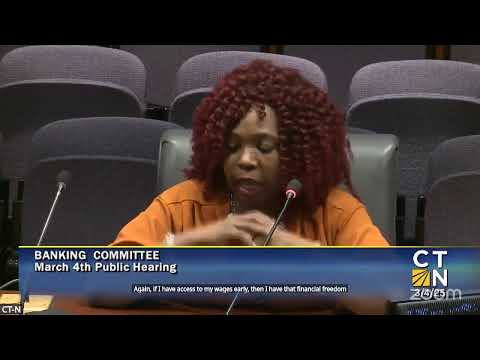
Connecticut legislators heard more than five hours of testimony Tuesday on Senate Bill 13‑96, which would create a licensing and consumer‑protection framework for earned‑wage‑access services that let workers draw on wages they have already earned.
Connecticut legislators heard more than five hours of testimony Tuesday on Senate Bill 13‑96, a proposal to set rules and a licensing framework for earned‑wage‑access (EWA) services that give workers early access to wages they have already earned.
Proponents including large EWA providers, payroll groups and some customers argued the services are a low‑cost alternative to overdrafts and payday loans and can help workers avoid more costly debt. Opponents, including consumer advocates and some labor representatives, warned the products can become costly if used frequently and urged stronger limits and monitoring before the state broadens legal protections.
Supporters framed the bill as a practical update to Connecticut law that would preserve consumer protections while allowing employer‑integrated and direct‑to‑consumer providers to operate here. Joseph Chambers, general counsel for the Department of Banking, said the draft was the product of months of negotiations with industry and that the text now on the table would “cap the total allowable finance charge per advance at $5 including tips and expedited fees.”
Why it matters: Advocates for low‑income and hourly workers described situations where an EWA transfer meant the difference between paying a bill on time and incurring costly overdraft or late‑payment fees. Ryan Naples of DailyPay told the committee that when instant transfers were unavailable “nearly nine out of 10 DailyPay users reported … accrued late fees, overdraft fees, and increased credit‑card interest charges” after the product was restricted in other states.
What supporters said: Employer‑integrated providers and payroll groups said EWA products are generally nonrecourse and allow employees to use wages they have already earned, not new credit. Tara Bridal of Bridget (an EWA provider) described internal limits her company uses — a per‑advance cap and one outstanding advance at a time — and said that, in her view, these features reduce consumer risk.
What opponents said: Consumer advocates and unions emphasized patterns the state should try to prevent. Monica Burks of the Center for Responsible Lending pointed to transactional studies documenting repeat usage and “loan stacking” across providers, and Ed Hawthorne of AARP said Connecticut should not create carve‑outs that would permit higher effective annual costs than state limits now allow.
Open issues and next steps: Committee members pressed both sides on two central technical questions: whether the state should require a third‑party, real‑time transaction registry to prevent multiple advances on the same wages, and how to treat voluntary “tips” or expedited‑transfer fees (whether they count toward the bill’s per‑advance cap). EWA providers argued a registry would impose per‑transaction costs that would be passed to consumers and would be difficult to implement across employer‑integrated and direct‑to‑consumer models. Consumer groups said a registry or other safeguards are needed to prevent overextension.
Ending: The committee did not vote; members asked the Department of Banking and industry and consumer groups to continue discussions. Supporters said they would accept the current draft as a workable compromise but asked the Legislature to consider a few outstanding technical points. Opponents asked for stronger limits and monitoring before statutory exemptions are adopted.