Get Full Government Meeting Transcripts, Videos, & Alerts Forever!
Get email alerts on the Pfas Law Amendments topic
No spam. Unsubscribe anytime.
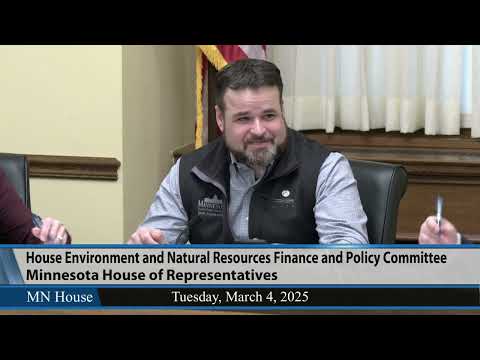
Committee refers bill with amendments to limit PFAS reporting deadline and commercial‑use exemptions to Commerce committee
Summary
House File 1627 (listed as 16 27 in committee) was amended and re‑referred to Commerce, Finance and Policy after testimony about reporting feasibility, industrial exemptions, and MPCA recommendations; the A1 amendment (aligning with MPCA report suggestions) carried and final re‑referral passed 7–5.
The Environment and Natural Resources Policy and Finance Committee on March 6, 2025, took up House File 16‑27, a bill that would modify Minnesota’s 2023 PFAS restrictions (Amara’s law) by excluding items manufactured for commercial or industrial use and by delaying manufacturer reporting of intentionally added PFAS from 2026 to 2028. The committee adopted an A1 amendment intended to incorporate portions of the MPCA’s recommendations, then re‑referred the amended bill to the Commerce Finance and Policy Committee.
Chair Huntsman introduced the bill and said it “makes 2 changes to Minnesota’s PFAS law. The first change is to exclude items manufactured for commercial or industrial use. … The second change moves the date on when manufacturers have to report products that contain intentionally added PFAS … from 2026 out to 2028.” He argued the state and manufacturers need clarity and time to compile supply‑chain information.
Industry witnesses (including Patrick Hynes for the Alliance for Automotive Innovation, Andrew Morley for the Minnesota Chamber of Commerce, Tony Quillis for the AGC and Consumer Technology Association, and others) supported the bill or the A1 amendment. They told the committee that many products include thousands of components, that PFAS comprise a very large class of chemicals with important technical uses in some industrial settings, and that manufacturers need additional time and clearer guidance to comply with the reporting requirement.
Public‑health and environmental witnesses — including family members of Amara Strandy, Clean Water Action, Minnesota Center for Environmental Advocacy, Sierra Club North Star Chapter and others — urged the committee to reject broad exemptions for commercial and industrial uses and to keep strict reporting deadlines. Speakers described local PFAS contamination, estimated cleanup costs, and personal health impacts. Michael and Nora Strandy urged the committee to preserve Amara’s law; Nora Strandy cited MPCA estimates that Woodbury clean‑up could cost $400 million and described EWG tap‑water data for PFBA in her hometown.
Assistant Commissioner Kirk Koudelka (MPCA) testified in opposition to a broad commercial/industrial exemption, saying it “moves us backwards” and would create enforcement challenges because products marketed as commercial could be used by consumers. MPCA recommended targeted extensions for internal and electronic components — not a blanket commercial and industrial exemption — and said the law already includes a currently unavoidable use designation for limited exemptions.
The committee adopted the A1 amendment, which incorporated MPCA recommendations (the amendment carried by voice vote). After testimony and questions the committee re‑ferred the bill, as amended, to the Commerce Finance and Policy Committee; the roll‑call vote to re‑refer passed 7 ayes to 5 nays. Committee members and witnesses repeatedly emphasized the tension between rapid PFAS phase‑out goals and the practical challenges manufacturers cite in identifying PFAS across complex global supply chains.