Get Full Government Meeting Transcripts, Videos, & Alerts Forever!
Get email alerts on the Pfas Exemptions Ohv topic
No spam. Unsubscribe anytime.
Committee approves exemption for youth off‑highway vehicles from Minnesota PFAS ban
Summary
After testimony from industry groups, safety instructors, environmental advocates and family members of PFAS victims, the committee recommended House File 81 to the general register, following discussion of safety risks, alternative materials, and MPCA policy recommendations.
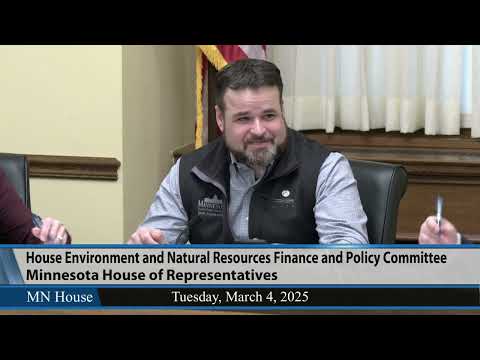
The Environment and Natural Resources Policy and Finance Committee on March 6, 2025, recommended House File 81 to the general register after extended testimony and discussion. House File 81 would carve juvenile off‑highway vehicles (OHVs) — for example youth ATVs, youth snowmobiles and some e‑bikes used by children — out of the statutory definition of a juvenile product subject to Minnesota’s 2023 PFAS restrictions (often referred to in testimony as Amara’s law).
Representative Antoin (bill author) told the committee the bill seeks to “exempt off highway vehicles … from the definition of a juvenile product,” citing safety concerns that banning youth OHVs has pushed novices onto adult machines. Chris Conroy, chair of the youth safety committee for ATV Minnesota, testified: “Youth ATVs, which are low powered, lightweight machines are excellent tools to teaching riders … to ride responsibly.” He said banning youth machines could push inexperienced riders onto higher‑powered adult ATVs and increase crash risk.
Industry groups and dealers supported the bill. Kyle Macarios of the Motorcycle Industry Council, representing manufacturers and dealers, said certain PFAS‑containing components such as fuel hoses and gaskets currently have no PFAS‑free alternatives ready for some vehicle applications and argued that banning youth models would push children to adult machines.
Environmental and public‑health witnesses urged the committee to reject the exemption. Ivana Stark, state director of Clean Water Action Minnesota, said the manufacturers and trade associations “knew” the law and failed to prepare retailers; she asked the committee to reject HF 81. Lori/Laura Ohlinger of Sierra Club North Star chapter and other public‑health witnesses cited concerns about fluoropolymers, persistence, and disposal. Assistant Commissioner Kirk Koudelka of the Minnesota Pollution Control Agency (MPCA) opposed the bill, telling the committee it would reintroduce PFAS into uses that the 2023 law sought to phase out and that MPCA had recommended a narrower extension for internal and electronic components until 2032 instead.
Members asked the MPCA about pathways of exposure and landfill/leachate impacts; Koudelka said PFAS in disposed products can concentrate in landfill leachate and wastewater treatment plant inflows, citing measured leachate levels “up to 10,000 parts per trillion.” Representative Jordan said she would vote no, citing public‑health and municipal cleanup costs. Representative Heintzeman, the bill author, responded that the bill aims to bridge safety concerns for children while allowing time for industry to produce tested alternatives.
The committee considered and defeated a motion to table the bill (roll call: 5 yes, 7 no). On a subsequent roll call to recommend House File 81 to the general register, the motion passed with 7 ayes and 5 nays. Committee members asked the bill author to continue discussions as the bill moves to the House floor.
Quotes in this article are taken from committee testimony and are attributed to speakers who appeared before the committee.