Get Full Government Meeting Transcripts, Videos, & Alerts Forever!
Get email alerts on the Medical Education Funding topic
No spam. Unsubscribe anytime.
Mayo Clinic officials tell Minnesota House committee state funds support scholarships and family medicine residencies
Summary
Mayo Clinic representatives briefed the House Higher Education Finance and Policy Committee on how state appropriations are used for medical school scholarships and family medicine residency support, and described student counts, program structure and outcomes for Minnesota residents.
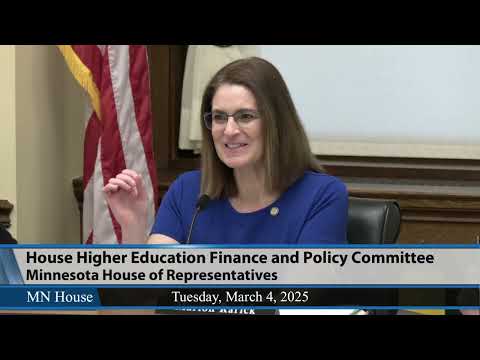
Mayo Clinic representatives told the Minnesota House Higher Education Finance and Policy Committee on March 1 that state appropriations to the Mayo Clinic College of Medicine and Science are used primarily for scholarships for Minnesota residents and to help operate family medicine residency programs.
The committee heard the presentation from Dave Dolan, education compliance officer and accreditation liaison for the Mayo Clinic College of Medicine and Science, and John Poe, a Mayo education official. Dolan said the college credits state scholarship funds directly to students' accounts and that the legislative language requires the program to encourage graduates to enter family medicine and primary care.
Dolan said the medical school appropriation for the current biennium is $1,330,000 and that the annual amount — $665,000 — averages to roughly $41,563 in state scholarship funds per eligible student in the most recent reporting year. He said those scholarships are credited on students' invoices and are limited by statute to Minnesota residents.
Poe described the family medicine residency funding as an operating subsidy rather than direct student scholarships. He said the family medicine residency appropriation for the biennium totals $2,268,000, or $1,134,000 per year, and that those funds are used to help cover program expenses, including resident salaries and benefits. Poe said Rochester has been the long-standing site of the residency program, and that Mayo became the sponsoring institution for a family medicine residency in Mankato several years ago after the University of Minnesota transitioned the program.
Dolan reported outcome measures the committee requested: over the past three years, 12 medical school graduates who were supported by the state scholarship program completed training; of those 12, eight had entered primary care careers (family medicine, pediatrics, internal medicine) and four were in residencies in Minnesota. He also said the long-running Rochester family medicine residency has graduated 321 physicians since its founding and that 140 of those graduates (44%) are still practicing family medicine in Minnesota. He said the Mankato program’s 14 graduates include 10 practicing in nonmetro Minnesota.
Committee members asked questions about program scale, the labeling of the organizations that receive appropriations, and the role of Mayo Clinic’s broader finances. Representative Lee asked how the scholarship shows up on a student's bill; Dolan said the appropriation appears as a state capitation credit on the student's account. Representative Allen and others asked about Mayo Clinic’s institutional revenues and the relationship between Mayo’s operating surplus and investments in education; Poe said Mayo provides institutional investment in education but deferred financial-detail questions to Mayo’s finance staff and offered to return with additional information.
The Mayo presenters outlined the college’s structure and enrollment: the College of Medicine and Science comprises five schools (graduate school, graduate medical education, health sciences, medical school across three campuses, and continuous professional development) and, excluding external academic nursing affiliations, serves more than 6,000 learners across research, clinical and allied-health programs. Poe and Dolan emphasized investments in digital education, immersive simulation, regenerative medicine and robotics, and noted partnerships with more than 42 academic nursing programs that help educate more than 4,000 nurses annually.
The presentation was informational; no legislative action or votes on Mayo-related funding occurred in the committee during this session. Committee members asked the presenters to provide additional documentation on Mayo’s financial statements and program-level outcomes; the presenters said they would follow up with the committee.
Mayo Clinic officials’ summary materials and the committee’s packet provided the figures the presenters cited; the presenters also identified statutory limits on who may receive scholarship capitation (Minnesota residents) but did not cite a specific statute number in the hearing.