Get Full Government Meeting Transcripts, Videos, & Alerts Forever!
Get email alerts on the K3 Discipline topic
No spam. Unsubscribe anytime.
Minn. House committee hears hours of testimony on bills to restore K–3 suspensions and roll back non‑exclusionary discipline
Summary
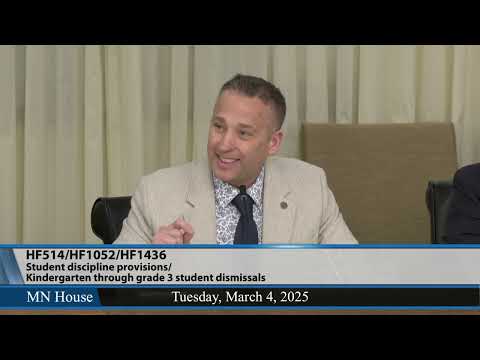
The House Education Policy Committee on March 4, 2025, heard hours of testimony on three bills by Representative Ben Bakeberg that would permit or expand suspensions for kindergarten through third‑grade students and change non‑exclusionary discipline rules.
The House Education Policy Committee on Tuesday, March 4, 2025, heard more than two hours of public testimony and member remarks on three bills authored by Representative Ben Bakeberg that would loosen limits on suspensions for kindergarten through third‑grade students and repeal parts of the state—s non‑exclusionary discipline (NED) framework.
Representative Ben Bakeberg, the bills— author and a middle‑school principal, told the committee the measures aim to "provide every single person that walks into our schools a safe learning environment" and described the three bills as differing approaches: one would repeal NED requirements while adding alternate educational services in exclusion or expulsion cases (House File 14‑36); one would restore unlimited suspension authority for K–3 administrators (House File 5‑14); and one would allow suspensions for K–3 students but cap them at three days (House File 10‑52). "I have in my professional role done that 0 times in my career," Bakeberg said of expulsions, adding that his priority is to keep other students learning when a classroom is repeatedly disrupted.
The committee heard unified support from many elementary principals and district leaders who said short suspensions provide time to plan reentry and to protect the classroom. Michelle Kral, executive director of the Minnesota Elementary School Principals Association, urged the committee to "allow for up to 3 days of suspension when necessary," saying a brief removal can give staff time to develop an intervention and a structured reentry plan. Patrick Glenn, an elementary principal in the Prior Lake‑Savage area, described using brief suspensions to create reentry plans and said in his five years at his current school he oversaw 14 suspensions (five in‑school, nine out‑of‑school), with seven of the nine out‑of‑school cases involving K–3 students receiving special education services.
Opponents — including students, parents, civil‑rights and disability advocates, Legal Aid, and restorative‑justice practitioners — urged the committee to keep the 2023 protections that largely bar suspensions for kindergarten through third grade. Testimony cited national and state studies showing racial and disability disparities in exclusionary discipline and the potential for short‑term removals to harm academic progress and increase future contact with the juvenile justice system. "Suspension is not the solution, especially for our younger learners," said Jessica Webster, a staff attorney with Legal Aid, who described research finding that exclusionary discipline does not improve future behavior or academic outcomes.
Multiple testifiers recounted personal incidents. Brianna Sanders, a parent and school public health nurse, described an alleged assault on her second‑grade daughter on Sept. 12, 2024, and said statutory limits on exclusionary discipline left the school with what she characterized as inadequate options. Other speakers described the impact of suspensions on working families and on children with trauma histories.
Several witnesses raised concerns about specific language in the bills. Matt Shaver of Ed Allies highlighted that House File 10‑52 would repeal Minnesota Statute 121A.611 (enacted in 2023) and remove certain limits, including those governing withholding recess; he argued those protections were established after bipartisan work. Advocates for students with disabilities and disability rights groups warned that repeals could worsen disproportionate exclusion of students with disabilities; The Arc Minnesota testified that students with disabilities are 14 percent of enrollment but account for 43 percent of suspensions per state data cited in testimony.
Officials from the Minnesota Department of Education (MDE) and several superintendents said MDE and districts are working to implement non‑exclusionary approaches and that the department offers trainings and resources. Edo Shuni, MDE—s director of government relations, told the committee MDE provides monthly NED trainings, newsletters, and a district feedback system to support implementation.
The committee did not vote on the three discipline bills. After more than two dozen in‑person and remote speakers, Chair Bennett said the panel would "not do anything with these three bills right now" and that Representative Bakeberg would hold additional member listening sessions. Representative Bakeberg thanked testifiers and said he wanted further member engagement before moving the measures.
Why it matters: The March 4 hearing highlighted a recurring tension in Minnesota K‑12 policy — balancing classroom safety, educator authority, and parents— and students— rights, against research and advocacy showing exclusionary discipline disproportionately affects students of color and students with disabilities. Committee members on both sides asked for more data and local‑level detail before further action.
Next steps: Representative Bakeberg said he would convene follow‑up meetings with members and stakeholders. The committee did not advance the bills at the March 4 hearing.