Get Full Government Meeting Transcripts, Videos, & Alerts Forever!
Get email alerts on the Government Accountability topic
No spam. Unsubscribe anytime.
House committee advances bill to create independent statewide inspector general for fraud oversight
Summary
The House State Government Committee voted to re-refer House File 1, which would establish an independent Office of Inspector General within the legislative branch to investigate fraud and oversight of state grants; the proposal drew debate over collective-bargaining rights, federal funding risk and how existing agency OIGs would be transferred.
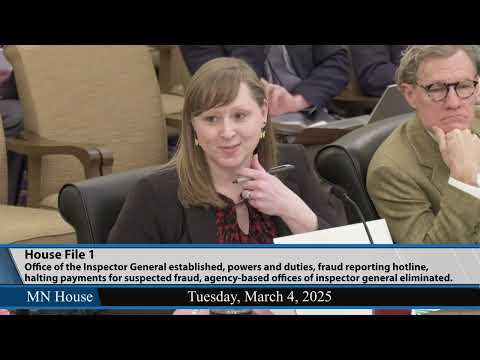
Representative Patty Anderson brought House File 1 before the Minnesota House State Government Committee, urging creation of an independent Office of Inspector General (OIG) within the legislative branch to investigate fraud, misuse and provide oversight of state grant making.
Anderson said the office would be “absolutely not political” and “nonpartisan,” and described the proposal as modeled on the legislative auditor’s office and overseen by the Legislative Audit Commission. “Their job would be to investigate and combat fraud, misuse,” Anderson said.
The bill would consolidate many existing OIG functions that are currently housed in multiple state agencies, transfer some agency employees into the new office and re-create a fraud-reporting hotline and investigative capacity. Anderson said consolidation aims to reduce siloing between agencies and between executive-branch OIGs so investigators can share information about vendors and grantees across the enterprise.
Union and agency witnesses expressed concerns. Devin Bruce, director of legislative and political affairs for the Minnesota Association of Professional Employees (MAPE), told the committee that moving employees from the executive to the legislative branch would strip them of collective-bargaining rights because “the legislature is currently exempted from [Minn. Stat.] chapter 179A.” Bruce also argued the bill would not by itself improve fraud prevention, noting criminal investigations often require lengthy multi-departmental work and due-process safeguards, and he raised constitutional concerns about mandatory, unannounced inspections of private homes for some long-term and disability services providers.
Alyce Bailey, budget director at the Department of Human Services (DHS), told the committee that DHS’s Office of Inspector General totals about 487 employees, and its program-integrity unit is about 99 employees — figures committee members cited when questioning whether a statewide OIG could replace agency expertise.
Committee members pressed on multiple topics: whether the new OIG would have prosecutorial power (Anderson said it would not; referrals would go to county attorneys, the Bureau of Criminal Apprehension or the attorney general), how the proposal would interact with recent executive-branch moves of fraud units into the BCA, and whether consolidating functions might risk federal funding. Nonpartisan staff identified the bill’s transfer language and noted the statute that exempts the Legislature from chapter 179A.
Anderson said the bill includes carve-outs intended to preserve functions that must remain inside specific agencies to comply with federal requirements; nonpartisan staff pointed to language on page 18 of the fourth engrossment that exempts certain DHS licensing and program-integrity positions from transfer. Representative Hicks repeatedly pressed for documentary assurance that federal matching funds — including Medicaid-related federal funds — would not be jeopardized; Anderson committed to provide documentation and said the bill’s drafters are working to avoid losing federal dollars.
Committee members also questioned timing, staffing and fiscal impacts. Nonpartisan staff explained that while the bill’s effective date is written as July 1, 2025, transfers of duties and personnel would not occur until the new inspector general certifies in writing that the office is ready to assume responsibility. Anderson estimated full implementation could take roughly 18 months.
After more than four hours of testimony and questioning, the committee voted by voice to re-refer House File 1 to the Committee on State Government Finance. The transcript records a voice vote with “Aye” and “Nay” calls but does not include a roll-call tally.
Why it matters: Supporters said moving the office into the legislative branch would create an independent investigative body better able to detect and deter large-scale fraud in state grant and vendor programs. Opponents and some Democrats on the committee warned that consolidating agency investigatory units without clear protections for federal compliance or for employees’ collective-bargaining rights could risk funding and damage agency expertise.
What happens next: The bill was re-referred to the Committee on State Government Finance for further consideration; sponsors expect additional committee stops and continued negotiation with the Senate and stakeholder groups.