Get Full Government Meeting Transcripts, Videos, & Alerts Forever!
Get email alerts on the Elections Districting topic
No spam. Unsubscribe anytime.
Gilroy holds first public hearing on move from at-large to district elections; demographer briefs council and public
Summary
Redistricting consultant explained the California Voting Rights Act, criteria for drawing districts and the five-meeting schedule. Dozens of residents gave input on communities of interest and asked for translated materials and workshops across the city.
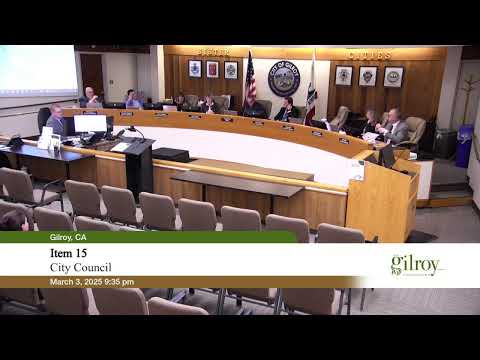
The City Council held the first of five public hearings on March 3 about transitioning Gilroy from at-large elections to district-based elections, a change the city is pursuing under the California Voting Rights Act process.
Redistricting consultant Liz Ditt of Redistricting Partners presented the legal framework and practical steps residents should consider when identifying communities of interest. "The California Voting Rights Act ... prohibits at-large election systems if there's evidence of racially polarized voting," Ditt told the council, and she outlined why public outreach and multiple hearings are part of the safe-harbor process.
Nut graf: The hearing was educational and intended to solicit input on communities of interest and basic map-drawing criteria; no council action was taken. Staff and the consultant emphasized that the next meetings would allow public map submissions and specific mapping exercises using an online tool the city will post the week after the hearing.
What presenters said: Ditt explained core redistricting principles — population equality (using 2020 census totals), contiguity, compactness, keeping neighborhoods and communities of interest together and avoiding gerrymandering. She said jurisdictions must consider both total population for equalization and citizen voting-age population (CVAP) when assessing whether protected groups can elect their preferred candidates.
Public input: Eleven speakers were heard in a two-minute per-speaker public comment block; overall roughly two dozen residents addressed the council during the extended public-comment period on districting. Speakers representing neighborhoods and community groups urged the council to hold meetings in widely accessible locations, provide translated materials and workshops, and to treat schools, neighborhoods and socioeconomic groupings as legitimate communities of interest. Several speakers from the Gilroy East Side and longtime residents said they felt underrepresented under the at-large system. Yvonne Martinez Beltran, a Morgan Hill councilwoman who has experience running district campaigns, urged Gilroy to hold workshops, provide language access and consider transportation and multigenerational households in outreach.
Process and schedule: Ditt and staff said the council will hold at least five public hearings. The next meeting is scheduled March 17 for further education and input; the demographer will present draft maps at a later hearing and the council will have additional opportunities to request modifications before a final vote. Staff said the City will post a Districting Partners mapping tool and a dedicated districting webpage the week following the hearing so residents can draw and submit maps online.
Ending: Council members generally supported broader outreach. Several members asked staff to hold community-based workshops at different times and locations to increase participation; staff confirmed an online mapping tool and translated materials would be made available. No change to the election system was adopted on March 3; the item remains in the public-input phase.