Get Full Government Meeting Transcripts, Videos, & Alerts Forever!
Get email alerts on the County Budget And Finance topic
No spam. Unsubscribe anytime.
Howard County spending-affordability panel urges caution, $25 million GO‑bond pause and scenario planning amid federal uncertainty
Summary
The Spending Affordability Committee told the Howard County delegation on March 5, 2025, that recent federal and economic developments have created an unusually risky revenue outlook and recommended a conservative fiscal approach for fiscal 2026, including a $25 million general‑obligation bond ceiling and a pause on major new long‑term commitments.
The Spending Affordability Committee (SAC) told the Howard County delegation on Wednesday, March 5, 2025, that economic and federal‑funding uncertainty make the county’s near‑term revenue outlook unusually risky and recommended a conservative approach for fiscal 2026 budget planning.
Dr. Holly Sun, Howard County budget administrator and SAC chair, told the delegation that recent weeks have produced rapid changes that forced the committee to revise assumptions used in its revenue forecast. “This is not a typical budget conversation. We are not at a normal time, to be honest,” Sun said. She said earlier projections showing property‑tax and personal‑income growth above 4 percent must be rethought because of rising uncertainty in financial markets and signs of slowing GDP.
SAC’s principal concerns and recommendations - Double risk to local finances: SAC members warned the county faces a possible decline in revenues at the same time demand for county services could rise if federal spending and grants are reduced. Dr. Richard Clinch, SAC’s economist, provided context for the county’s exposure: Howard County is highly dependent on federal employment, federal procurement and related contractors, and reductions at the federal level or among federal contractors could reduce income‑tax receipts and grant funding. - Conservative bond issuance recommendation: SAC recommended a conservative general‑obligation (GO) bond ceiling of $25 million for the upcoming year to avoid committing the county to large long‑term debt if revenue growth weakens. - Five‑year planning projection: The committee recommended using a planning assumption of roughly 3.6 percent average annual revenue growth for the next five years but warned of “choppiness” and substantial downside risk. - Pause and scenario planning: Committee members urged a “pause” of six months to a year on launching large, long‑term spending commitments and recommended a countywide risk assessment that includes nonprofits, capital projects and operating pressures. - Use pay‑as‑you‑go (PAYGO) funds selectively: SAC advised using one‑time PAYGO funds for critical maintenance and life‑extension projects rather than new, ongoing obligations.
Key figures and concerns discussed - SAC estimated Howard County’s general‑fund revenue pool at about $1.5 billion and noted that roughly 92 percent of that revenue comes from property and income taxes; property taxes are relatively stable, while income taxes are volatile. - Dr. Clinch said a small percentage loss of employed residents (3–5 percent) tied to federal cuts could reduce county revenues by roughly $20–30 million and that the county also receives $25–$35 million a year in federal grants for social services that could be at risk. - The committee singled out the Ellicott City “Safe and Sound” flood‑mitigation program as a large capital item; members cited a current total program estimate of about $277 million from county, state and federal sources and emphasized the need to monitor costs as the project proceeds. - Deferred maintenance: SAC noted approximately $500 million in deferred school maintenance reported in the system’s records and urged prioritizing PAYGO funds for asset life extension and maintenance.
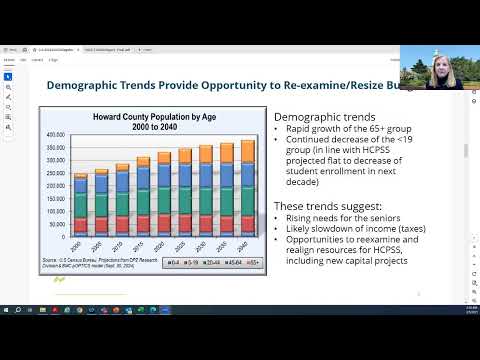
Demographics, housing and schools - SAC members described slowing population growth, out‑migration of high‑income residents statewide, and a long‑term shift toward an older age profile that reduces income‑tax base growth. The county’s residential‑building permit activity has fallen, and SAC urged accelerated implementation of Howard County by Design to encourage appropriate housing supply and density. - School enrollment: SAC and school officials reported that pre‑pandemic enrollment peaks have not returned; enrollment is flat or projected to decline, which affects long‑term capital and operating plans. Committee members recommended aligning school capital priorities with updated enrollment projections.
Committee members emphasized the uncertain, fast‑moving nature of the situation and urged the delegation and county leadership to weigh state proposals that could shift costs to counties. SAC requested continued communication with the delegation as state policy choices and federal funding trends evolve.
What happens next SAC’s recommendations are advisory; the delegation and county executive retain budget‑making authority. The committee urged the delegation to consider tools to limit new long‑term obligations this year, to request clearer project funding breakdowns for major capital programs (including sources and remaining needs for Ellicott City work), and to undertake countywide risk scenarios for the coming 6–12 months.