Earned wage access bill exposes sharp split: fintech and payroll firms back new rules; attorney general warns of high APRs
Loading...
Summary
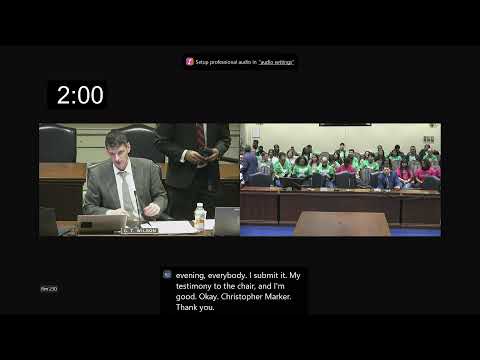
House Economic Matters Committee — The committee heard more than two hours of testimony on HB 12‑94, a measure to create a regulatory framework for earned wage access (EWA) services that let workers draw pay they have already earned before regular payday.
House Economic Matters Committee — The committee heard more than two hours of testimony on HB 12‑94, a measure to create a regulatory framework for earned wage access (EWA) services that let workers draw pay they have already earned before regular payday.
Delegate Marlon Ampre introduced the bill as a follow‑up to the 2024 discussions about EWA and said the legislation seeks to protect workers while allowing providers that follow consumer protections to operate in Maryland. Key provisions require providers to offer a fee‑free option, prohibit credit scores for underwriting and credit reporting, ban employer compensation tied to EWA fees, require clear disclosures and set a per‑transaction fee cap of $5 for advances of $75 or less and $7.50 for advances above $75.
Fintech trade groups and major EWA providers testified in favor. Ashley Urisman of the American Fintech Council said the bill—s guardrails mirror industry standards and would allow responsible providers to return to Maryland after prior regulatory guidance pushed some out. Representatives from Earnin, DailyPay, PayActiv and other EWA firms said the services help workers avoid overdrafts, late fees and higher‑cost alternatives; Earnin—s Kyle George testified that nonrecourse EWA advances give workers cash without credit reporting or collections risk.
But the Office of the Attorney General—s consumer protection division delivered a strong caution: assistant attorney general Bill Meeks said Maryland—s existing lending laws cap interest at 33% for many small loans, and the draft of HB 12‑94 could allow fees that amount to annualized rates well above that cap. "The bill allows EWA lenders to charge fees equaling interest of 240% or more," Meeks told lawmakers, and he urged the committee to reject the current draft. Deputy Commissioner Kat Hyland of the Maryland Office of Financial Regulation presented a market inquiry the agency conducted: the office surveyed providers and found the average EWA transaction about $108 and an average consumer cost of roughly $76 per year, with an APR equivalent across some providers around 101% and repeated use common among lower‑income workers.
Supporters replied that the proposed statutory caps and the nonrecourse design keep EWA distinct from credit and would protect consumers while avoiding the harms of payday loans and overdraft exposure. DailyPay and PayActiv stressed employer‑integrated EWA that verifies wages and offers a free option; the American Fintech Council and providers urged the committee to adopt a licensing approach in title 12 to bring clarity and permit responsible firms to operate.
The committee did not vote. The hearing featured several requests for technical fixes: consumer advocates and the attorney general—s office asked for clearer APR disclosure, limits on variable tipping or fees, and reporting to regulators; industry groups asked that the fee cap apply only to per‑transaction expedited fees and not to optional subscription services. Lawmakers asked whether the fee caps would be enforceable and whether the Department of Labor or the Office of Financial Regulation should be the lead regulator.
Ending: HB 12‑94 remains a work in progress. The hearing underscored the tension between worker protections and novel fintech products: regulators worried about hidden high effective interest rates and repeat usage among vulnerable workers, while fintech firms argued clear guardrails would allow helpful services to operate and prevent higher‑cost alternatives.