
Maryland committee hears dueling views on privacy bill to narrow data‑collection limits
Get AI-powered insights, summaries, and transcripts
Sign Up Free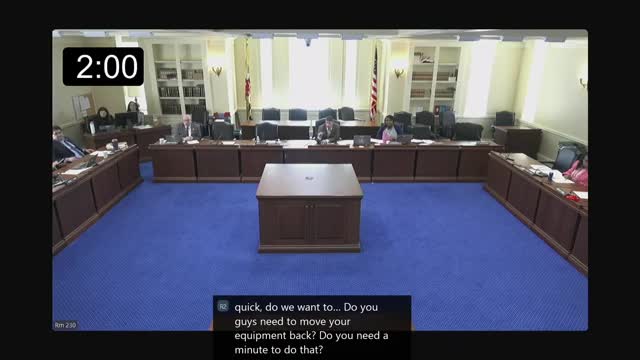
Summary
Supporters said HB 13‑65 would align Maryland—s data minimization rule with other states and Europe; consumer advocates and privacy groups warned it would weaken protections enacted last year and encourage more data collection and "consent fatigue."
House Economic Matters Committee — A bill to change Maryland—s data minimization standard drew sharply divided testimony on March 4 as lawmakers considered HB 13‑65.
Delegate Andrea Harrison (Prince George—s County), the bill sponsor, told the committee the measure would clarify a novel, strict requirement in last year—s Maryland Online Data Privacy Act that businesses collect only data "requested by the consumer" for a specific product or service. Harrison and business witnesses said that interpretation could force companies to add many state‑specific pop‑ups and degrade user experience.
"This provision in the law has created significant confusion and could lead to consumer consent fatigue," Harrison said, arguing the bill would adopt a standard — "adequate, relevant and reasonably necessary" — used in the EU—s GDPR and by other U.S. states.
Supporters from retailers, trade groups and technology firms told the committee the change would align Maryland with what other states have adopted. Kaylee Locklear of the Maryland Retailers Alliance and Grayson Wiggins of the Maryland Chamber of Commerce told lawmakers they support HB 13‑65 because it would preserve the ability of retailers to show related products, send promotional notices and run common marketing activities without imposing a de facto opt‑in on ordinary non‑sensitive data. Paul Martino, an attorney who counsels retailers, said the statute—s current language is "novel" and could undermine the practical functioning of online commerce.
Opponents, including the Electronic Privacy Information Center (EPIC), Consumer Reports and Public Interest Research Group (PIRG), said the bill would roll back protections enacted last year. Kara Williams of EPIC told the panel HB 13‑65 "would reverse that pro‑consumer work" and explained that the current standard prevents companies from collecting data without a clear purpose. Consumer Reports— Matt Schwartz said the change would replace a meaningful default limit on data collection with a weaker formulation adopted by industry‑backed laws.
The attorney general—s consumer protection division and other consumer advocates argued Maryland—s law promotes predictable protection for residents and that weakening the rule could increase unsafe collections and higher‑risk data practices. Supporters said they had discussed the measure with the attorney general—s office and other stakeholders; Paul Martino testified he believes the amendment "completes" the original law and makes it workable.
Where the committee goes next: no formal votes were recorded during the hearing. Witnesses asked lawmakers to weigh enforcement clarity against unintended operational effects for businesses. Supporters urged a favorable report, while privacy groups urged rejection. Lawmakers raised questions about definitions ("adequate" and "relevant") and the potential for state‑specific compliance burdens, and several witnesses said they were open to continued drafting changes.
Ending: If the committee advances HB 13‑65 it will join a national debate over how privacy laws balance consumer protection against cross‑state compliance costs for businesses. Supporters say the bill brings Maryland in line with other states and international standards; opponents say it would erode one of the strongest consumer protections in the country.