Get Full Government Meeting Transcripts, Videos, & Alerts Forever!
Get email alerts on the Inclusionary Housing topic
No spam. Unsubscribe anytime.
Monrovia staff recommends targeted inclusionary housing ordinance; council asks for citywide analysis
Summary
City of Monrovia staff on Tuesday presented a proposed inclusionary housing ordinance that would require most new residential projects of five or more units in targeted high-density areas to include or fund affordable units and asked the City Council for direction on whether to expand the requirement citywide.
City of Monrovia staff on Tuesday presented a proposed inclusionary housing ordinance that would require most new residential projects of five or more units in targeted high-density areas to include or fund affordable units and asked the City Council for direction on whether to expand the requirement citywide.
The proposal, presented by city staff member Sherry Vermejo, targets corridor and transit-focused areas such as the Station Square Transit Village, the South Myrtle Avenue corridor (including PD-12 and the Avalon project), and portions of the West Huntington Drive mixed-use corridor. Vermejo said the ordinance is intended to align with the city’s general plan and recent housing element actions and to avoid placing new requirements on Monrovia’s older, lower-density neighborhoods.
“0% of 0 is 0,” Vermejo said, characterizing the staff goal of setting an inclusionary requirement that produces affordable units without halting development. She and consultants from Kaiser Marston and Sage Crest presented technical feasibility analysis, examples from other San Gabriel Valley cities, developer survey feedback, and draft ordinance mechanics.
Key recommendations presented
- Threshold and geography: The requirement would be triggered on projects that result in five or more total units on a site and would initially apply to the city’s identified higher-density planning areas, any housing project on a nonresidential site that meets the threshold, any future housing opportunity sites added during the housing element cycle, and projects seeking a general plan or zoning change to increase density.
- Affordable unit requirements: For ownership projects, staff recommended 10% of units be set at the moderate-income level. For rental projects the draft tiers are: 5–20 units — 6% at low income; 21–49 units — 10% at low income; and a possible 50+ tier presented for discussion at 15% (staff said the 15% tier was provided for discussion after consultant feasibility work showed it could be feasible for very large projects).
- Exemptions and covenants: Accessory dwelling units (ADUs) would be exempt because state law prevents local deed restrictions on ADUs. Staff recommended covenant lengths aligned with state law: 55 years for rental units and 45 years for ownership units.
- In-lieu fees and fee calculation: Staff recommended a per-square-foot in-lieu fee rather than a per-unit fee to make the fee option more proportionate for smaller projects. Examples shown in the presentation used a proposed rental in-lieu rate of $24.50 per square foot and an ownership in-lieu rate of $29.40 per square foot; under those example calculations a hypothetical 5-unit rental project (1,500 sq. ft. units) would pay $183,750, a two-unit net-addition on an existing site would pay $73,500, and a 50-unit ownership scenario produced an example in-lieu total shown in the slides. Staff said the in-lieu option would generally be available only to ownership projects and to rental projects of 20 units or fewer.
- Alternatives and incentives: The draft allows alternative compliance options including off-site construction, land donation, and use of density bonus concessions, parking reductions and other incentives. Off-site projects would generally be delivered by affordable housing developers working in partnership with market-rate builders, the consultants said.
Council direction and next steps
Council members expressed support for moving the ordinance forward while asking staff to analyze whether the requirement should instead apply citywide. Councilmember Edward Belden urged a citywide approach, saying it would be more defensible and would capture more opportunities across Monrovia. Mayor Shevlin and others emphasized the need to monitor market conditions and to revisit fee levels and thresholds periodically.
Council guidance recorded in the study session asked staff to finalize the ordinance language, conduct legal review, pair the ordinance with a density-bonus update, and return to the council (staff stated a goal of returning in May, with implementation timed to follow formal adoption). Staff recommended annual review of the in-lieu fee schedule to reflect market changes and CPI adjustments.
What was not decided
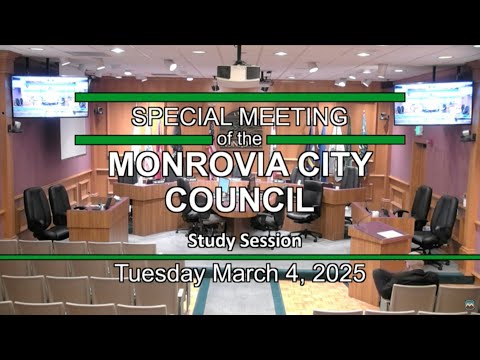
No formal vote was taken; the meeting was a study session and staff sought policy direction. Council members did not adopt the ordinance at this meeting. The council asked staff to prepare the ordinance for public hearing and to provide additional analysis comparing the proposed targeted-area approach to a potential citywide requirement.
Who said what (selected)
Sherry Vermejo, city staff, presented the proposal and feasibility work with Kaiser Marston and Sage Crest. She described the three-tier rental approach and the suggested 10% ownership requirement, and stated the staff preference for a targeted-area approach aligned with the general plan vision.
Edward Belden, Councilmember, said he would prefer a citywide approach and argued targeting only some areas could be “less defensible” and miss opportunities to produce affordable units across the city.
Dylan (city staff) clarified the draft’s thresholds and fee application, confirming staff’s presentation that the in-lieu option as drafted would be restricted to ownership projects and smaller rental projects (20 units or fewer) while larger rental projects would be expected to provide on-site affordable units.
Consultants Cathy Head (Kaiser Marston) and David Blumenthal (Sage Crest) described the regional survey of ordinances, developer focus groups, and feasibility modeling. Consultants noted several San Gabriel Valley cities use citywide ordinances while others limit applicability to targeted areas, and that program details and fee levels vary depending on local market conditions and the affordability gap.
Why it matters
Monrovia has produced substantial multifamily housing in recent years concentrated in its planned higher-density zones; staff said roughly 941 units were permitted in 2022–2024 in those areas. The ordinance would be a new tool to secure affordable units tied to new development and to capture fee revenue to fund affordable housing if developers choose the in-lieu option. How the city sets thresholds, income targets, and fee levels will affect developer feasibility and the quantity and type of affordable housing produced, staff and consultants said.
What to watch next
Staff will finalize the ordinance text and legal review, and return to the Planning Commission for advisory review and to the City Council for public hearing and adoption. Councilmembers asked staff to include additional analysis comparing targeted-area versus citywide applicability and to report proposed monitoring and enforcement practices if the ordinance is adopted.