Get Full Government Meeting Transcripts, Videos, & Alerts Forever!
Get email alerts on the Property Tax Revaluation topic
No spam. Unsubscribe anytime.
Providence officials hear statistical revaluation showing widespread assessment increases; appeals, tax-equalization options discussed
Summary
Vision Government Solutions presented the City of Providence’s triennial statistical revaluation to the City Council Committee on Finance on March 4, 2025, showing median assessment increases across multiple property classes and prompting council members to seek clearer explanations, ward‑level commercial data and options for residents on fixed incomes.
Vision Government Solutions presented the City of Providence’s statutorily required triennial property revaluation to the City Council’s Committee on Finance on March 4, 2025, showing median increases across most residential and mixed‑use property classes and prompting questions from council members about the impact on homeowners and tenants.
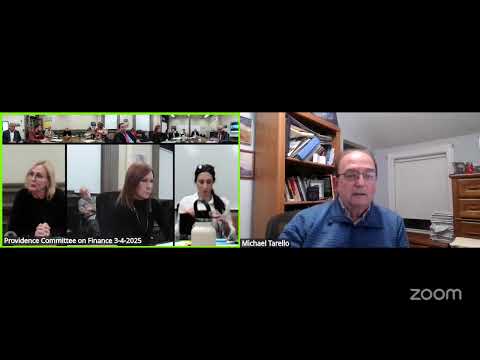
The consultant, Michael Torello, vice president of appraisal operations at Vision Government Solutions, told the committee the work was a “statistical update” and that the firm inspected sales records and permits and conducted drive‑by reviews to assemble the market data used in the analysis. “We did inspect all the sales and permits, and we did a review … drive‑by review of all the properties,” Torello said.
Why it matters: The presentation showed median sales and assessment increases since the city’s last revaluation. Vision Government Solutions’ tables reported large increases for small multifamily buildings and mixed‑use properties and a notable rise in land values as a contributor to overall increases. That pattern—higher land contribution to total value—was one of several recurring concerns councilors voiced at the hearing.
What the consultant showed: Torello summarized the firm’s methodology (sales comparison, cost and income approaches by property type) and provided class‑level and ward‑level tables. In the materials he marked as exhibits, the firm reported assessment changes including, by class, assessment increases on the order of: single‑family ~32%, two‑family ~46%, three‑family ~52%, four‑family ~51%, condos ~32% and mixed‑use ~50% (figures presented by the consultant in the meeting packet). Torello told the committee the three approaches to value (sales, replacement cost and income) were used where appropriate and that for many residential analyses the firm relied primarily on recent sales data, supplemented by time‑trend adjustments where sales were sparse.
Council reaction and concerns: Several council members said the increases would be hard for long‑time residents and retirees to absorb. Councilor Graves described her own experience: “My rebound went up $2,260,000 … I’m retired. My husband’s retired,” she said, urging more clarity and relief options. Council members also raised two recurring themes: (1) the marked rise in land values versus building values, which some councilors said results from investors buying properties to redevelop, and (2) the limited number of sales in some neighborhoods that can skew statistics. Councilor Vargas asked why vacant lots in some areas are showing large increases and warned of displacement for low‑income and fixed‑income residents.
Tax equalization, timing and appeals: Chief Mancini and other city officials explained the difference between the revaluation (which sets assessed values) and the municipal levy process. Chief Mancini described tax equalization as the mechanism used to reduce rates against higher assessments so the city begins from a revenue‑neutral baseline: “Our goal is to lower the rate as low as we can and get back to the revenue of the prior level. It’s called tax equalization,” he said. Officials told the committee that although assessed values are changing now, the city’s next step is budget setting; rates are then adjusted within state classification limits to meet revenue needs.
Vision Government Solutions and the assessor’s office reiterated that the city had provided residents informal review opportunities ahead of tax bills, and that a formal appeal route exists after bills are mailed. Torello described the informal meetings as a chance for taxpayers to provide documentation: “They’re part of our team. We look at it as giving us more information to make it as accurate as possible,” he said. City staff said informal appointment slots would be expanded as needed but that a firm deadline is required so the city can complete budget work; the formal appeal period after bills are sent was identified as 90 days.
Requests for more data and next steps: Council members asked the consultant for ward‑level commercial breakdowns, clearer plain‑language explanations of the methodology and example scenarios taxpayers can use to prepare for informal reviews. Torello agreed to provide additional materials showing the variables the firm uses to value properties and additional neighborhood‑level data. Council members said the administration should better explain how revaluation, tax equalization and the levy process fit together and asked staff to prepare educational material for residents.
Actions at the meeting: The committee formally accepted presentation materials as exhibits and concluded the hearing. Staff and the consultant said they will supply additional breakout tables and user‑friendly guidance to council offices and the public. The committee did not take final action on tax rates; those will be set later in the city’s budget process.
What remains unresolved: Councilors pressed for consideration of targeted relief (for example, circuit‑breaker or income‑based exemptions) and said the city should study policy options to reduce displacement risk. Officials cautioned that many revenue and classification constraints are set by state law and that changes to the timing or method of revaluation would require legislative action.
For residents: The consultant and assessor’s staff urged taxpayers who believe property descriptions (square footage, room counts, physical condition) are incorrect or incomplete to use the informal review window or to submit supporting documents and photos ahead of the formal appeal period after tax bills are mailed. The city will publish further materials and ward‑level commercial data requested by council members.
The committee adjourned after the presentation and discussion. Vision Government Solutions and city staff will deliver follow‑up materials to council offices and the assessor’s public information channels.