Get Full Government Meeting Transcripts, Videos, & Alerts Forever!
Get email alerts on the Affordable Housing Metro Loma topic
No spam. Unsubscribe anytime.
Glendale council approves $376,000 to avert foreclosure at Metro Loma Apartments
Summary
The Glendale City Council and Housing Authority approved a $376,000 appropriation to cover missed mortgage payments and immediate capital needs at Metro Loma Apartments, a 44-unit affordable complex facing foreclosure by its senior lender.
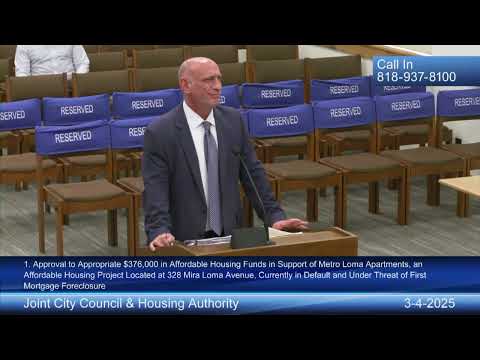
Glendale City Council and the Glendale Housing Authority voted to authorize up to $376,000 to stabilize Metro Loma Apartments, a 44-unit affordable housing development at 328 Mira Loma Avenue that is in default and facing foreclosure by its senior lender.
The funds, approved by motion and council resolution, are intended to cover five months of missed mortgage payments to the senior lender and immediate capital repairs identified in a capital needs assessment. Mike Fortney, deputy director of community development, told the council the appropriation would cover short-term cash needs while staff and lenders negotiate a longer-term solution.
The appropriation passed on a council roll-call vote with all voting members recorded as "yes." Councilmember Corsican moved the action; a councilmember seconded the motion.
Fortney said Metro Loma is a 9% tax-credit project placed in service in February 2009 and that the Housing Authority owns the land and leased it to Metro Loma LP. The project carries two subordinate loans and a senior loan held by California Community Reinvestment Corporation (CCRC). Fortney reported the combined outstanding loans total about $4,168,000 (a mix of low-mod and HOME dollars); the County of Los Angeles holds a third-position loan of approximately $1,472,000; and the CCRC senior loan outstanding is roughly $1,400,000.
Fortney described a recent move by the senior lender: after initial staff-level talks, CCRC’s committee directed staff to begin a foreclosure process and a notice was filed a week before the meeting. He said the borrower stopped making mortgage payments in November and is five months behind. The requested $376,000 would be used to pay the five months owed to CCRC and to fund about $217,000 of immediate capital needs identified in the lender’s assessment; Fortney said remaining eligible reserve accounts at the property would also be tapped where permissible.
The deputy director said staff is negotiating a cooperation agreement with the lender, the county and the borrower to preserve the property’s affordability covenants and to buy time—he said there is typically a minimum 120-day period to negotiate after a foreclosure notice. Fortney also said staff will prepare a pro forma, review audited financial statements (including work with the property’s auditor Novogradic) and compare notes with Los Angeles County to evaluate long-term feasibility.
Councilmembers pressed staff on resident impacts and portfolio risk. Fortney said worst-case, if the project sold into the open market, many households now in units targeted at roughly 30–60% of area median income would not be able to remain at market rents. He estimated more than half of the building’s households could be displaced and noted there are about 25 households at special risk of displacement. He also said some households in the building currently earn substantially more than 60% AMI and could remain if a market-rate owner preserved their tenancies.
Public commenters sharply criticized the proposed use of city funds. Alex Balakian, a resident who spoke during public comment, called the appropriation a bailout for a for-profit operator that “intentionally walked away from their debts” and argued taxpayers should not cover repairs or lender obligations. Fernando Roldan, commenting remotely, urged the council to prioritize seniors and residents with disabilities and to vote carefully.
Councilmember Corsican framed the action as an effort to preserve housing for tenants rather than to prop up a troubled operator: "...for them to be able to have a roof over them, their heads is, not a solution that I think that any of us here around this dais are interested in" (remarks made when moving the appropriation). Council comment also noted the city has reviewed the project in prior closed sessions and that staff would audit expenses and ask detailed questions about reported costs.
The council directed staff to continue negotiations with CCRC and the county, to review audited financial statements for the project and for other portfolio properties, and to develop pro forma financials to determine whether Metro Loma can be sustained or requires a different long-term solution.
Votes at a glance
- Motion and resolution to appropriate up to $376,000 for Metro Loma Apartments (to cover five months of missed mortgage payments to CCRC and immediate capital needs). Moved by Councilmember Corsican; seconded (name not stated on the public record). Vote: recorded roll-call yes votes from Brautman; Garpet Yan; Sasak Yan; Naja Dhyan; Nayaras Adaryan (all recorded as yes). Outcome: approved.
Background and next steps
Metro Loma is a 44-unit tax-credit development placed in service in February 2009 on land owned by the Housing Authority. Staff said the senior lender’s outstanding balance is about $1.4 million and the property also carries loans from the Housing Authority and Los Angeles County. Staff will use the short-term appropriation to pause foreclosure activity while producing audited financial reviews and a pro forma to evaluate long-term viability. Fortney cautioned that the project will not be financially feasible for a new developer unless the senior loan position is addressed.
What the council did not decide at the meeting was a long-term ownership or management plan; staff said a receiver may be appointed if a managing operator is not secured and that any long-term solution will be informed by audited statements and pro forma analyses.