Get Full Government Meeting Transcripts, Videos, & Alerts Forever!
Get email alerts on the Land Use Development topic
No spam. Unsubscribe anytime.
Neighbors push council to limit height of proposed gravel‑pit condominium near Canyon Cove
Summary
Residents of Canyon Cove and nearby neighborhoods told the Cottonwood Heights City Council during public comment that a proposed condominium in the former gravel pit should be capped well below the heights currently allowed by an amendment, citing scale, setbacks and neighborhood character.
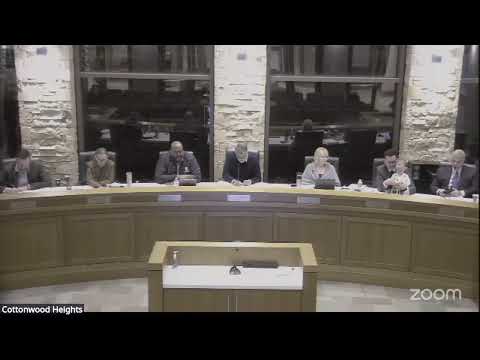
Neighbors of a proposed condominium development on the former gravel‑pit site pressed the Cottonwood Heights City Council during public comment on March 4 to limit the building’s height and enforce the site plan’s setback requirements.
The comments were delivered by residents who said the amendment under consideration would permit a building far taller than neighboring homes. Linda Lekman, president of the Canyon Cove Homeowners Association, said she and other neighbors have lived in the area for decades and asked the council not to “codify the 150 feet,” calling that scale “out of character with Cottonwood Heights.”
The concern centers on a condominium parcel that fronts Gun Club Road and adjoins single‑family neighborhoods to the north. Lekman said the amendment could allow a structure significantly taller than existing buildings along the East Bench and contrasted a developer’s stated plan for roughly 20 feet with amendment language that could allow much more height.
“Since this is a building that is taller than any other along the East Bench area,” Lekman said, “...not to codify the 150 feet. That would be so out of character with Cottonwood Heights.”
Lori Khotadad, a Canyon Cove neighbor, said she supports private property rights but urged a lower limit that would better match nearby homes. “I would like to see that condominium building would be no more than 35 to 50 feet above the Gun Club Road level,” Khotadad said.
Emily Gray, who identified herself as a member of the Cottonwood Heights City Council for District 5 and said she represents the adjacent neighbors, urged a compromise cap of 80 to 100 feet. Gray said the amendment’s allowed height would “far exceed any other height within Cottonwood Heights” and said the change would place six stories above grade across the street from single‑family homes.
Gray also raised a site‑plan concern she described as a substantive discrepancy: she said the plan specifies a 100‑ to 250‑foot setback from Wasatch Boulevard, but that the developer was measuring setbacks from SR‑190 instead of the current Wasatch Boulevard alignment. “This is not a minor discrepancy. It’s in direct violation of the site plan,” she said.
Speakers repeatedly requested a buffer and stepped massing to reduce intensity of use adjacent to single‑family zones; they emphasized this was about the scale and transition—not only view sheds. Gray said past council actions and a previous mayor had denied the taller height for this site, a claim she attributed to prior council decisions.
No formal council action on the gravel‑pit amendment occurred during the public comment period recorded in the transcript. The remarks were part of the citizen comment segment of the March 4 business meeting and supplemented discussion the council held earlier in a work session, according to the meeting record.
The city’s formal legislative process for any zoning amendment or site‑plan approval would include subsequent staff analysis and council review; residents asked the city to apply the same height and transition standards used elsewhere along the East Bench.
The council did not take immediate public action on the specific height requests during the business meeting’s citizen comment period.