Get Full Government Meeting Transcripts, Videos, & Alerts Forever!
Get email alerts on the Land Use Zoning topic
No spam. Unsubscribe anytime.
Newcastle planning commission backs PUD for Town Center Plaza, approves preliminary plat
Summary
The Newcastle Planning and Zoning Commission on March 4 recommended approval of a rezoning from CC-2 to a Planned Unit Development for the city-owned Town Center Plaza at 250 South Main Street and approved the preliminary plat with conditions addressing uses, signage and administrative review.
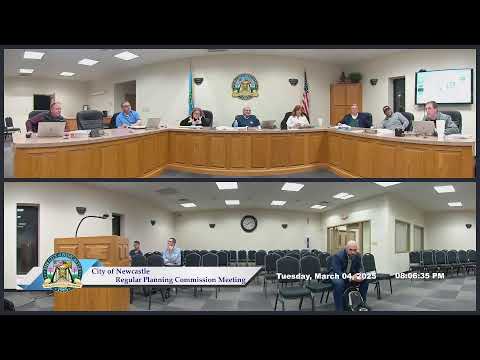
The Newcastle Planning and Zoning Commission on March 4 recommended approval of a rezoning of 250 South Main Street from CC-2 Community Commercial District to a Planned Unit Development known as Town Center Plaza and approved a companion preliminary plat, both by unanimous vote.
The rezoning and preliminary plat cover roughly 9.6 acres at the northwest corner of U.S. Highway 62 (Main Street) and East Cross Lane. The city is the property owner and the application, filed as R-2024-012, would create six lots, shared access and shared parking, two Main Street entrances and a secondary entrance off Southeast Third Street. The PUD preserves a 45-foot maximum building height and reduces building setbacks to 15 feet to increase buildable area.
The PUD includes architectural and landscaping guidelines, a common-area regional detention basin at the north end of the site, curb-and-gutter storm conveyance and utility connections to public water and sanitary sewer. Staff said the objective is to create a “town center” node to attract retail, sit-down restaurants and other sales-tax-generating uses toward the southern edge of town.
Why it matters: The city purchased the property in November 2023 as an economic-development investment. Commission members said the PUD is intended to give the city flexibility to market six buildable lots while ensuring a consistent site character for future commercial development.
Commission discussion focused on parking, traffic access and administrative flexibility over permitted uses. Sean McGraw, civil engineering consultant for the applicant, said the plan builds flexibility into parking calculations so different tenants can share stalls at differing peak times: “Wewere trying to maximize the seven buildable acres here... and if we had to say truly, okay, if one QSR came first and we had a set number of parking and no one else can borrow from that, then your chances of attracting the grocer are going to be difficult.”
Several commissioners pressed staff on whether the PUDs administrative review provisions would allow the city to approve new or "similar" uses without returning to the commission. Commissioners expressed concern about precedent and public perception if staff discretion was broad. One commissioner reiterated that the PUD should not allow uses clearly outside the listed retail and dining categories to be added administratively.
The motion recommending approval included several edits requested on the record: removal of an unnecessary bullet in the permitted-uses list, clarifying language in special condition 9, and a wording change in the PUD document to refer to the city as “developer” rather than “landlord.” Commissioner Gordon Hines (chair) moved for approval; the motion and a second passed by unanimous voice/hand vote with three commissioners present.
The commission also discussed platting mechanics that staff said would be updated in the PUD and in the staff report. Staff explained they expect to file a final plat that could facilitate sale of individual lots without the city posting a subdivision bond, but said infrastructure improvements and any building permits would still require completion or financial security; staff committed to amending the PUD text to align the document and the staff report.
Whats next: The commissions recommendation will go to the City Council for final action and any ordinance adoption. The commission did not set an effective date; staff said those details and final language edits will be returned to the council and the commission as the project advances.