Get Full Government Meeting Transcripts, Videos, & Alerts Forever!
Get email alerts on the Land Use Development topic
No spam. Unsubscribe anytime.
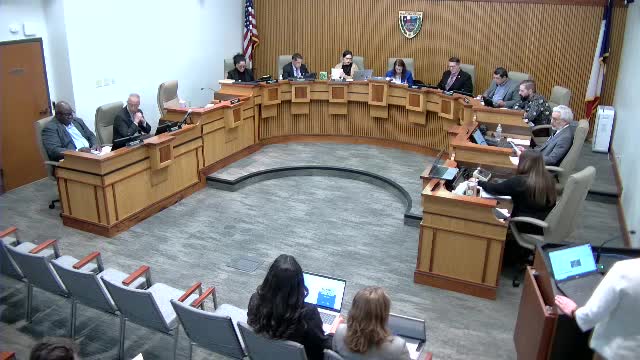
San Marcos council approves amended Riverbend Ranch development agreement over resident objections
Summary
After hours of public comment about flooding and septic-related health concerns, the San Marcos City Council approved amendments to a large Riverbend Ranch/Riley’s Point development agreement that allow greater earthmoving while requiring enhanced stormwater controls and water-quality measures.
San Marcos City Council approved amendments to the Riverbend Ranch / Riley’s Point development agreement on March 4, 2025, voting to accept a revised agreement that expands certain construction waivers while adding engineering and water-quality conditions aimed at reducing runoff and pollutant loads.
The development, commonly called Riverbend Ranch or Ball Ranch in planning documents, covers about 1,046 acres in the city’s extraterritorial jurisdiction between Old Bastrop Highway and FM 110. The council vote to approve the amendment was 6–1 following a staff presentation and a lengthy public hearing in which nearby residents raised concerns about existing flooding, septic-system contamination and community health.
The amendment rewrites the agreement’s engineering exhibit and adjusts several previously authorized variances. Among the most significant changes: the maximum allowable cut-and-fill on portions of the property was increased to as much as 30 feet; block-perimeter allowances and dead-end-street length were modified; and the developer committed to site-level stormwater and water-quality controls that the city says go beyond standard requirements.
City staff and the applicant negotiated additional measures tied to the cut-and-fill authority. The amended agreement requires that the developer install advanced water quality treatment designed to remove 70% of total suspended solids (TSS) from post-development runoff and to reduce post-development peak flows that reach downstream properties by 15% compared with existing conditions. Staff said some stormwater controls must be in place before vertical construction begins.
Those mitigation commitments were central to staff’s recommendation for approval. Amanda Hernandez, director of Planning and Development Services, told council that the rewritten Exhibit F clarifies prior variances so that staff can apply them consistently during permitting and construction. Richard Arnoza, assistant director of Engineering, confirmed detention and other drainage improvements will be provided and pointed to large, mapped detention basins in the engineering exhibits.
Residents who spoke during the public hearing urged the council to deny the amendments or to require stronger protections. Several speakers representing the Rancho Vista and Redwood neighborhoods described longstanding flooding and a 2020 University of Texas study they said documented parasitic infections tied to failing septic systems. “Runoff is an issue now,” said Veronica Reyes Ibarra, president of a local neighborhood association and water-supply corporation, during public comment. “We are already experiencing flooding.”
Council members debated the trade-offs: several said the development agreement’s regulatory framework provides more protection than allowing the property to develop by-right without city conditions. Others expressed skepticism that the mitigation would be sufficient and urged further steps to assist downstream neighborhoods with septic and wastewater problems.
The amendment acknowledges that municipal utility districts (MUDs) have been created for parts of the development and allows future adjustments to MUD boundaries within the agreement’s overall footprint. The amendment also includes definitions clarifying the roles of developer and ultimate buyer, and confirms the city can provide water service if the property is released from an existing water service provider.
Councilmember Miguel Gomez (note: council roll call names vary in the record) moved the motion and Councilmember Matthew Mendoza seconded; the motion carried 6–1. The council also directed staff to return to council with additional outreach options for neighboring residents about wastewater and annexation as appropriate.
The amended agreement is the latest step in a process that began with a 2021 development agreement. City staff said the current amendment addresses typographical corrections, ownership updates, and rewording of variance exhibits so staff can administer them during permitting. The agreement includes requirements to construct detention and water-quality features that city staff said are intended to limit impacts on downstream properties.
The agreement as amended does not require annexation; the developer remains vested to 2021 codes for the parcels addressed in the agreement. The developer will proceed with required engineering, permitting and phasing under the amended terms, and the MUDs will fund some on-site infrastructure. Council members said they expect continued follow-up from staff on stormwater and wastewater issues affecting neighboring neighborhoods.