Get Full Government Meeting Transcripts, Videos, & Alerts Forever!
Get email alerts on the Bikeway Planning topic
No spam. Unsubscribe anytime.
Council approves preferred bikeway concepts for De La Cruz, Lick Mill and Scott corridors and directs policy work on protected facilities
Summary
The Santa Clara City Council approved preferred bikeway concepts for De La Cruz Boulevard, Lick Mill Boulevard and Scott Boulevard and directed staff to return with a policy and operational plan for protected bike lanes.
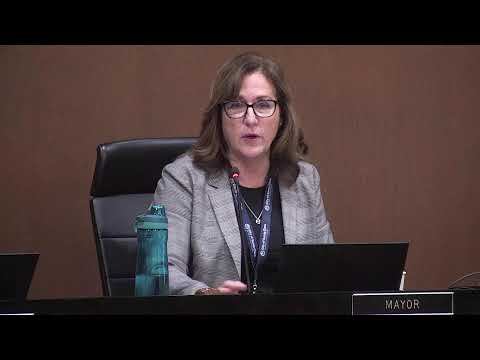
The Santa Clara City Council approved resolutions adopting preferred bikeway concepts for three city corridors ' De La Cruz Boulevard, Lick Mill Boulevard and Scott Boulevard ' after a staff presentation and public comment. The motion, which passed 4'—' (four yes, no no votes) with three members recused for conflicts of interest, endorsed the staff and Bicycle and Pedestrian Advisory Committee (BPAC) recommendations and also directed staff to develop a citywide policy to address protected bike lanes and associated operational and maintenance needs.
What the council approved: staff presented corridor-by-corridor cross-section options developed through grant-funded planning and outreach. The adopted concepts (staff's recommended alternatives) bundled into corridor-level treatments were described in the staff report as follows: for De La Cruz Boulevard (Montague Expressway to West Trimble Road) the board endorsed a "2C" concept: two travel lanes (one each way), buffered bike lanes with parking-protected treatments where appropriate, a two-way center-turn lane and parking retained on both sides where feasible; for Lick Mill Boulevard the council approved a concept that preserves two travel lanes with buffered bike lanes and retains on-street parking in residential sections; and for Scott Boulevard the council adopted a mix of buffered facilities and lane reductions in selected sections to create continuous bicycle facilities while preserving vehicular operations where needed.
Vote and recusals: at the beginning of the item three members announced recusals because of property proximity (Council Member Gonzales, Vice Mayor Cox and Council Member Chahal). The legislation passed 4'' to 0 with Mayor Gilmore, Council Member Hardy, Council Member Jain and Council Member Park voting yes.
Funding and timing: staff said the planning effort is grant-funded (federal community project funding appropriated to the city) and that approximately $2.7 million is available for design and construction of the prioritized corridor work; staff said design must proceed on a compressed calendar to avoid losing the grant. The council added direction that staff return with a policy-level work plan on protected facilities and the operational steps necessary to keep them maintained and clear (sweeping, debris removal, addressing curb slopes, and drainage) so the council has a path to upgrade buffered lanes to physically protected facilities where feasible.
Public comment and controversy: public speakers were divided. Some neighborhood speakers opposed removal of on-street residential parking and warned of congestion around stadium events; other residents, parents and BPAC and advocacy speakers urged parking-protected or physically protected facilities for improved safety, especially for children, seniors and less-experienced riders. Staff and the BPAC described corridor differences: some sections with many driveways or constrained right-of-way are better suited to buffered lanes, while commercial stretches with limited curb parking are candidates for parking-protected treatments.
Next steps: staff will start design on the approved concepts, return with regular progress and cost updates, and include a council-level discussion of the new policy recommendations on protected facilities and operations in the city's upcoming priority-setting calendar. Council directed staff to pursue the design and implementation steps as the grant timeline requires.