Get Full Government Meeting Transcripts, Videos, & Alerts Forever!
Get email alerts on the Land Use topic
No spam. Unsubscribe anytime.
Teton County adopts broad LDR changes aimed at protecting wildlife, clarifying grading and retaining-wall rules
Summary
The Teton County Board of County Commissioners unanimously approved a package of Land Development Regulation text changes aimed at raising the priority of environmental and wildlife considerations in grading, access, and retaining-wall reviews, adopting the applicants’ redline with staff modifications and additional procedural clarifications.
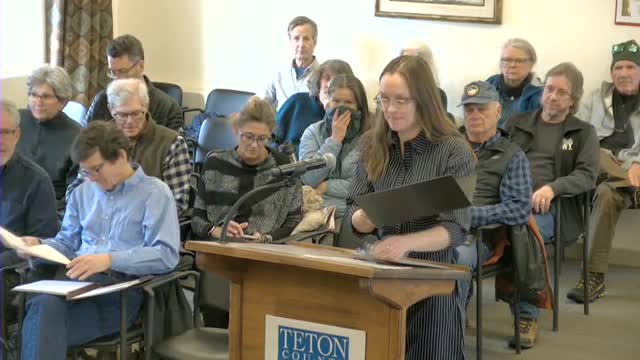
The Teton County Board of County Commissioners unanimously approved an amended package of Land Development Regulation (LDR) text changes on March 4 that rework how grading, road access and retaining walls are reviewed in environmentally sensitive parts of the county.
The package, filed as AMD 2023-00002 and initiated by local residents and landowners, was adopted by a motion from Commissioner Probst and seconded by Commissioner Carlman after more than three hours of staff presentation, applicant testimony, expert and public comment and a series of amendments adopted during the meeting.
County staff framed the measures as clarifications and procedural codifications; applicants said the changes were needed to ensure environmental standards receive equal consideration with dimensional transportation requirements. Aaron Monroe, associate long range planner, told the board staff supported many edits but opposed several specifics that would embed detailed environmental cross-references in general provisions. "The general provisions are not intended to focus on very specific LDR standards," Monroe said during his presentation.
Applicant Bill Collins said the amendments seek "equal consideration of the environmental standards and the LDRs with the road standards," adding the goal is not to make roads unsafe but to ensure environmental protections are actively weighed when access or grading is proposed.
Public commenters included wildlife and conservation experts and residents who said recent infrastructure projects had blocked animal movement and that local review rules had been insufficient. Annie Band, a wildlife biologist who lives on Fish Creek Road, described a loss of large-mammal use at a spring following construction and urged the board to adopt the changes. The Jackson Hole Wildlife Foundation reiterated its support and asked the county to use context-sensitive design approaches used by state and federal transportation agencies.
Key board decisions and changes
- The board approved the applicants' 02/11/2025 redline as the basis for action, and then adopted multiple specific amendments and staff-drafted clarifications. That package included: requiring alternatives analyses for proposals that would impact mid- and high-tier Natural Resource Overlay (NRO) areas or involve natural-hazard crossings; clarified retaining-wall applicability and added a staff-drafted emergency exemption for private retaining-wall construction in urgent situations; direction that grading permits and related building permits generally be reviewed concurrently in circumstances that could materially affect environmental resources; and language codifying coordinated multi-department review for transportation facilities that could affect significant natural resources.
- The board and staff also agreed to remove several proposed changes to the way density bonus tools (PRD / floor-area options) are calculated so those tools can be re-examined in a future long-range planning work program. (Staff had warned that changing the base- vs gross-site-area calculation would weaken the incentive structure for conservation bonuses.)
- The board directed staff to return a clean resolution-format version of the adopted changes, set to take effect May 1, 2025.
What the amendments do and what remains
The adopted edits emphasize context-sensitive design in the county's street and roadway standards and give explicit authority for the county engineer and planning director to require alternatives analysis and, in some cases, neighborhood meetings for projects that seek essential access across steep slopes, water bodies or that affect mid/high NRO areas. The retaining-wall changes broaden review applicability and create an emergency exemption pathway; staff and the Planning Commission had recommended a specific new definition so shorter tiered walls are not unintentionally excluded.
The board left work on larger incentive-structure issues — notably the calculation used to determine density bonuses for conservation (gross site area vs. base site area) — to a future work-plan item and removed the immediate changes to those tools from today's adoption.
Why it matters
Commissioners and supporters said the changes respond to a recent, widely contested construction and to community concern that past permit decisions allowed infrastructure that fragmented wildlife movement. The amendments make procedural changes that increase multi-department review and require stronger documentation and alternatives analysis when development or access would affect higher-value natural resources.
What comes next
Staff will prepare a final ordinance/resolution for the board and a clean, consolidated redline for public record. The board set the new rules to take effect May 1, 2025. Staff and commissioners said they plan additional follow-up work on the PRD/floor-area incentive tools as part of the county's long-range planning work program.