Get Full Government Meeting Transcripts, Videos, & Alerts Forever!
Get email alerts on the Transportation topic
No spam. Unsubscribe anytime.
Sacramento staff recommend nonprofit development corporation, study of special district to advance Valley Station redevelopment
Summary
City staff briefed council on preliminary recommendations to create an independent entity to manage Sacramento Valley Station operations and development — proposing a nonprofit/development corporation as a first step and a later study of a special district — citing capital investments, state grants and the need for sustainable operations funding.
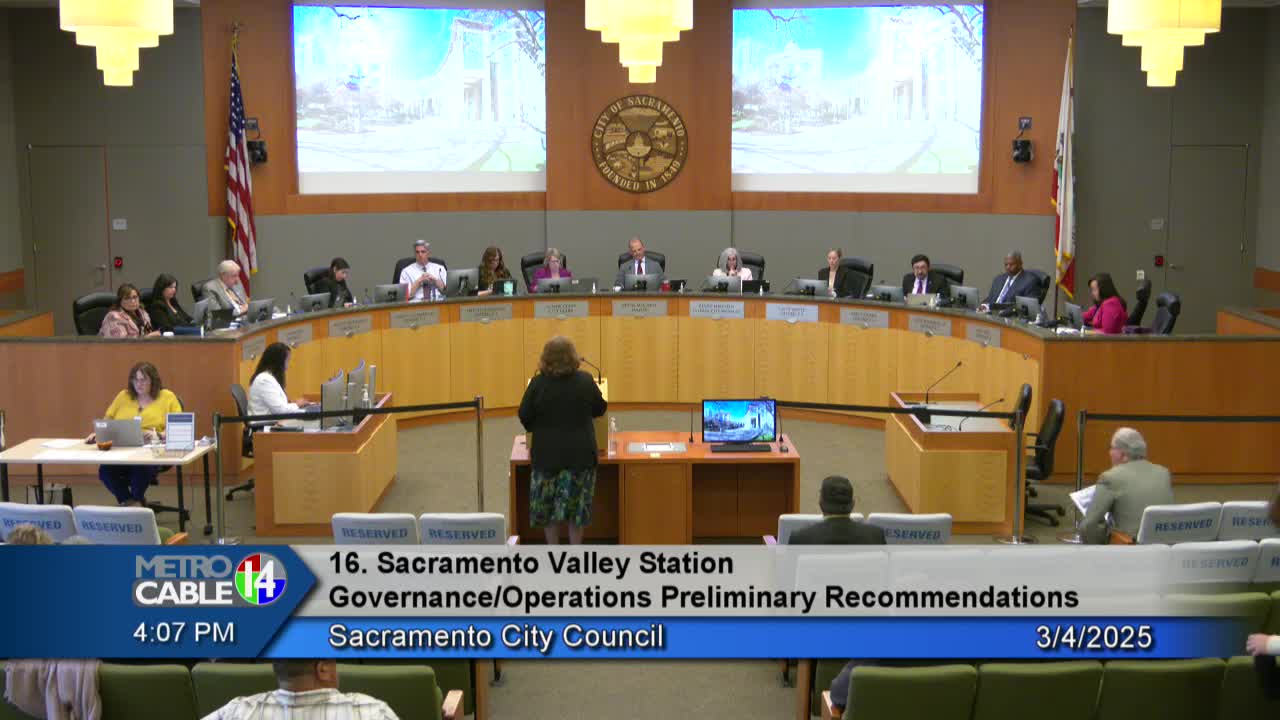
City staff on March 4 presented preliminary governance options for the Sacramento Valley Station and surrounding railyards area, recommending the city form an independent nonprofit development corporation and pursue due diligence on a possible special district to secure long‑term operations funding and accelerate development.
The station, staff said, is a regional asset that the city acquired about 20 years ago and has since upgraded with major capital investments. Staff described operations funding and management as the current constraint: the city funds most operations for a facility that serves regional rail lines and lacks direct access to some rail funding streams.
The matter matters because Sacramento Valley Station is a major intermodal hub: staff noted about $77 million in state Transit and Intercity Rail Capital Program (TIRCP/TRSIP) grants have supported recent work, the station is projected to approach one million passengers in 2023‑era use and was ranked 11th in Amtrak ridership in 2023. Staff said Phase 1 (track relocation) cost roughly $82.5 million and Phase 2 station renovations ran through 2017 with further projects funded and planned.
Public Works Director Lucinda Wilcox and project architect Greg Taylor framed three governance alternatives from a year of study: (1) a nonprofit corporation or development corporation to act as the station’s independent face and development manager; (2) a joint powers authority (JPA) model for limited purposes; and (3) a special district that could provide dedicated revenue for station operations. Staff recommended forming a nonprofit/development corporation in the near term to build brand, attract private investment and begin project delivery, and to use the nonprofit’s first two years to study whether a special district is viable.
“As a city we’ve done the capital work. We don’t have direct access to rail and transit funds for operations,” Wilcox said, describing constraints on general fund resources and the city’s role as landlord and operator. Greg Taylor said other cities have used nonprofit station authorities to attract private partners and capture development value; examples cited included Washington, D.C., Denver and San Diego.
Council members generally signaled support for the approach while urging attention to regional participation. Councilmember Dickinson said a development corporation would optimize value capture and retail opportunities in and around the station; she noted other successful examples where station developers paired retail and adjacent real‑estate projects to generate revenue for station operations. Several councilmembers urged that partners include regional transit agencies and reflected interest in moving quickly to secure grant funding for station and railyard connections.
Staff recommended returning to council by year‑end with a final recommendation after completing financial due diligence, outreach to partner agencies and a funding strategy. The presentation listed near‑term funded projects including a new tunnel entrance, bus connector work on Fifth Street, and a Burkett Street extension to connect to the station tunnel and bus layover area.
Ending: Council received the presentation for review and asked staff to continue partner outreach and return with a final governance recommendation and implementation plan by the end of the year.