Get Full Government Meeting Transcripts, Videos, & Alerts Forever!
Get email alerts on the Public Health And Safety topic
No spam. Unsubscribe anytime.
Supervisor Fielder calls hearing on 'four pillars' drug strategy; Supervisor Dorsey seeks waste‑water drug testing analysis
Summary
Supervisor Shamann Fielder announced a hearing to explore adopting a Zurich‑style four‑pillars strategy (prevention, treatment, harm reduction, enforcement) citywide; Supervisor Matt Dorsey submitted a letter of inquiry asking three city agencies to estimate resources to implement wastewater‑based drug surveillance and to provide pilot data.
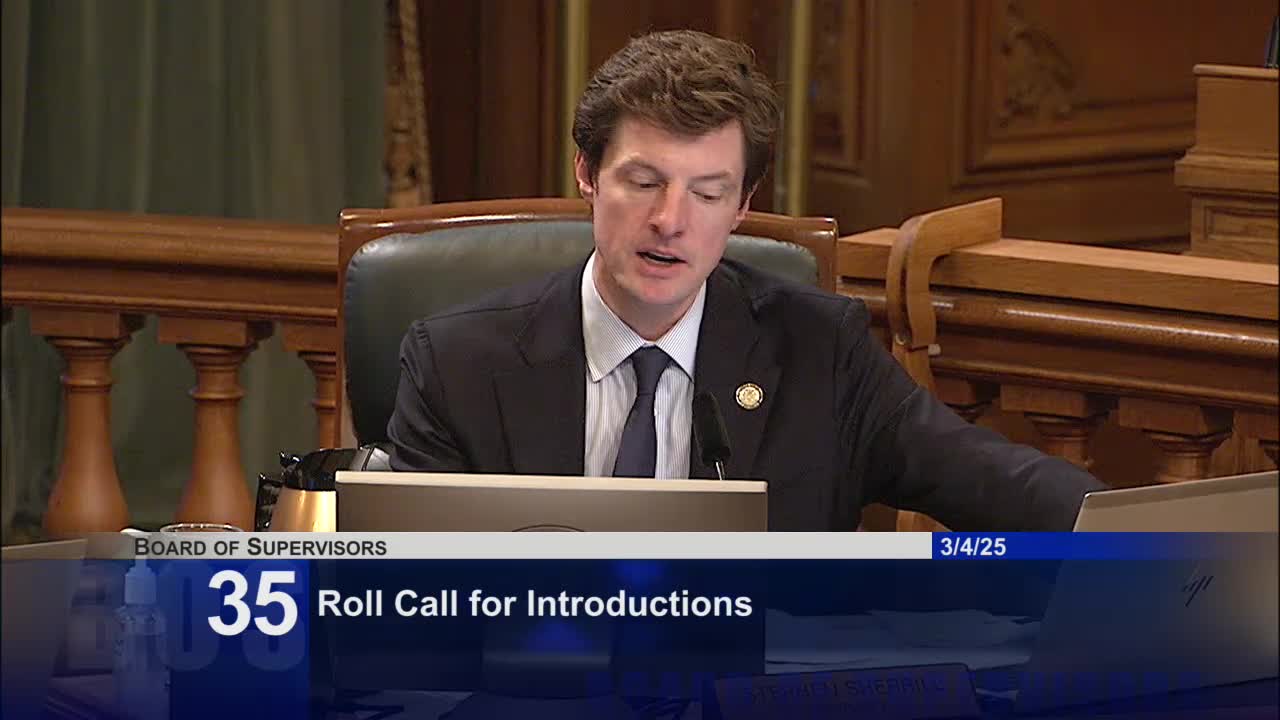
At the March 4 meeting of the San Francisco Board of Supervisors, Supervisor Shamann Fielder said he will hold a hearing to study a comprehensive "four pillars" approach to the city's drug overdose and open‑air drug market challenges, and Supervisor Matt Dorsey delivered a formal request for information on wastewater‑based drug testing.
Fielder said the model—used in parts of Europe and cited in the Board’s Budget and Legislative Analyst report—combines prevention, treatment, harm reduction and enforcement. He told colleagues the approach requires coordinated, long‑term investment and day‑to‑day collaboration between public health, law enforcement and social services. He cited Zurich as an example where officials deployed a coordinated strategy and recorded measurable safety improvements; he said the city’s Budget and Legislative Analyst found the approach transferable to San Francisco’s fentanyl crisis.
Dorsey’s letter of inquiry requests that three city agencies—the Department of Public Health, the Public Utilities Commission and the Office of the Chief Medical Examiner—provide: (1) an estimate of resources and staffing needed to implement a wastewater‑based epidemiology (WBE) program for drug monitoring, (2) additional policy or resource considerations relevant to legislation, and (3) any available results from San Francisco’s participation in a BioBot Analytics pilot that the National Institute on Drug Abuse supported in 2023–24.
Why it matters: Fielder framed the hearing as an attempt to move beyond piecemeal responses and to build lasting infrastructure for overdose prevention, treatment access and targeted enforcement. Dorsey told the board that wastewater surveillance could measure trends in fentanyl and methamphetamine and help detect new adulterants such as xylazine (often referred to colloquially as "tranq") and other substances.
Next steps: Fielder said the upcoming hearing will bring city departments together to identify resources, implementation steps and oversight needed to scale a four‑pillars approach in San Francisco. Dorsey’s letters will inform the staff reports and legislative drafting by specifying resource estimates and pilot data for the board’s consideration.
Ending: The board did not adopt legislation at this meeting; the actions announced create a timeline for interagency study and a public hearing focused on a multi‑sector response to the overdose crisis.