Get AI Briefings, Transcripts & Alerts on Local & National Government Meetings — Forever.
Chico council opens broad discussion on homelessness, forms expedited ad hoc committee
Summary
Following extensive public comment urging managed campgrounds, safe parking and more services, the council agreed to create an ad hoc committee to draft recommendations on ordinances, code changes and programs and return to council in June.
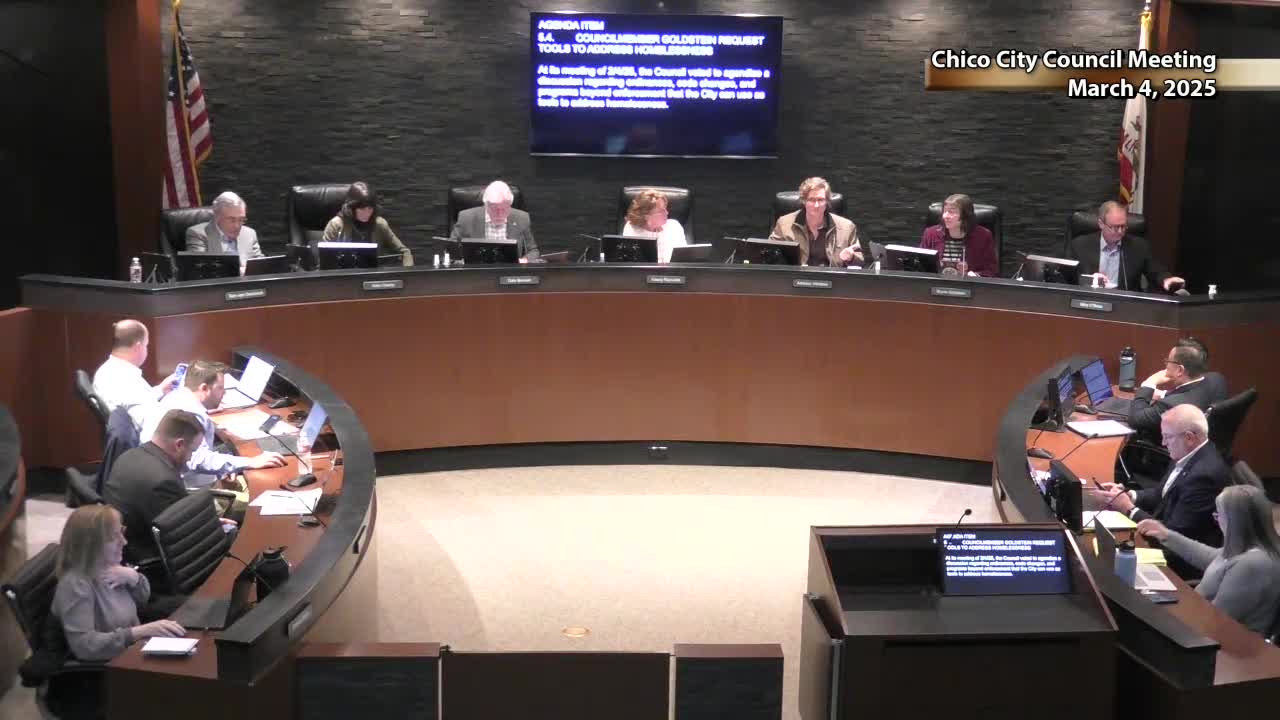
The Chico City Council on March 4 held an extended public discussion on tools to address homelessness and approved the creation of a time-limited ad hoc committee to produce recommendations on ordinances, code changes and programs. The committee will be chaired by a council member and include two other council members; the council set a target to return recommendations at a June meeting.
Councilmember Goldstein introduced the item to solicit public input on a range of approaches beyond enforcement, including managed campgrounds, safe parking, micro-shelters, partnerships with faith-based organizations and expanded behavioral health services. More than a dozen speakers urged the council to fund or enable noncongregate shelter options and to stop routine street sweeps that move people from place to place.
Hillary Crosby, director of SafeSpace Winter Shelter, said SafeSpace sheltered more than 160 individuals in its recent 11-week season and described a population that is aging and medically complex: "Options such as safe car parking and managed campgrounds provide safety for people when experiencing homelessness and are shown to be an entry point into services for opportunities for engagement with service providers who are trusted messengers," Crosby said.
Several speakers highlighted cost and operational arguments in favor of managed campgrounds. Charles Withoon, citing examples from Denver and other West Coast cities, said properly run sites can reduce crime in adjacent neighborhoods and lower public costs compared with repeated sweeps. Other commenters requested mail services, showers, on-site case management and reduced barriers to shelter entry.
Council members agreed to form a focused ad hoc committee to work with service providers, staff and community members. The council described a process intended to be expedited and to draw in experts from local nonprofit service providers, county services and those with operational experience. Councilmembers who spoke emphasized the need for data, jurisdictional coordination (city, county, state) and quick, actionable recommendations rather than open-ended study.
The council also debated more immediate operational questions about existing shelter capacity. A separate council motion to direct staff to pursue immediate changes to better utilize pallet shelter space without interrupting the council's enforcement schedule failed 3-4; council members said the topic was better addressed within the ad hoc committee. The ad hoc committee will return to council with recommendations focused on three items: ordinances, code changes and programs.