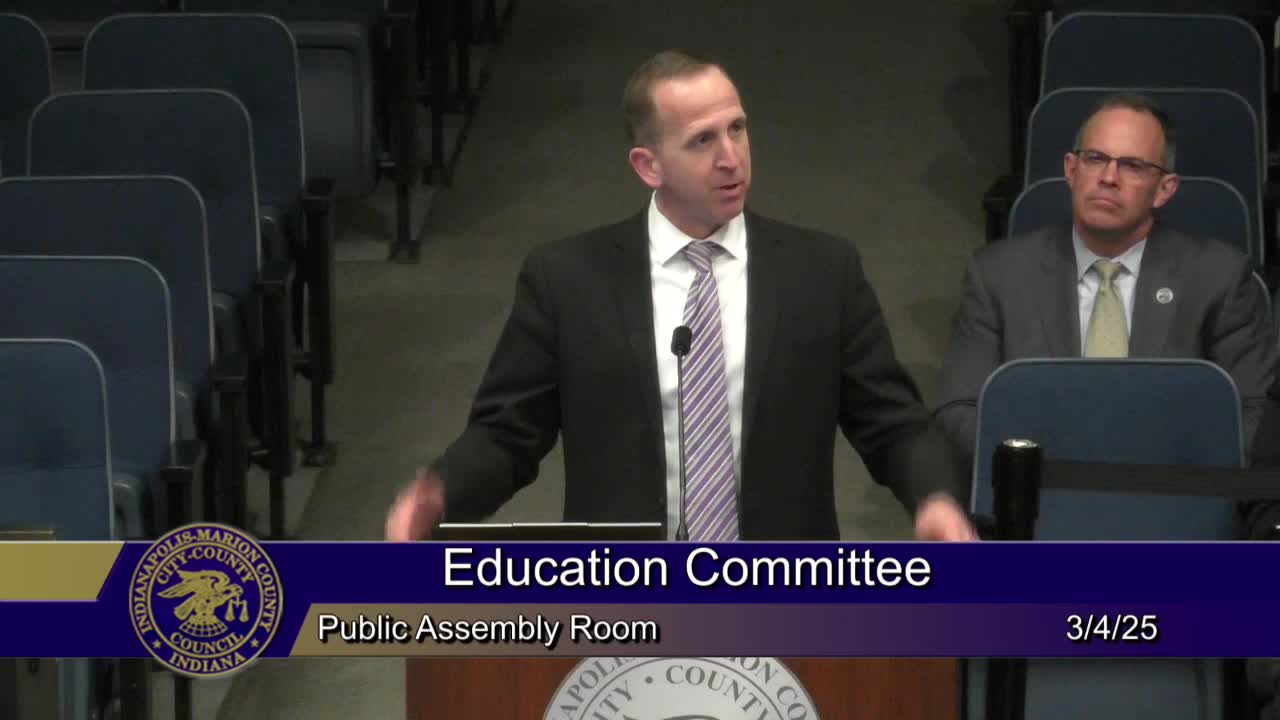
Wayne Township highlights solar arrays, batteries and propane buses as school district energy savings
Loading...
Summary
MSD of Wayne Township told the City–County Council Education Committee it has installed solar and battery systems at multiple sites, replaced lighting and controls, and moved its 92 daily bus routes to propane, reporting roughly $4 million in energy savings to date.
Steve Samuel, assistant superintendent for finance and operations for MSD of Wayne Township, told the Indianapolis City–County Council Education Committee March 4 that the district has pursued multiple energy‑savings projects to reduce operating costs and preserve classroom dollars.
Why it matters: Wayne leaders said energy price increases and property tax caps have put pressure on district operating revenue; the district told the committee that energy projects are a way to reduce recurring utility costs and protect instructional spending.
Most important facts
- Solar and batteries: Samuel said the district’s solar array behind Ben Davis High School “powers most of Ben Davis High School on a given day.” He said batteries are installed “at 9 sites now” and are used to smooth peak demand and avoid higher monthly electricity rates tied to peak usage.
- Fleet and fuel: The district reported that all 92 daily bus routes this year are powered by propane, which the district said costs less than diesel and reduces maintenance burdens. Samuel said two electric buses had been planned but were delayed by funding timing; the district has obtained a federal grant to offset higher purchase prices for two electric buses so they could be tested.
- Guaranteed energy‑savings contract and monitoring: Wayne has a guaranteed energy‑savings agreement with a vendor (presented as Verigee in testimony) and uses an energy dashboard to monitor usage and performance.
- Savings reported: Samuel told the committee the district has saved about $4 million to date from energy initiatives and is currently saving roughly $1.5 million per year; those savings are being redirected to classroom priorities.
Details and context
Samuel and other presenters described a suite of measures: rooftop and canopy solar, LED fixture replacements, variable‑speed controls, improved chillers and boilers, occupancy sensors and software to track usage. The district also built solar canopies to net‑meter several buildings where roof space alone was insufficient.
Samuel stressed the district’s motivation: growing electricity rates (presenters said local rates have risen roughly 70% over the last 10 years) and the fiscal impact of property tax caps on district operating revenue. He said energy projects were driven initially by student groups (the Area 31 Career Center Green Giants) and by the district’s desire to avoid sending more dollars to utilities and instead fund staff and programs.
Ending: Samuel invited committee members to review a district video and visit the transportation center once projects (including canopied solar at the transportation facility) come online in late spring.
Sources and attributions
All reporting above is drawn from the departmental presentation to the Education Committee on March 4, 2025. Quotes and figures are attributed to Steve Samuel and other district presenters in committee testimony.