Get Full Government Meeting Transcripts, Videos, & Alerts Forever!
Get email alerts on the Leadership Development topic
No spam. Unsubscribe anytime.
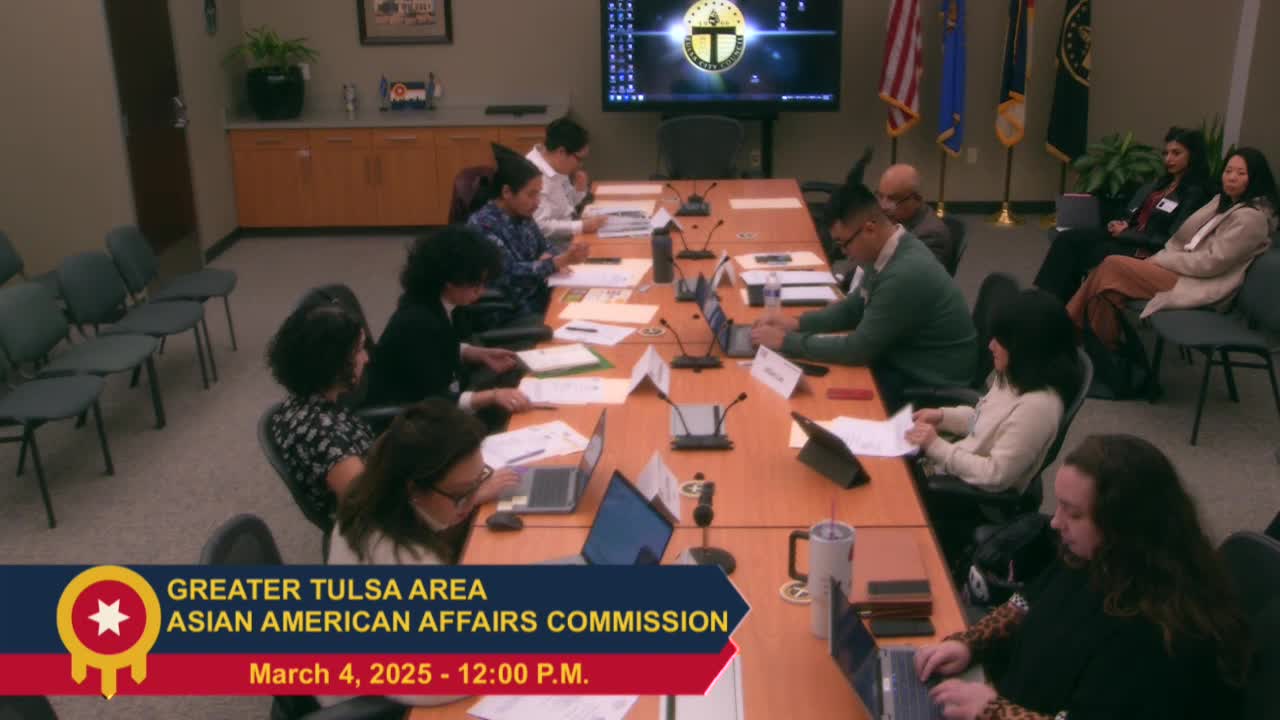
Tulsa Asian Affairs Commission adopts leadership-development goals for 2025
Summary
At its March meeting the Tulsa Asian Affairs Commission approved an overarching 2025 goal of leadership development with three supporting objectives: connect with community leaders, raise future leaders (scholarships and awards) and increase the commission's visibility; commissioners set follow-up steps including outreach and committee work.
The Tulsa Asian Affairs Commission voted to adopt leadership development as its overarching goal for 2025, approving three supporting objectives — connecting with community leaders, raising future leaders through scholarships and awards, and increasing awareness of the commission — during its March meeting.
The vote to approve the 2025 goals passed after a motion, a second and a unanimous voice vote. The chair summarized the decision, saying, "Our overarching goal is leadership development," and read the three supporting objectives aloud for the commission prior to the vote.
Commissioners said the priorities are intended to align committee work around measurable activities that can reach the city's Asian, Asian American and Pacific Islander (AAPI) communities. The approved set of objectives is meant to guide the commission's advisory work and event planning for the remainder of 2025 and into early 2026.
Committee reports and discussion during the meeting fleshed out early actions to support the goal. Ethan, culture committee chair, said the committee was debriefing the Lunar New Year event and is discussing a broader "Tulsa Asia Fest" that would represent multiple AAPI cultures rather than one holiday. Cecilia, who described herself as the commission's contact for APIDA Tulsa, outlined upcoming meetings with two national organizations — the National API Mental Health Association and Asian Americans Advancing Justice's education advocacy team — and invited commissioners to take advantage of training offered by those groups. "If over 10 of us are interested, they can have a private mental health first aid virtual session for us," Cecilia said.
The data and research committee reported a pilot outreach plan to catalog existing translated resources and resource guides already used by local organizations, then embed that information into a city-facing resource or recommendations. Sarah (data and research), who led that report, said committee members will each conduct at least one conversation with a community partner before the commission's next meeting to test questions and assess information gaps.
Other initiatives discussed included a scholarship proposal tied to the commission's award ceremony, a back-to-school outreach effort and an Asian women's empowerment initiative. The workforce and education committee said it has selected three initiatives and is organizing committee membership and timelines; the awards committee reported a timeline that would open public nominations in the second quarter and complete interviews later in the year.
Commissioners addressed outreach and communications logistics. Several noted the commission's inability to create its own social media channels under city rules; members were advised that individual commissioners can use personal social accounts to amplify commission work but the commission itself must route requests and event postings through the city's department channels. Staff confirmed emails sent to the commission mailbox (resilient@cityoftulsa.org) are routed to appropriate chairs and vice chairs.
The meeting produced several concrete next steps: committees will compile and share contact lists for community leaders and organizations, the data committee will pilot partner conversations, the culture committee will consider an ad hoc planning group for a Tulsa Asia Fest, and staff will forward incoming requests and event invitations to the proper committee chairs. Commissioners also encouraged joint outreach at upcoming events and asked volunteers to support marketing and social-media pushes where allowed.
Public comment included a representative of the Filipino American Association of Tulsa who said the association wants to connect with the commission and be more involved in events and outreach.
The commission set near-term engagement items including a March 11 debrief meeting for data partners, a March 16 community event tied to Ramadan, and a March 17 Leading Generation summit (expected attendance: 30'50 people). Commissioners also discussed sponsorships and fundraising to support community events and a scholarship fund.
The commission framed the adopted goals as advisory rather than regulatory: commissioners repeatedly noted they would support and advise community organizations rather than supplant existing nonprofits that already provide direct services. The commission asked committees to coordinate to avoid duplicating work already underway by community partners and to ensure equitable sharing of information and promotional support across Tulsa's many Asian-serving organizations.
The commission plans to track implementation of the 2025 goals through committee reports at future meetings and by compiling shared contact and partner lists that do not remain siloed with individual members.