Wayne Township outlines literacy, staffing and professional-development plan as part of goal to reach grade-level reading by 2030
Loading...
Summary
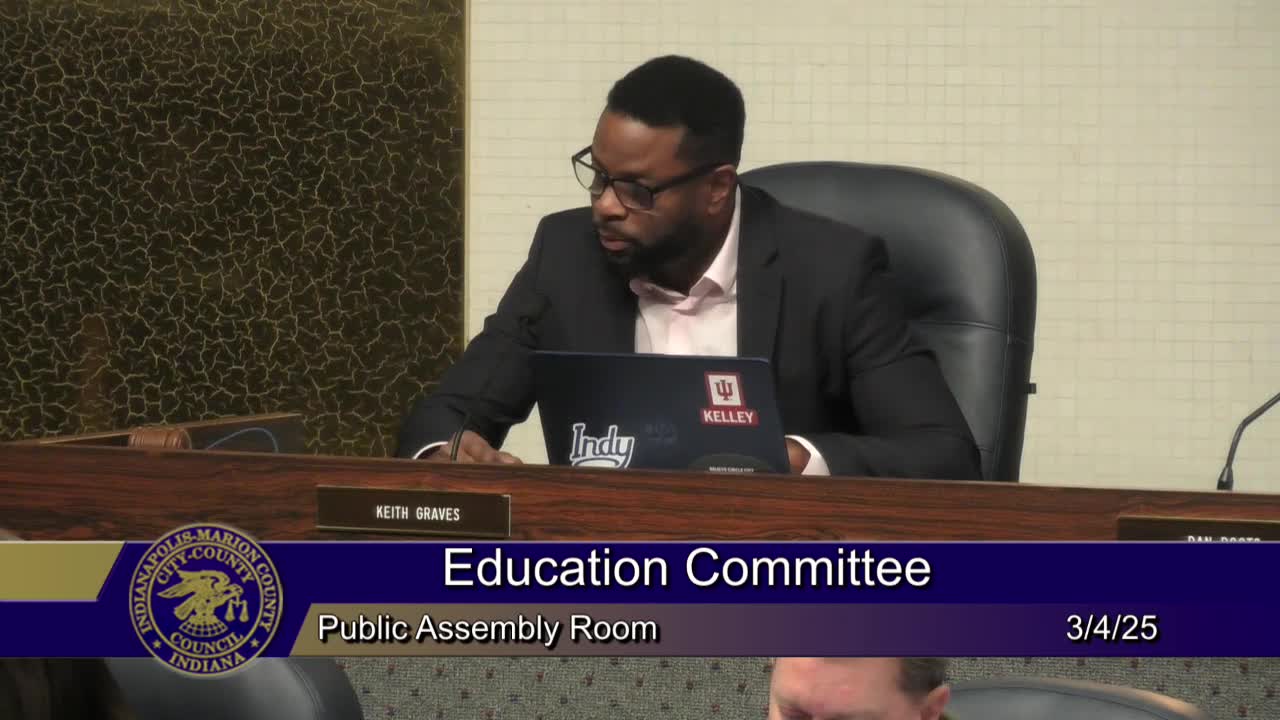
Chairman Keith Graves convened the Indianapolis City–County Council Education Committee hearing and said he has made it “my mission … to ensure that every student in Indianapolis reaches grade level reading proficiency by 2030.”
Chairman Keith Graves convened the Indianapolis City–County Council Education Committee hearing and said he has made it “my mission … to ensure that every student in Indianapolis reaches grade level reading proficiency by 2030.”
Dr. Jeff Butts, superintendent of MSD of Wayne Township, told the committee March 4 that Wayne Township is pursuing a citywide push on literacy as part of a broader strategic plan that emphasizes reconceptualizing teaching and learning, increasing student belonging and recruiting and retaining staff.
Why it matters: Council members framed tonight’s hearing as an information‑gathering session about what is working in local schools and where the council might supplement efforts. Third‑grade reading proficiency carries policy consequences at the state level; committee members pressed district leaders on IREAD‑3 performance, preschool access and teacher turnover as potential leverage points.
Most important facts
- District goal and context: Chairman Keith Graves said the committee’s objective is that “every student in Indianapolis reaches grade level reading proficiency by 2030.” Dr. Butts described Wayne’s strategic planning process, which included feedback from more than 8,325 constituents and nearly 11,000 students.
- Demographics and size: Dr. Butts said Wayne Township employs just under 2,300 staff and serves 22 schools and programs. He said the district’s current enrollment is 15,810 and that Wayne represents students from 90 countries and 83 languages. Dr. Danita Harris (introduced as assistant superintendent for exceptional learners) said multilingual learners represent roughly 38% of the district’s students; Wayne also reported 71% of students qualify for free or reduced lunch, 15% are identified as special education students and about 10% are identified as high‑ability learners.
- Literacy work and results: Dr. Heather Pierce, assistant superintendent for elementary education, described this year’s districtwide literacy action research, a literacy cadre partnership with the University of Indianapolis, expanded reading interventionists and an after‑school high‑dosage tutoring program with transportation and snacks provided. Dr. Butts said the district’s IREAD‑3 first‑pass proficiency was 66% last year; he said early data from this year indicate a higher first‑pass rate and that the Indiana Department of Education recently allowed an additional end‑of‑year retest before summer school.
- Professional development changes: Dr. Elizabeth Walters and other leaders described a new schedule for 2025–26 that will include four full‑day districtwide professional‑learning days (September, November, February and May) and a two‑hour late start every Monday to give teachers regular collaborative time. Walters said the Monday late start will run as a two‑hour delay in bell schedule (students still attend school, arriving two hours later) and that breakfast, lunch and transportation remain available.
- Teacher recruitment and retention: Dr. Shania Suggs, assistant superintendent for human resources, and other leaders said Wayne typically hires 80–100 teachers a year, that the district hosted 35 student teachers recently and offered 28 contracts, and that the district’s certified‑staff turnover has ranged from about 6.5% (low) to 13% (high). Wayne’s current turnover rate was reported as 11%. Leaders said stay interviews with more than 200 staff helped identify retention drivers, including work environment and support, not just pay.
- Early childhood: The district operates a centralized preschool and a Title I pre‑K and reported the centralized preschool currently serves “about 450, almost 500” children; Wayne said it is adding eight classrooms to open in July to expand capacity. Leaders said the district currently supplements preschool with more than $1 million from the general fund because preschool is not fully funded through regular K–12 revenue streams.
- Artificial intelligence and cybersecurity: Dr. Butts and Chief Technology Officer Dr. Tony Harvey said Wayne is piloting AI platforms (secondary and elementary pilots named in testimony) as a closed/controlled partner for teachers and students to provide feedback and data analysis. Harvey outlined cybersecurity measures: devices are proxied when used offsite, the district uses E‑Rate funding for access points and has secured a federal cybersecurity pilot grant. He said intrusion detection and prevention systems are in place and that the district works to “front load” protections.
- Philanthropy and training: Dr. Butts described participation in Lilly‑funded initiatives in Marion County. Wayne submitted a Phase 2 proposal and, with a district match, intends to use Lilly funds to support administrator and teacher professional learning. Dr. Butts said the district plans to send 150 administrators to the National Institute for School Leadership and train 840 teachers through a multi‑year teaching‑for‑effective‑learning action research program; he emphasized the district’s goal of sustaining instructional capacity beyond one‑time program dollars.
Committee questions and context
Council members pressed for details on third‑grade performance, pre‑K access and the board’s authority over funding. Dr. Butts and staff stressed that state funding formulas and legislative decisions are set at the statehouse, not by the city council, but welcomed local council support where feasible. Committee members also asked for follow‑up on how the Monday late‑start schedule and other changes affect families and workforce logistics.
Ending: Dr. Butts invited council members to visit Wayne Township schools in person to see programs and facilities.
Sources and attributions
All reporting above is drawn from the Education Committee presentation and Q&A on March 4, 2025. Direct quotes are attributed to speakers in the committee record, including Chairman Keith Graves and Dr. Jeff Butts.