Get Full Government Meeting Transcripts, Videos, & Alerts Forever!
Get email alerts on the Land Use Zoning topic
No spam. Unsubscribe anytime.
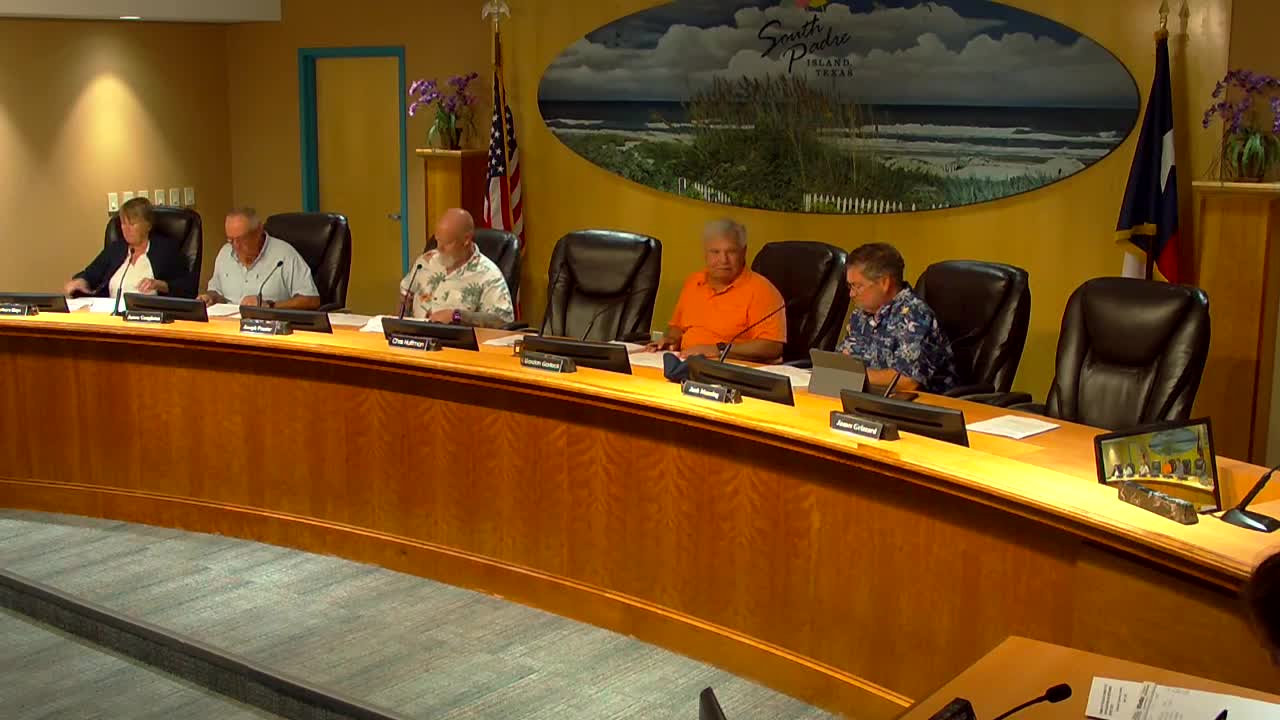
Planning and Zoning Commission forwards revised Padre Boulevard entertainment-district code to City Council
Summary
The South Padre Island Planning and Zoning Commission voted to forward revisions to the Padre Boulevard and Entertainment District Code to the City Council with three recommendations, including an added appeal fee and the removal of a specific numeric provision.
The South Padre Island Planning and Zoning Commission voted to forward revisions to the Padre Boulevard and Entertainment District Code to the City Council with three formal recommendations and a favorable endorsement.
The revision package, presented by Alex Huntress, Public Works Director, and summarized by City Attorney Ed Seganos, reworks the 70-page form-based code to reflect recent state guidance on construction materials and to resolve conflicts with the city’s existing Chapter 20 zoning code. The commission approved forwarding the draft with recommendations to add an additional fee for appeals to City Council, remove section 3.10.8 (listed in the draft as 3.1.0.8 in places), and adjust specified wording as discussed by commissioners.
The revisions make two major structural changes. First, several previously mandatory design requirements in the code’s design guidance were converted from “shall” to “should” or relabeled as “design standards and recommendations,” a change prompted by an opinion of state law summarized in the draft. Alex Huntress told the commission, “We did some edits and the majority of the edits were based on that Senate bill about the construction method and the material on the buildings.” Seganos explained the legal rationale in more detail, citing what the draft calls chapter 3,000 of the Texas Government Code and saying the city sought an opinion from the attorney general but did not receive a clear answer. Seganos said the city’s position remains that the code’s color palettes are required but that many architectural prescriptions are now advisory.
Second, the draft clarifies how the Padre Boulevard code fits into the city’s existing regulatory framework. The revised text explicitly makes the Padre Boulevard and Entertainment District Code part of Chapter 20 (the zoning code) for properties inside the district’s boundaries and establishes an appeal flow: decisions by staff are appealed to the Planning and Zoning Commission, decisions by the commission may be appealed to the City Council, and civil appeals may proceed to district court. Seganos summarized the effect by saying the code “controls and governs” in areas where it applies and noted a flow chart in the draft shows the process.
Key operational and substantive changes discussed by the commission include: - Parking: the draft eliminates the in-lieu parking fee as an alternative to providing required parking; off-site parking distance was reduced in the draft from 1,200 feet to 200 feet. Staff told the commission landscaping standards from Chapter 20 still apply when not in conflict with the Padre code. - Appeals and fees: the draft sets deadlines (an initial 15-day deadline to file an appeal was discussed) and requires fees for appeals. Commissioners recommended adding an additional fee for a party that appeals a Planning and Zoning decision to City Council; the discussion included a staff suggestion of a $250 fee and comments from commissioners about whether a higher amount (one commissioner suggested $500) would deter frivolous appeals. - Design guidance: the earlier 40-page design guidelines were renamed and reframed as recommendations rather than mandatory rules where state law preempts local prohibition of certain building materials or methods. - Art district: a small area was newly designated as an arts district within the Padre Boulevard corridor; the designation is mapped but does not change allowed uses or district boundaries in the draft.
Commissioners asked staff to confirm that safety, fire, windstorm, or other health-and-safety codes remain unaffected; Seganos and staff said those codes would still apply and that some exceptions in the state statute preserve rules needed for windstorm protection and fire safety. The draft also retains provisions that require compliance with portions of Chapter 15 (signs and public art) when expressly referenced.
Planning Commissioner Martha Hayes and others asked for wording clarifications (for example, replacing Roman numerals with Arabic numbering and ensuring consistent use of “will/shall” where appropriate). Huntress and Seganos said staff made mostly formatting and typo corrections after the commission packet was prepared; substantive changes were limited to a few provisions already discussed.
At the meeting’s close, a commissioner moved to forward the draft to the City Council with the three recommendations discussed (add a fee for appeal to City Council, eliminate section 3.10.8, and the editorial/wording adjustments). The motion received a second, was put to a voice vote and passed. The commission’s vote was recorded as a unanimous voice vote in favor; no “no” votes were stated on the record.
The City Council is scheduled to consider the package next; Seganos said the council is expected to ask questions at its first reading and that a second reading will follow after the required public-notice period. The commission’s recommendations will be included in the materials forwarded to the council.
Notes: The commission discussed but did not adopt a final numeric fee. The draft and the commission’s recommendations refer to state law described in the draft as chapter 3,000 of the Texas Government Code and to the city’s Chapter 20 (zoning) and Chapter 15 (signs/public art).