Get Full Government Meeting Transcripts, Videos, & Alerts Forever!
Get email alerts on the Public Safety topic
No spam. Unsubscribe anytime.
Spokane Valley council weighs adding seven officers, presses county on indirect costs
Summary
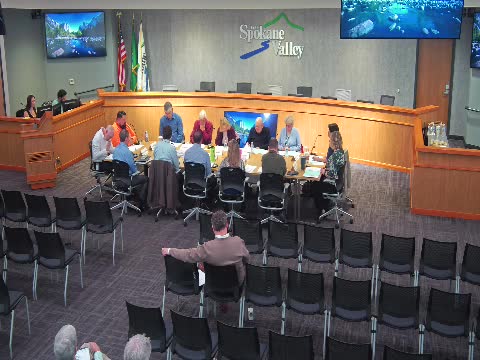
At an Oct. 23 workshop, Spokane Valley leaders discussed a Public Safety Committee recommendation to add seven sworn positions in a phase 2 staffing plan and pushed for an accounting review of county indirect charges that have sharply increased the city’s law-enforcement bill.
Spokane Valley City Council on Oct. 23 considered a Public Safety Committee recommendation to add seven sworn positions to the city’s contract with the Spokane County Sheriff’s Office and explored funding options after staff warned indirect county charges and a coming collective‑bargaining settlement are driving the 2025 public safety cost increases.
The committee recommended seven new positions — four patrol deputies, one school resource officer, one shared sexual‑assault/child‑abuse detective and one behavioral‑health deputy — if funding is identified. City staff estimated recurring costs for the seven positions at about $1,038,000 and one‑time equipment and vehicle costs at about $390,000, for roughly $1.08 million in the first year. The school district and grants would cover part of several positions, staff said.
Why it matters: public safety is the city’s largest single budget area for 2025, and city leaders said indirect charges the county applies to the contract are a major driver of recent increases. Council members pressed staff on whether savings or accounting fixes could be redirected to boots‑on‑the‑ground staffing rather than absorbed by overhead.
Staff and committee members emphasized that the phase‑2 recommendation is conditional on identifying recurring funding. Chief Ellis, who has been working with the committee, described operational benefits: “They actually help drive down the calls because they work with them when they’re not in crisis to prevent them from going into crisis,” Ellis said of the department’s behavioral‑health deputies, describing them as proactive in reducing repeated crisis calls.
The discussion also covered the collective‑bargaining context. “Because it is a public‑safety position, it’s subject to binding arbitration,” staff noted, meaning an arbitrator may set pay by comparing compensation across Washington jurisdictions if negotiations fail. Council members and staff said that state‑level comparables constrain local cost outcomes.
Council members raised concern about the county’s indirect‑cost allocation. Staff reported the county’s indirect rate rose about 23% in a single year for 2023, and city officials said they had requested backup documentation. To help contest and better understand those allocations, the city is hiring an accounting consultant to review the county methodology and the 2023 reconciliation; staff estimated that contract at about $30,000 and said the consultant is intended to provide evidence and recommendations for adjustments.
Council members repeatedly stressed fiscal prudence. “I would suggest that any savings or cost‑containment procedures or whatever savings we get be turned back into the direct cost to hire more people or buy more equipment,” Council member Padden said, noting the council’s aim to prioritize direct public‑safety spending.
Next steps and caveats: staff said the consultant contract was not finalized and that any phase‑2 hiring would not proceed until the council identifies recurring funding. Multiple council members asked staff to return with options — including internal reallocation, fee and tax changes, and voter‑approved revenue — and with the consultant’s findings on county indirect charges.
Ending: The Public Safety Committee and the city’s leadership signaled broad interest in expanding patrol and specialty units if funding can be found and if the county’s accounting practices can be clarified or adjusted; staff will return with the consultant report and funding options for council consideration.