Payson staff propose broad fee schedule changes across airport, library, parks, police and utilities
Loading...
Summary
At a March 4 work study, department heads presented proposed changes to municipal fees and fines that staff said are intended to reflect cost recovery, inflation and new services; the proposals will go to a public hearing in April and, if approved, take effect July 1.
Payson department leaders presented a package of proposed fee changes and clarifications at the March 4 work session covering airport access and penalties, community development and building fees, engineering equipment rates, fire department response and stand-by charges, library meeting-room fees, parks and recreation event fees, police booking and jail fees, and water service deposits and related fees.
Why it matters: Municipal fees and fines finance parts of town operations, influence access to public facilities and reflect the town's cost recovery policies. Council will consider the proposals at a public hearing in April and may adopt a revised schedule that would start July 1.
Highlights of proposed changes
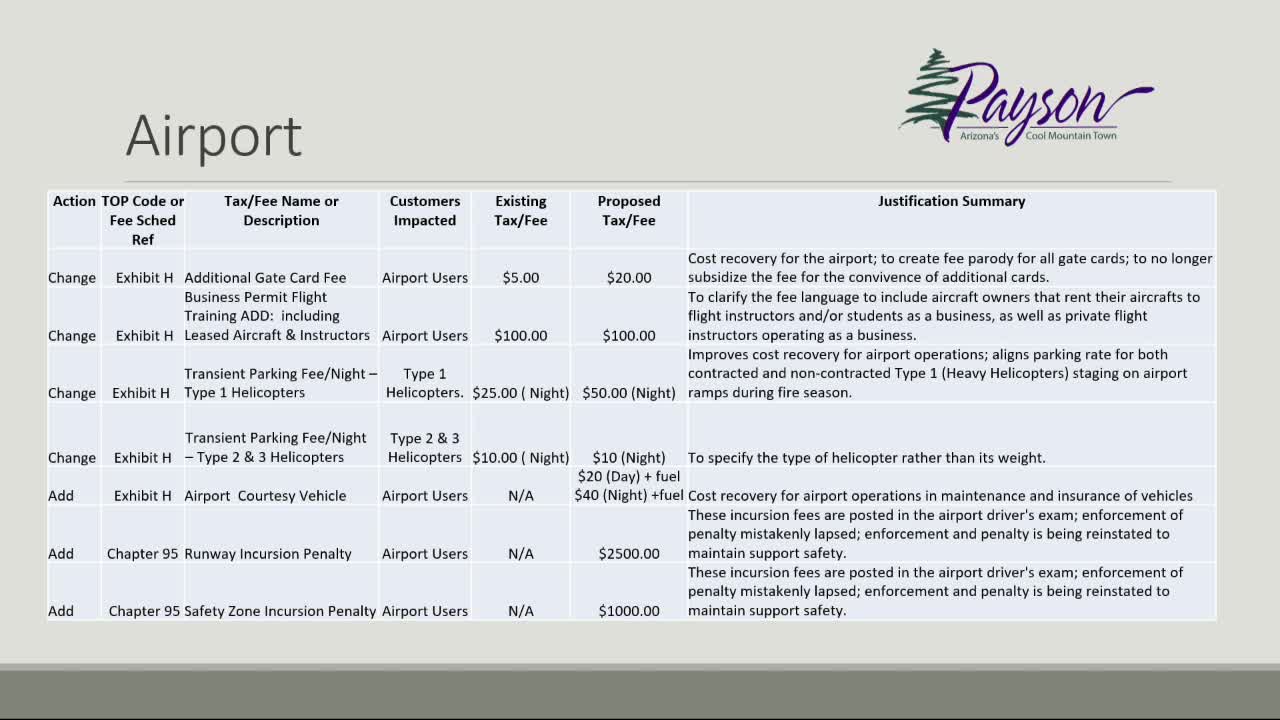
- Airport: The airport director proposed raising a gate card fee to $20 (from $5) per card and setting new transient aircraft parking rates for large firefighting helicopters; introduced a $100 penalty for illegal vehicle use of the Bravo Gate and a $100 fine for dogs off leash on airport property. The director said the airport will send the proposals to the Airport Commission for review before council action.
- Community development / engineering: Staff proposed rewording and raising several permit fees to better reflect inspection costs (for example, temporary certificate-of-occupancy-related inspection fees), and cleaning up the technology improvement fee and demolition-permit language. Engineering seeks to remove daily/weekly equipment rental rates in favor of an hourly rate.
- Fire: The fire chief presented modest increases in out-of-area response and inspection fees and a clarified schedule for fire-guard and standby services. The department said it bills insurers or responsible parties for many response-related fees.
- Library: The library director proposed eliminating fees related to kitchen use (which the library stopped offering during COVID) and changing the meeting-room policy: the new proposal would charge $100 for two hours and $25 for each additional hour (previously $100 for up to four hours); nonprofits and government users would remain exempt.
- Parks and Recreation and bed-tax-funded items: Staff proposed modest increases (for example, raising the rodeo/event center daily rental fee slightly) and asked council to consider whether bed-tax revenues should fund sign and corridor beautification projects or be used in part to support event-center needs. Councilors discussed limits on sponsorship tiers and whether to retain an upper cap on sponsorship/in-kind donations.
- Police: The police chief proposed adopting a booking fee for arrested individuals and confirmed the town follows Gila County for jail housing fees; staff said most fee recovery comes from insurance or billed defendants.
- Water: The water superintendent proposed raising security deposits (owner deposits from $100 to $150; rental deposits to $225), modest increases in meter- and service-related fees and a higher shop-test meter fee to recover actual test costs. Staff said some meter testing and service-call fees previously did not cover actual inspection labor.
Process and next steps: Staff told the council the proposed fees are being submitted under state statute A.R.S. §9-499.15 for municipal fee regulation and that the fees will be posted for public comment. The council will hold a public hearing in April and consider a resolution in May; if adopted, new fees would take effect July 1.
Ending note: Several councilors asked staff to provide clearer collection processes (for example, how the $100 Bravo Gate fine would be assessed and collected) and to ensure that proposed increases are transparent and targeted to recover costs rather than to raise general revenue.