APS outlines wildfire safeguards, public-safety power shutoff plan for Payson area
Loading...
Summary
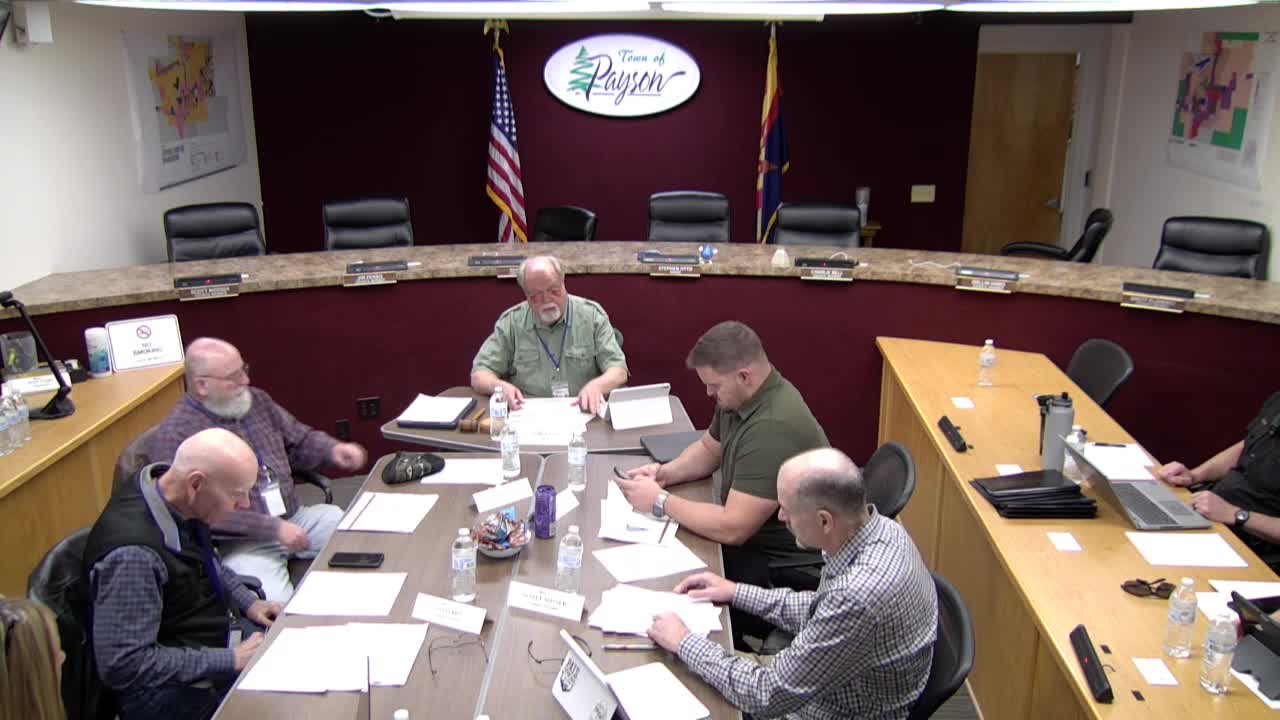
Janet Dean, public affairs manager for Arizona Public Service in the Northeast region, told the Payson Common Council on March 4 that wildfire risk drives APS's investments in vegetation management, grid hardening, monitoring and operational protocols — and that public safety power shutoffs (PSPS) would be a last-resort, data-driven tool for lines APS identifies as extremely high risk.
Janet Dean, public affairs manager for Arizona Public Service in the utility's Northeast region, told the Payson Common Council on March 4 that wildfire risk drives the company's investments in vegetation management, equipment hardening, monitoring and operational protocols — and that public safety power shutoffs (PSPS) are the newest and most rarely used tool.
Why it matters: Payson sits inside APS's wildfire mitigation district and town officials said a PSPS could affect feeders that serve the hospital, parts of town and nearby Star Valley. A shutoff would affect water systems, medical-device users and local businesses and would require coordinated alerts and staging with county emergency managers.
Dean described five pillars of APS's wildfire mitigation program, beginning with vegetation management and defensible space around poles. She said APS has a hazard-tree program that depends on partners, noting the utility must secure permission to remove trees outside its rights-of-way. "We're working very closely with the Forest Service, state land departments," Dean said.
The utility's grid-hardening work includes replacing some wooden poles with steel where access allows, "fire wrapping" equipment on selected poles and targeted asset inspections. Dean told council APS spent about $100 million on fire mitigation work last year and uses foot patrols, truck patrols, helicopters and drones with infrared cameras for inspections.
APS said it has expanded on-site weather sensing and cameras: the company now operates close to 100 weather stations along its system and is installing roughly 50 AI-capable smoke-detection cameras across Northern Arizona by May. Dean said the cameras recently triangulated an ignition near Prescott and provided an estimated two- to three-hour earlier alert to firefighters there.
Operational mitigations include turning off automatic reclosers during high fire risk — equipment that would otherwise try to restore power automatically after a fault — and suspending non-emergency line work on red-flag days. Dean said the emergency management chain includes daily updates to county emergency managers and coordinated messaging to customers via APS and county alert systems.
On PSPS specifics, Dean said APS has identified roughly 230 lines it classifies as "fire mitigation" lines and that 65 of those are the highest risk and might be targeted for shutoff if extreme conditions materialize. "What this means is that when the conditions are so extreme that everything else we've done... we may choose to turn power off to lines that are in very, very high risk areas," Dean told council.
She described the timeline the utility will use to communicate a potential PSPS: about four to five days out APS will notify emergency managers and town staff; three days out it will begin direct messages to customers; the day before and the day of APS will repeat notices and warn people to prepare. Dean said staff expect many PSPS events to be forecastable several days in advance and that a typical PSPS would last about 20 hours on average: a nighttime outage, then patrols at first light and restoration within approximately two hours after patrols clear lines (not including additional repair time if crews find damage).
APS described incident experience and scale: the company piloted PSPS tools in the prior year and had 13 feeders in the pilot; two small feeders in Payson had been included in earlier planning. Dean said she believes the PSPS tool will be used occasionally, not routinely, because forest and fuel conditions change and even extensive mitigation does not remove all risk.
Council members and staff pressed APS on medical-device customers and critical facilities. Dean said APS maintains a medical-monitoring registry so staff can do outreach to customers who rely on medical equipment; she also said the county and Red Cross would coordinate to provide charging or shelter resources if an extended outage occurs. "We do have a system where we try to get anyone who has medical equipment registered with us so that we can do personal outreach to them prior to an event," Dean said.
On who makes PSPS decisions, Dean said APS's internal fire-mitigation team (which she described as staffed with fire scientists and meteorologists) recommends action; final decisions involve senior utility leaders. "That'll be our internal APS fire mitigation team making recommendations… up to the APS president, CEO, he's gonna be involved. He'll in consultation with the fire mitigation team," Dean said.
APS representatives urged residents to sign up for both APS and county alerts, to register medical needs with APS, and to prepare for outages by unplugging or shutting down sensitive equipment and otherwise planning for a controlled reenergizing of homes after an outage.
Council response and next steps: Council members asked how many feeders could leave Payson without power; APS staff said two feeders in Payson had been on PSPS status in earlier planning and the district currently lists 10 feeders of special concern this year (APS staff said there are 14 feeders in the district they manage and that several are within town service areas). APS said it will continue town briefings, share maps with municipal staff and coordinate pre-event logistics including water-system readiness and traffic-light operations.
The presentation did not propose any new local ordinance or regulatory change; APS said statewide regulatory or statutory action is under discussion at the legislature but that, at present, the Arizona Corporation Commission does not require a specific utility wildfire mitigation plan. Council members asked staff to continue coordination with APS and county emergency management.
Where the record stands: APS presented its wildfire-mitigation approach and PSPS protocols; it did not ask the council to approve a local policy or action. Town staff will continue coordination and will receive PSPS planning materials from APS for local use. Council members said they want ongoing updates as APS refines targeted feeder lists and outreach materials.
Ending note: APS emphasized PSPS is a targeted, data-driven tool intended to reduce the risk that electrical infrastructure could spark a wildfire in extreme conditions; the company encouraged residents to keep contact information current and to register medically dependent customers for outreach.