Get Full Government Meeting Transcripts, Videos, & Alerts Forever!
Get email alerts on the Workplace Harassment Training topic
No spam. Unsubscribe anytime.
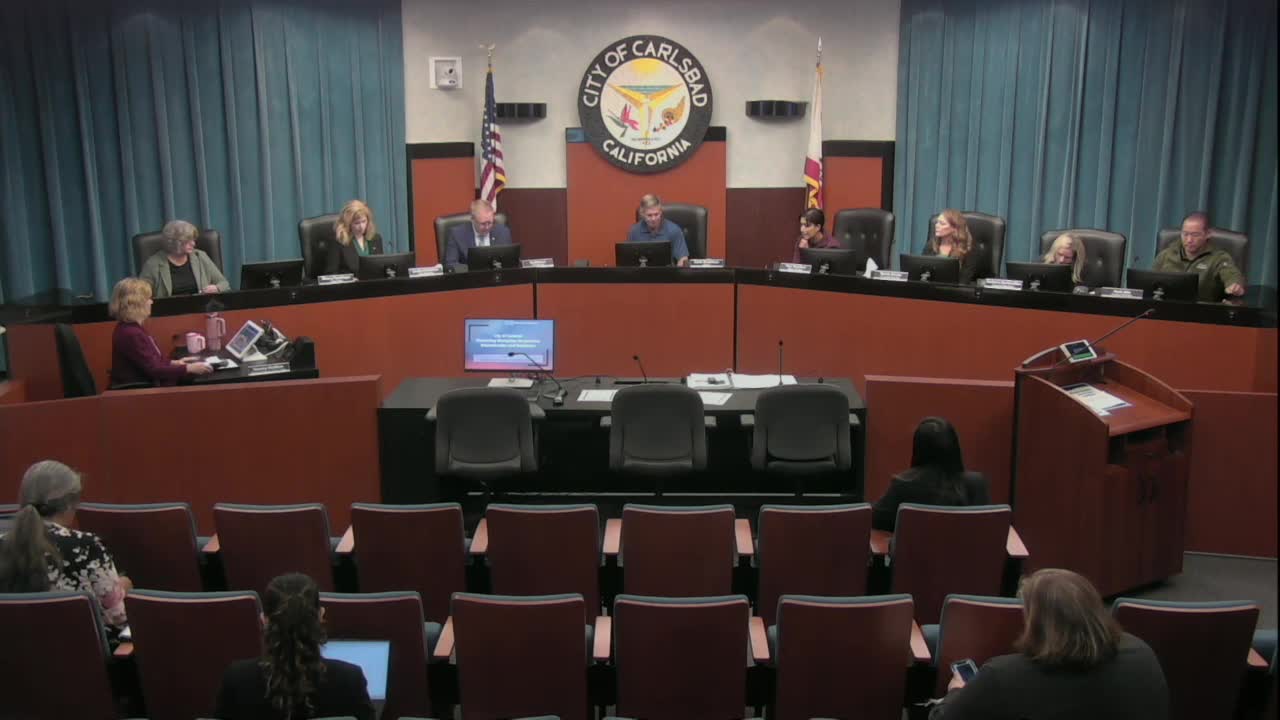
Carlsbad holds state-mandated workplace harassment prevention training for city employees
Summary
City of Carlsbad held a two-hour, state-mandated training on preventing workplace harassment, discrimination and retaliation featuring outside counsel and the city dministration s presenters; training emphasized Admin Order No. 45, supervisors' reporting duties, new protected classifications and investigative procedures.
Carlsbad city employees attended a two-hour, state-mandated training on preventing workplace harassment, discrimination and retaliation led by Stephanie Lowe of the law firm Lieber Cassidy Whitmore and organized by Human Resources Director Judy Vaughn Kalinowski.
The training, described by Lowe as "a piece of the city's commitment" to an inclusive workplace, reviewed federal and California law, the city's Administrative Order No. 45, and practical steps supervisors and staff must take when a complaint is raised.
Lowe told the council and staff that the session covered Title VII, the Age Discrimination in Employment Act, the Americans with Disabilities Act, the California Fair Employment and Housing Act, recent California updates including the state Equal Pay Act and new protected categories, plus administrative practice such as complaint intake, investigation, and confidentiality limits. She said the city policy (Admin Order No. 45) explicitly protects applicants, volunteers, independent contractors and employees and that the city must make the policy available to staff.
The trainer emphasized several points repeatedly. Supervisors have a duty to report conduct they observe or learn about and to take immediate, appropriate corrective action when violations are suspected; confidentiality can be preserved "to the extent possible" but cannot be guaranteed when an investigator must interview alleged subjects and witnesses; and an employer may continue an investigation even if the alleged harassment stops. Lowe also noted that harassment can be quid pro quo or a hostile work environment and that hostile-environment claims require conduct linked to a protected classification that is objectively and subjectively offensive and that is severe or pervasive enough to interfere with work.
Lowe summarized recent California developments that she told attendees to note: reproductive health decision-making is now a protected characteristic, California recognizes protection for combinations of two or more protected characteristics (effective January 2025), and employers generally must treat volunteers and interns as protected for harassment law purposes. She also covered the regulations on gender identity and expression, including using employees' preferred names and pronouns and permitting restroom access consistent with gender identity. Lowe said employers should not demand documentation to prove gender identity.
In practical guidance, Lowe said employees are not required to submit complaints in writing for an investigation to begin, and that requests for religious accommodations must be handled case-by-case with HR to assess reasonableness and undue hardship. She cautioned employees and supervisors that individual personnel who fail to report or who condone harassment may face personal liability, including potential damages, while employers may be liable if they fail to take reasonable steps to prevent or stop harassment. She explained that remedies can include discipline up to termination, back pay, and emotional-distress or punitive damages in individual-liability cases.
The training included hypotheticals and audience Q&A. A council member asked how investigations differ when elected officials are involved; Lowe said the laws apply to elected officials but investigations and corrective options can be more complicated because elected officials cannot be terminated in the same way as staff and conflicts of interest may require outside investigators or alternative processes. Another discussion topic included bystander reports and the supervisor obligation to act even if the targeted employee was not present when an offensive conversation was overheard.
Human Resources Director Judy Vaughn Kalinowski asked attendees to complete an acknowledgement form and sign in for attendance tracking. The training closed with a reminder that the city's administrative order can be enforced as a zero-tolerance policy and that managers must follow the reporting and investigation processes described.
No formal votes or council actions were recorded during the training portion of the meeting.