Get Full Government Meeting Transcripts, Videos, & Alerts Forever!
Get email alerts on the Workforce Upskilling Security Career Series topic
No spam. Unsubscribe anytime.
Dallas committee reviews upskilling pilot, security officer pay and career series
Summary
The Workforce Education and Equity Committee heard updates on the city's upskilling pilot, merit-pay mechanics, security officer staffing and a proposed career series to clarify promotion paths and correct pay disparities.
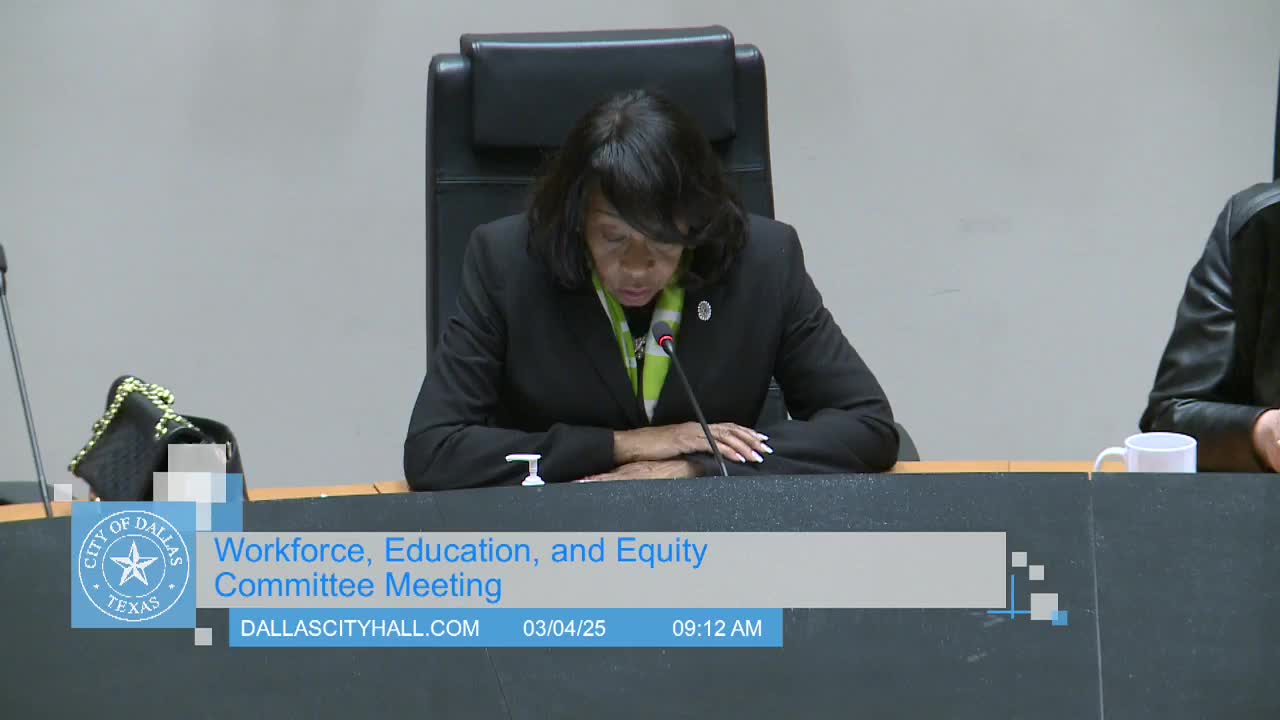
The Workforce Education and Equity Committee of the City of Dallas on March 4 heard a progress update on the city's upskilling pilot program, human resources merit processes, and staffing and compensation for Dallas City Marshal security and detention officers.
Committee members were told the city's merit program is governed by a city-manager recommendation and council approval, with an FY25 average merit pool of 3% and a performance rating scale that assigns typical merit increases ranging from 0% to 5% depending on rating. "It means you have done something and now you merit some reward," Human Resources Director Nina Arias said, describing the principle behind merit increases.
The presentation focused on pay-setting factors for security officers, which Arias said include experience (including outside experience), internal equity, performance and market benchmarks (ERI salary data). Arias said new hires sometimes enter above incumbents because a candidate's outside experience or market conditions justify a higher starting rate; departments must request analysis to hire above mid-point.
The Dallas City Marshal's security administrator, Joseph Childs, gave staffing figures for the Marshal's security division: 33 authorized security officer positions, 26 filled and seven vacancies. Childs said the office is using overtime and an active applicant pool to cover shifts and has five applicants currently in the hiring pipeline. He outlined recruiting steps including job fairs and a coordinated presence with Dallas Police Department at recruiting events.
Human Resources staff described a career series framework meant to create clearer internal progressions for security and other classifications. Under the proposed career series, employees would advance to higher-paying related titles based on documented skill growth, credentials, successful progression evaluations and a minimum continuous employment period (one year), with no disciplinary actions in the prior six months. Arias said the career series mapping and salary analysis are expected to be completed in March.
Training staff summarized outreach tied to the upskilling pilot, including a December DPD-focused recruiting session for security officers that drew 19 attendees and follow-up contact information shared with DPD for interested candidates. A wider, citywide recruiting session drew 78 registrants from 22 departments; the city will use manager and employee feedback (including a Bloomberg Harvard Managing Talent and Government engagement) to finalize an upskilling design targeted to employees making less than $46,000 per year.
Committee members asked about due process for promotion and evaluation appeals; Arias said promotion requests and transactions are recorded in Workday and that a formal appeal/grievance process exists with published forms and timelines and escalation to department directors.
No formal policy changes were adopted at the briefing. The committee did, early in the meeting, approve minutes from its Feb. 10, 2025 meeting: a motion to approve minutes was moved by Vice Chair Shultz and seconded by Councilmember Resendiz; a voice vote was recorded as "aye," with no opposition recorded and the minutes were filed.
City and department staff said the next steps are to complete the career-series job descriptions and mapping, finish the salary analysis, conduct employee feedback sessions March 7'12, and use Results for America and Bloomberg Harvard feedback to finalize the 2025'—26 upskilling pilot design. Several presenters asked the committee to share questions and recommendations with the city manager as staff refine the proposal.
The committee made no binding decisions beyond the minutes vote; staff offered to return with a memo or a six-month update showing progress on implementation and recruitment outcomes.