Get Full Government Meeting Transcripts, Videos, & Alerts Forever!
Get email alerts on the Ethics topic
No spam. Unsubscribe anytime.
Denton council reviews board-backed ethics ordinance changes, debates ‘should have known’ standard
Summary
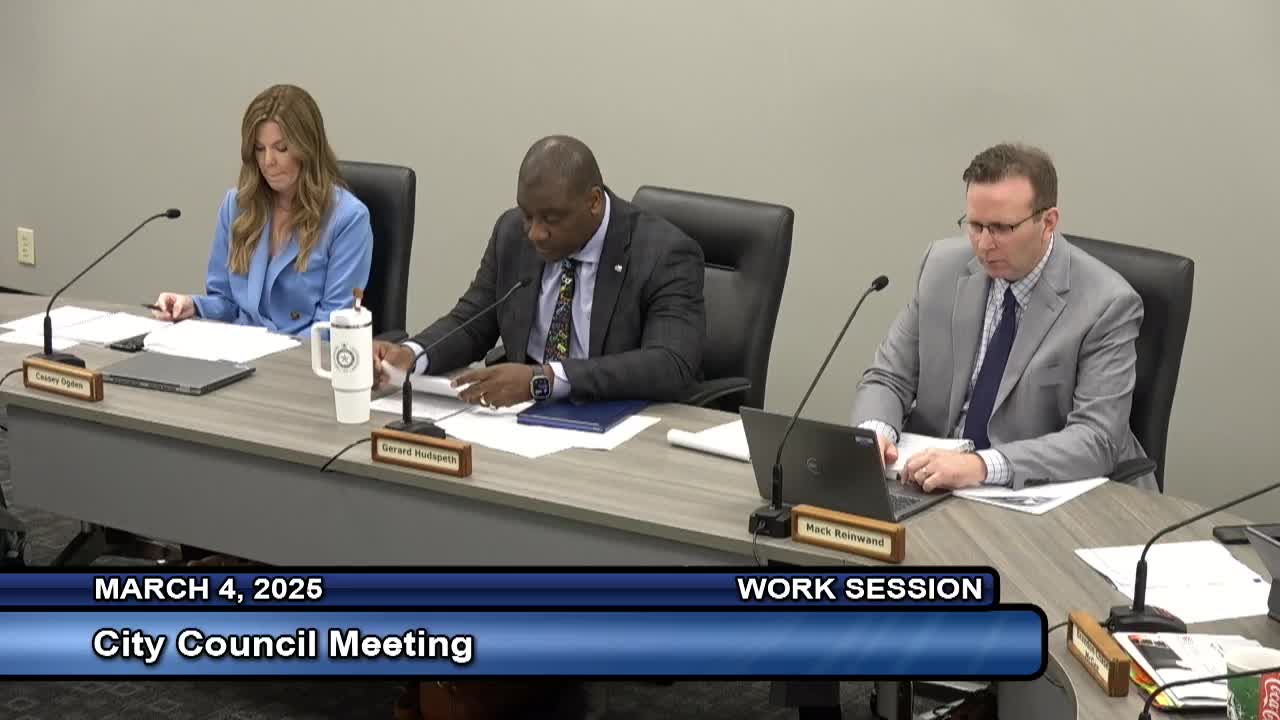
Denton City Auditor Madison Rorschaw presented two Board of Ethics'proposed amendments on March 4 and the City Council debated expanding the conflict-of-interest standard to include a "should have known" element, adding a 30-day disclosure deadline and changing which relatives and client relationships trigger automatic recusals.
Denton City Auditor Madison Rorschaw told the City Council on March 4 that the city's Board of Ethics is recommending two amendments to the city's ethics ordinance and sought council direction on several specific changes.
"Hello, mayor and council. I'm Madison Rorschaw, Denton City Auditor. I'm also the staff liaison to the city's Board of Ethics," Rorschaw said in opening the work session presentation. She said the Board developed the proposals over five meetings and based on review of other codes.
The central changes proposed by the Board of Ethics would: (1) broaden the definition of a conflict of interest by replacing the ordinance's narrow "pending matter" list with a four-part test and by including acts such as setting policy direction or making appointments; (2) add a 30-day deadline to file a disclosure after a conflict arises during deliberations, with that disclosure remaining effective for one year; (3) change which relatives automatically trigger a recusal and add a new client relationship category; and (4) replace the ordinance's unclear evidentiary language with a standard described as establishing facts "to a reasonable certainty."
Why it matters: supporters said the changes would let the Board of Ethics consider conduct beyond formal permits, contracts or tribunal cases and would give clearer deadlines for disclosures. Critics said the proposed language would create vagueness and enforcement risks.
Major points from council discussion
- "If somebody contracted with your company and you weren't aware of that, then you wouldn't have known," Rorschaw said, describing the Board's intent that a complainant must prove knowledge or show evidence a councilmember "should have known."
- Several councilmembers voiced concern about the proposal's move from a knowledge standard ("knew") to a negligence-like standard ("should have known"). A Representative from District 6 said, "I prefer the current version. I think it's more predictable and better able to be effective and follow." Other councilmembers said the "should have known" language could be struck or clarified before adoption.
- On timing, the Board proposed that a disclosure be filed within 30 calendar days of a councilmember's becoming aware of a conflict; supporters said that prevents open-ended delays, while opponents warned retroactive disclosures could still be used to allege a recusal violation.
- Proposed changes to which relatives trigger automatic recusals also drew debate. The Board proposed removing some extended relatives (for example, great-grandparents/great-grandchildren) from automatic recusal lists and adding domestic partner and foster child. Councilmembers asked that the Board add—rather than remove—items until the broader changes are settled.
- The Board proposed a new "client relationship" standard with a monetary threshold (the draft cited $2,500 over two years drawn from a model code). Several councilmembers said dollar thresholds risk penalizing small-business owners and recommended replacing a strict dollar test with a qualitative "material interest" standard or sending the client-relationship language back for further work.
- On evidentiary language, the Board recommended retitling the "burden of proof" section to "responsibility to establish facts" and setting the standard as "reasonably certain". Several councilmembers and the mayor urged restoring language that requires a complainant to put forth evidence, including testimony, and to keep the requirement that the complainant must generally appear and testify.
Council direction and next steps
Council gave mixed direction. On the first set of changes the council generally supported broadening the conflicts-of-interest scope to capture matters beyond permits and contracts, but several members asked to either remove or better define the "should have known" element. There was clear direction to add a note in the ordinance clarifying that the ordinance should not be read as conflicting with state conflict-of-interest law for votes under Texas law.
Council asked staff to return with revised language on the client-relationship dollar thresholds (many councilmembers suggested considering a "material interest" test rather than a fixed dollar threshold) and requested the Board consult further with the city attorney on overlap with state law. Council also asked that the Board's external counsel billing and the basis for dollar thresholds be provided to the council.
What the Board asked for: the ordinance draft and redlines remain under review by staff and the Board of Ethics; councilmembers asked the Board to rework client thresholds and clarify or remove the "should have known" language before a formal ordinance is advanced for adoption.
Ending: The council did not adopt ordinance text at this meeting. Staff and the Board of Ethics will return with revised language after further review and consultation, and council requested detailed backup on thresholds and outside counsel fees.