Get Full Government Meeting Transcripts, Videos, & Alerts Forever!
Get email alerts on the Capital Bonding Grants topic
No spam. Unsubscribe anytime.
DEED outlines status of 2023 capital investment grants: about $440M authorized, $200M still available
Summary
Kevin McKinnon of the Minnesota Department of Employment and Economic Development updated the Senate committee on the status of 2023 capital investment appropriations, described grant administration rules and said about $200 million of appropriations remain unspent while projects proceed through contracting and fundraising.
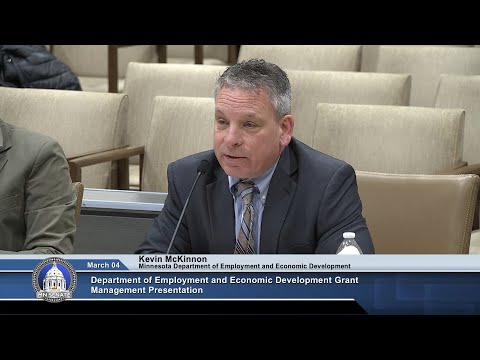
Kevin McKinnon, deputy commissioner for economic development at the Minnesota Department of Employment and Economic Development (DEED), briefed the Senate Capital Investment Committee on March 4 about the status and administration of 2023 capital investment grants.
McKinnon told senators that DEED and Minnesota Management and Budget (MMB) jointly manage the grants and that bond funds "can only be used for the items listed in the grant appropriation language and/or appropriate costs as a result of the construction of whatever the project is building." He summarized core grant-administration rules: grantees are discouraged from beginning reimbursable work before a grant agreement is in place, grants are paid on a reimbursement basis, administrative costs are prohibited, projects must meet local permitting and procurement rules, and DEED generally requires a first lien on property financed with state bond proceeds.
McKinnon said the 2023 capital investment package included roughly $440 million for about 120 local or nonprofit projects. As of the March 4 briefing, DEED reported 46 projects with grant agreements in place, representing about $140 million in appropriations; roughly 68 projects remained in process at various stages (some still fundraising or awaiting documentation) and DEED estimates about $200 million in appropriation remains available. McKinnon said the funds are commonly available for up to four years unless the legislature takes specific action to rescind them.
On monitoring and compliance, McKinnon described DEED practices: project managers are assigned to grants and, where possible, remain with a project for its life; DEED conducts monitoring visits and requires annual reports and a final closeout report; DEED typically holds back 10% of a grant until final documentation is submitted. He also noted the State Architect and the Department of Administration participate when projects involve building design and thresholds that trigger state oversight.
Senators asked for additional detail and assistance. Chair Housley and Senator Pappas asked DEED to provide a list of grants still in process and the reasons for delay so legislators can help where appropriate. Senators asked whether grantees could repurpose financed buildings, whether sale or change of ownership would require repayment, and whether DEED charges interest on repayments; McKinnon said the department generally requires repayment if a financed building is sold and that he would provide a specific answer about interest on repayment commitments.
McKinnon said DEED will continue biweekly internal project-management meetings and work with grantees on fundraising, required documents and possible legislative fixes. He also said DEED has not uncovered fraud in its oversight to date and reiterated that smaller nonprofit recipients sometimes need extra legal or financial assistance to complete contracts and procurement requirements.