Get Full Government Meeting Transcripts, Videos, & Alerts Forever!
Get email alerts on the Parks And Recreation topic
No spam. Unsubscribe anytime.
Lockhart staff outline wayfinding signs, two‑phase aquatics plan and new online pavilion rates
Summary
Parks Director Travis Hughes updated the City Council on three gateway monument signs awaiting TxDOT approval, a two‑phase aquatics facility backed by a $750,000 Texas Parks and Wildlife grant and a planned move to online hourly pavilion rentals. Council asked for budget guidance and a formal resolution to adopt new fees.
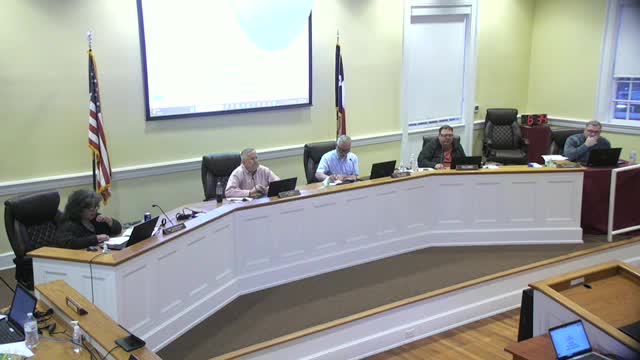
Parks and Recreation Director Travis Hughes told the Lockhart City Council on March 11 that the department is moving forward on multiple capital projects including three new gateway monument signs, a two‑phase aquatics facility and renovations to Lions Park while transitioning pavilion rentals to an online, hourly system.
The updates matter because the aquatics project is already supported by a $750,000 grant from Texas Parks and Wildlife and the city plans to apply this summer for another $750,000; officials said phasing the pool work makes the project eligible for additional grant opportunities and spreads matching costs across fiscal years.
Hughes said the wayfinding program originally included four monument signs along Highway 130 but one location near U.S. 183 did not fit the proposed sign dimensions and has been set aside for a later phase. “We’ve already developed an RFP for competitive sealed bids to select the fabricator and installer. We’re still awaiting final approval from TxDOT for the proposed designs,” Hughes said, adding staff have worked with Diana Schultz, the TxDOT area manager, and expect a determination soon. Councilmember questions established that the city budget contains a fixed parks capital amount and that staff had expected roughly $140,000 to be available for sign work in the current cycle.
On the aquatics facility, Hughes said the city received a $750,000 Texas Parks and Wildlife grant for the first phase and will apply for a second $750,000 award this summer for phase two. The city has issued an RFQ to select a design firm; Hughes said 15 firms attended the pre‑submittal meeting and submittals are due in the coming week, with the final selection scheduled for March 28. The planned site will be leased from the school district under an interlocal agreement; staff are completing a land survey and appraisal so the metes‑and‑bounds can be included in that agreement. Hughes said about nine acres are available at the site and the intention is to use roughly half for the aquatics facility and reserve the remainder for a future recreation center.
Hughes also reviewed Lions Park concepts, which staff estimated at about $3,000,000 to complete and recommended be done in two phases so the city could pursue the same state grant programs. The first phase would focus on infrastructure—new parking, trail connections that cross the creek, a permanent water feature and upgraded restrooms—while later phases would add amenities such as a multipurpose court or fitness stations depending on council priorities and funding.
Hughes said staff have begun outreach to potential sponsors. “We did reach out to H‑E‑B and didn’t get much response,” he said, and added St. David’s Foundation grants currently open to the city are focused on health care and wellness rather than recreation. Council members asked staff to continue pursuing sponsorships and partners, and requested a follow‑up that lists priority projects, anticipated funding sources and a timeline to inform the upcoming budget cycle.
Separately, staff described planned changes to park rental operations. Pavilion reservations will move to an online platform and the fee structure will convert from a daily rate to hourly blocks to work with the booking system. Under the draft schedule staff showed, the main pavilion would convert from a $95 daily fee to an example $20‑per‑hour rate with a five‑hour minimum (about $100), while special event permits that close an entire park would remain at the higher rates used for large events. Pool rentals were proposed as $75 per hour for a two‑hour block ($150 total) to align with current maximum party fees; Hughes said the city will continue its practice of requiring at least three lifeguards for rented pool events (and typically staffs four) and will retain a damage deposit that is forfeited if groups leave facilities unclean.
Council members pressed staff about operational issues raised by residents during last summer’s season—overflowing trash cans and unclear on‑call coverage—and Hughes said the parks maintenance crew now has a scheduled rotation for after‑hours and weekend responsibilities. The next formal step on rental rates is to bring a resolution forward on the regular council agenda for consideration.
The council asked staff to return with budget guidance and a prioritized timeline for the programs discussed, including the aquatics grant match requirements and any potential sponsorship arrangements. No formal votes on capital project spending were taken during the work session; staff said items requiring council approval will appear on the regular meeting agenda.