Get Full Government Meeting Transcripts, Videos, & Alerts Forever!
Get email alerts on the Land Use Rezoning topic
No spam. Unsubscribe anytime.
Little Elm council tables vote on rezoning of 10-acre parcel after residents press concerns about trees, traffic and lot sizes
Summary
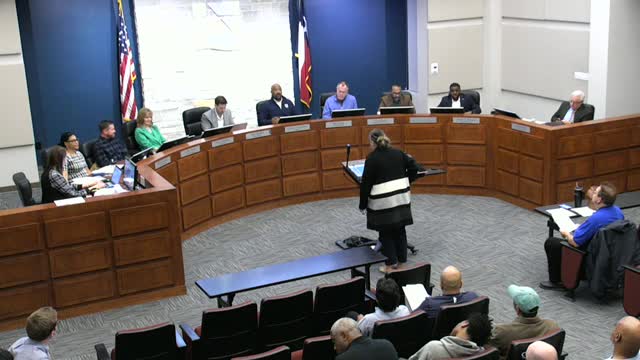
The Little Elm Town Council on March 4 tabled consideration of Ordinance 18‑02, a proposal to rezone about 10 acres north of U.S. 380 and Oak Grove Parkway for a 50‑lot single‑family planned development, after a public hearing that drew more than a dozen residents who said the project would remove trees, worsen traffic and reduce privacy.
The Little Elm Town Council on March 4 tabled consideration of Ordinance 18‑02, a proposal to rezone about 10 acres north of U.S. 380 and Oak Grove Parkway for a 50‑lot single‑family planned development, after a public hearing that drew more than a dozen residents who said the project would remove trees, worsen traffic and reduce privacy.
The applicant is proposing a planned development based on SF‑4 standards to allow 50 single‑family homes and about 1.17 acres of open space on roughly 10 acres. Town planner Miss Oka told the council the project proposes reduced setbacks and lot widths, preservation of some trees and a capped tree‑mitigation payment; post‑Planning & Zoning revisions also limited height along the east side to a single story and 25 feet.
Why it matters: residents said the project would eliminate a significant tree stand that buffers existing homes in Hillstone Point, increase congestion on narrow two‑lane neighborhood roads and put two‑story homes close to existing back yards. Planning & Zoning recommended denial 5‑1; the council moved to table the item so staff, the developer and residents could negotiate potential changes.
Several homeowners urged the council to preserve the eastern tree stand and to require single‑story houses along the property line nearest existing homes. John DeWerde, a resident of Rosaline Drive, said the neighborhood already suffers heavy traffic and that removing the trees would further degrade the area. "We have an opportunity to prioritize smart, sustainable growth, versus just maximizing the number of houses on a map," DeWerde said.
Other speakers made similar points: Steven Kilfoyle said the area lacks nearby parks and suggested converting the site to open space rather than adding housing; Phil Hemmer asked the council to remove six lots adjacent to the eastern tree line and require single‑story homes behind existing back yards; several residents described long commute times and safety concerns related to cut‑through traffic and construction vehicles.
Town staff summarized the development proposal: the applicant proposes 50 lots (about 5 dwelling units per acre), with lot widths of 40 and 50 feet (21 of the lots are 50‑foot wide), minimum lot areas around 4,400 square feet with 21 lots meeting 6,000 square feet, and a park area with amenities including pickleball courts, a playground, a small trail and a wet retention pond. The applicant originally proposed an $75,000 tree‑mitigation payment; after Planning & Zoning and public comment, the applicant offered to cap mitigation at $150,000 rather than the roughly $536,000 that full calculations would produce. Staff reported the value of preserved trees at about $300,000 and said surveys show 199 trees proposed for removal and 82 trees to be preserved.
Planning & Zoning deliberations and protest status: Miss Oka said the Planning & Zoning Commission voted 5‑1 to deny the rezoning request, citing concerns about the number of 40‑foot lots, tree preservation, and the proposed wooden perimeter fence along the northern boundary. Staff also reported that 31 property owners filed formal protest notices representing roughly 4.056 acres — about 16% of the area required for a protest supermajority under the Texas Local Government Code (20% required). Because the protest threshold was below 20%, the supermajority rule would not automatically block a zoning change.
Developer response and constraints: Kevin Patel, engineer of record for Triangle Engineering representing the developer, said grading and drainage needs require removing many of the trees along the eastern property line to allow runoff to the proposed southwest retention pond. He said the developer is prepared to require one‑story homes along the eastern line and to maintain existing wooden fences to the west, south and east through HOA covenants; he also said the developer is open to replacing the northern fence with masonry and could accept an 8‑foot masonry wall there if the project is approved. Patel said the builder intends to market the houses for sale rather than build-to-rent.
Council direction and next steps: after public comment and discussion the council moved to table the ordinance to the March 18 meeting to allow staff and the applicant to work through resident requests. Council members signaled interest in directions including single‑story homes adjacent to existing properties on the east (and at least consideration for single‑story on the south), an 8‑foot masonry wall along the northern perimeter, clarification of tree mitigation numbers and whether underground detention is feasible. Town staff will continue coordination with the developer and residents and return with revisions on March 18.
No formal rezoning ordinance was adopted; the council action on March 4 was to table the item and request additional information and potential revisions.
Provenance: The rezoning discussion and public hearing opened when Miss Oka described the site as "approximately 2,000 feet north of, US 380 and Oak Grove Parkway" and ran through the council's action to table the ordinance; the council announced "This item has been tabled until the March 18."