Get Full Government Meeting Transcripts, Videos, & Alerts Forever!
Get email alerts on the Polk Street Abandonment topic
No spam. Unsubscribe anytime.
Residents, council members urge pause on Polk Street abandonment and call for comprehensive mobility study
Summary
Community members and several council members pressed the City and Houston First to halt plans to abandon 700 feet of Polk Street, citing risks to East–West connectivity, emergency response access and equity. Speakers asked for a moratorium, a detailed multimodal mobility study, and fuller public engagement before any closure is approved.
Residents from the East End, Third Ward and Fifth Ward urged Houston city leaders on March 4 to deny—or at least pause—the proposed abandonment of a segment of Polk Street and to broaden public review of Houston First’s plans for the area.
Community members told the council that Polk Street functions as one of the few remaining east–west connectors into downtown and that closing approximately 700 feet of the roadway (per signs posted on the street) would increase commute times, strain transit routes and create gaps in emergency access.
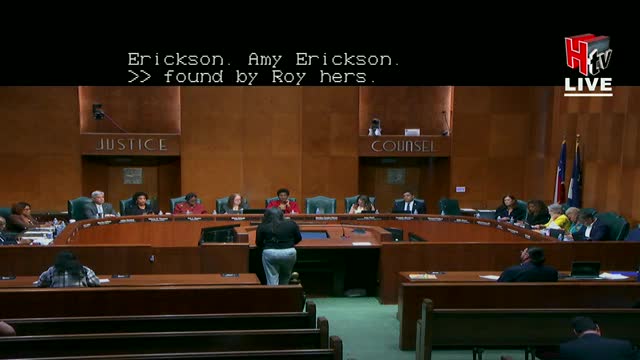
"Polk is a lifeline connecting communities, businesses, essential, and emergency services," said Amy Erickson, an East End resident and public commenter. "Polk's importance extends beyond my family's experience. It serves thousands of Second, Third, And Fifth Ward residents. ... The street is a lifeline of mobility for tens of thousands."
Why it matters: Speakers said the proposed Polk closure is part of a larger pattern of reduced east–west street connectivity into downtown dating back decades, and they said the current process—managed through a Houston First application and the city’s JRC (Joint Review/real-estate) process—lacked adequate maps, mobility analysis and direct outreach to the neighborhoods that will be affected.
Council members acknowledged the concerns and said they had extended the public-comment period and planned additional briefings. "We extended the comment period," Councilmember Martinez said, adding the city will host a public meeting where Houston First, Metro, Public Works and other agencies will present plans and answer questions. He urged neighbors to bring specific questions for the March 17 briefing and to participate in the extended comment period.
Speakers’ concerns and requests - Multiple commenters said signage and a 30‑day comment window were insufficient outreach; several asked for a moratorium on abandonment until a comprehensive, multi‑stakeholder mobility study is completed (involving Houston First, Public Works traffic engineers, Metro, TxDOT, Union Pacific and affected management districts and neighborhoods). - Residents and civic leaders requested detailed maps showing proposed changes and detour plans, emergency response routing, and an analysis of impacts on bus routes (commenters said Metro routes 40 and 41 use Polk), cyclists and pedestrians. - Several speakers framed the issue as an equity concern, saying past transportation decisions have disproportionately reduced access for neighborhoods east of downtown; they asked the city to avoid repeating those patterns.
What city officials said: Councilmember Martinez said item 33 on the agenda (a separate quiet‑zone matter for the East End) is at the "tail end" of its review and that the quiet‑zone vote would allow Union Pacific, the FRA and the city to inspect infrastructure modifications. Martinez and other council members said they would ask Houston First for briefings and would host a March 17 meeting to bring stakeholders together; Martinez said Metro and Public Works (traffic staff) would be invited to that meeting.
Public process and timing: Commenters said Houston First’s last publicly available plan dates to 2011 and criticized what they described as limited transparency about current designs. They noted a public presentation event scheduled by Houston First (described by commenters as a "reveal") and asked council to explain whether the public comment period can meaningfully influence decisions that appear to be moving forward.
Calls for study and mitigation: Multiple commenters asked for a formal, city‑led mobility and emergency‑access study before any abandonment vote. They also requested interim mitigation measures to preserve access while longer‑term planning and construction proceed, and they asked the council to clarify how proposed projects—such as the GRB expansion and TxDOT corridor work (I‑45 and US‑59/ I‑69 realignments)—would be coordinated with any Polk Street changes.
Voices from former public officials and neighborhood leaders: "Polk Street is critical to maintaining East West connectivity into the city," said Robert Gallegos, a former council member and vice president of a local civic club, noting that many residents use Polk daily to reach downtown jobs and venues. Ruben Garza, a Fifth Ward resident, urged the council to "overwhelmingly vote no to abandon Polk Street" when the matter reaches council if the community’s questions remain unanswered.
Next steps: Councilmembers said they would continue to press Houston First for clearer plans and hold an informational session March 17; the public‑comment period was extended into early April (commenters and council members described the new deadline as "early April," a specific date was not specified in today’s remarks). No abandonment vote or final action on Polk Street was recorded in the March 4 meeting transcript.
Ending note: Residents and neighborhood leaders said they support downtown investment but asked the city to ensure projects do not close off essential mobility for nearby neighborhoods, to commit to a transparent review that includes traffic and emergency‑response modeling, and to make any closures contingent on mitigations that preserve east–west access.