Get Full Government Meeting Transcripts, Videos, & Alerts Forever!
Get email alerts on the Industrial Zoning topic
No spam. Unsubscribe anytime.
Planning commission approves industrial land‑use and zoning changes for parcels near Governors Park; residents raise traffic, drainage and noise concerns
Summary
The Clay County Planning Commission voted to recommend approval of four companion applications to reclassify multiple parcels near County Road 209 South and County Road 226 from agricultural uses to industrial (IB), forwarding the items to the Board of County Commissioners on March 25.
The Clay County Planning Commission voted to recommend approval of four companion applications that would change land use and zoning on multiple parcels near County Road 209 South and County Road 226, moving the properties from agricultural to industrial (IB) classifications and forwarding the items to the Board of County Commissioners on March 25.
Jenny Bridal, Clay County zoning chief, presented the four paired applications (two land‑use and two zoning changes) affecting parcels in the Springs Planning District, in Commissioner Burke’s district. Bridal said the parcels include an approximately 9‑acre tract and a separate 1‑acre tract, and that staff and the Springs Citizens Advisory Committee recommended approval. “As previously staff does deem it consistent with comprehensive plan and consistent with the intent of the land development code and recommends approval,” Bridal said.
Developer and applicant representative Van Royal argued the location is appropriate for an industrial park, citing proximity to the new Outer Beltway interchange, existing industrial land adjacent to the site and anticipated water and sewer service. “This is an ideal situation because of the proximity of that new interchange that opens up this summer,” Royal said, adding that the site could provide local jobs and be developed as multiple 3–20 acre parcels rather than one large facility.
Residents and property owners urged denial or delay, citing safety and infrastructure concerns. Luke Lisonbee, who said he has lived in the area 52 years, called the site a “conservation area” and asked commissioners to visit. Sandra Boykey, who lives on County Road 209 South, said portions of the properties already have been cleared and expressed concern about clearing without an approved development plan; she reported on‑the‑ground measurements that showed the road pavement is about 18 feet wide from edge to edge and said heavy commercial traffic would create safety hazards for residents and first responders. “A semi takes up more space than 7 feet,” Boykey said, describing lane widths and emergency vehicle access.
Commissioners debated competing priorities. Some members said infrastructure and roadway improvements should come before zoning changes; others urged using the county’s new interstate access to attract jobs. Commissioner discussion also addressed the Live Local Act and whether deed restrictions could prevent future multifamily development; County Attorney Courtney (last name not provided in transcript) said a restriction attached to a deed would inspire greater confidence than a standalone county order.
Staff said mobility (road) fees apply to developments; planning staff indicated the fees are collected during development review and that payment is required before certain utility or permit steps (staff: Kelly). The planning director noted that engineering review through the county’s Development Review Committee (DRC) is required before site‑plan approval and that building permits will not be issued until engineering signs off on required road and infrastructure improvements.
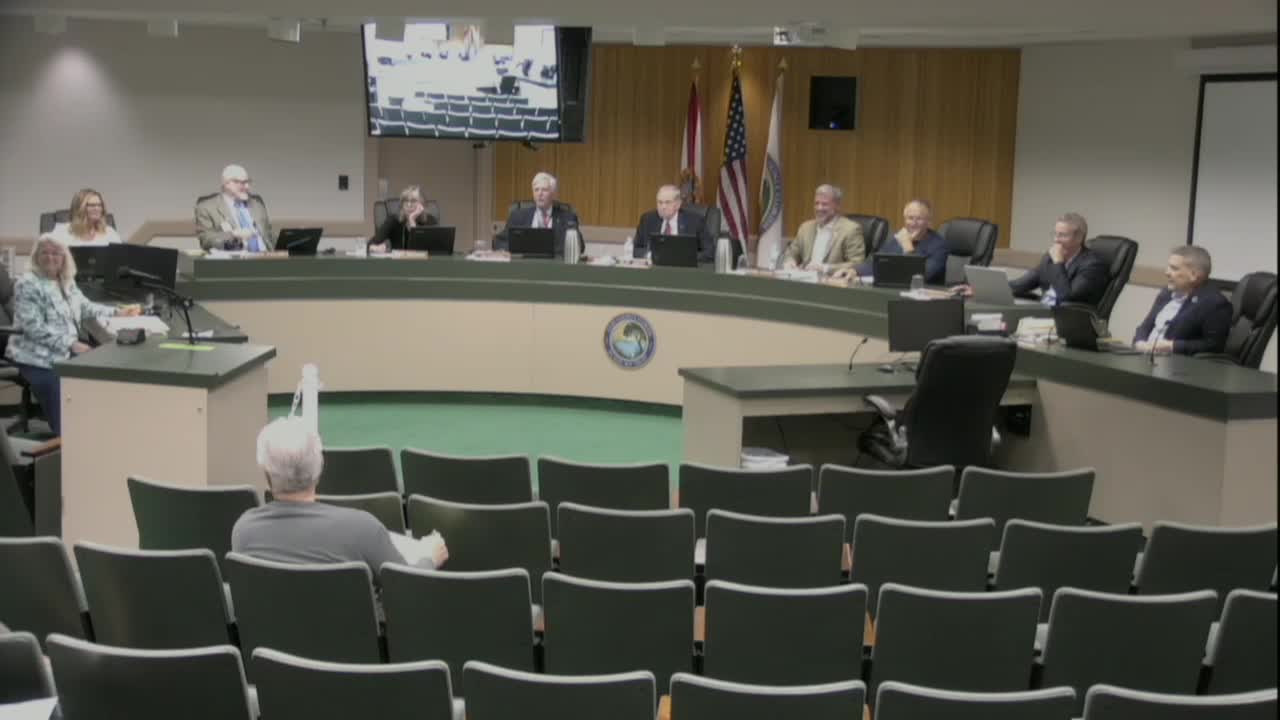
After public comment and deliberation, the commission approved the four companion items on voice votes and forwarded them to the Board of County Commissioners for decision March 25. Several commissioners urged that engineering, drainage, road improvements and any deed restrictions or development agreements be worked out before construction permits are issued.
Why this matters: the changes would enable industrial‑scale uses near a future interstate interchange and could affect traffic patterns, drainage and the character of nearby rural neighborhoods. Residents asked for stronger protections on noise, road improvements and limits on future uses; developers and some commissioners framed the changes as a chance to create local jobs and make use of recent highway investments.
Next steps: the items will go to the Board of County Commissioners on March 25. If the Board approves them, future development proposals will still require DRC engineering review, payment of mobility fees, and separate site‑plan and building‑permit approvals before construction.