Get Full Government Meeting Transcripts, Videos, & Alerts Forever!
Get email alerts on the I35 Cap And Stitch topic
No spam. Unsubscribe anytime.
UTC urges 'city streets' design for I‑35 frontage roads, calls for slow speeds, trees and parking
Summary
The Urban Transportation Commission voted to recommend that frontage roads and East Avenue sections of the I‑35 Cap & Stitch or related designs be planned as city streets: no more than two travel lanes each way, 10–11 foot lanes, street trees on both sides, raised crosswalks and parking on both sides to activate edges. The commission framed the
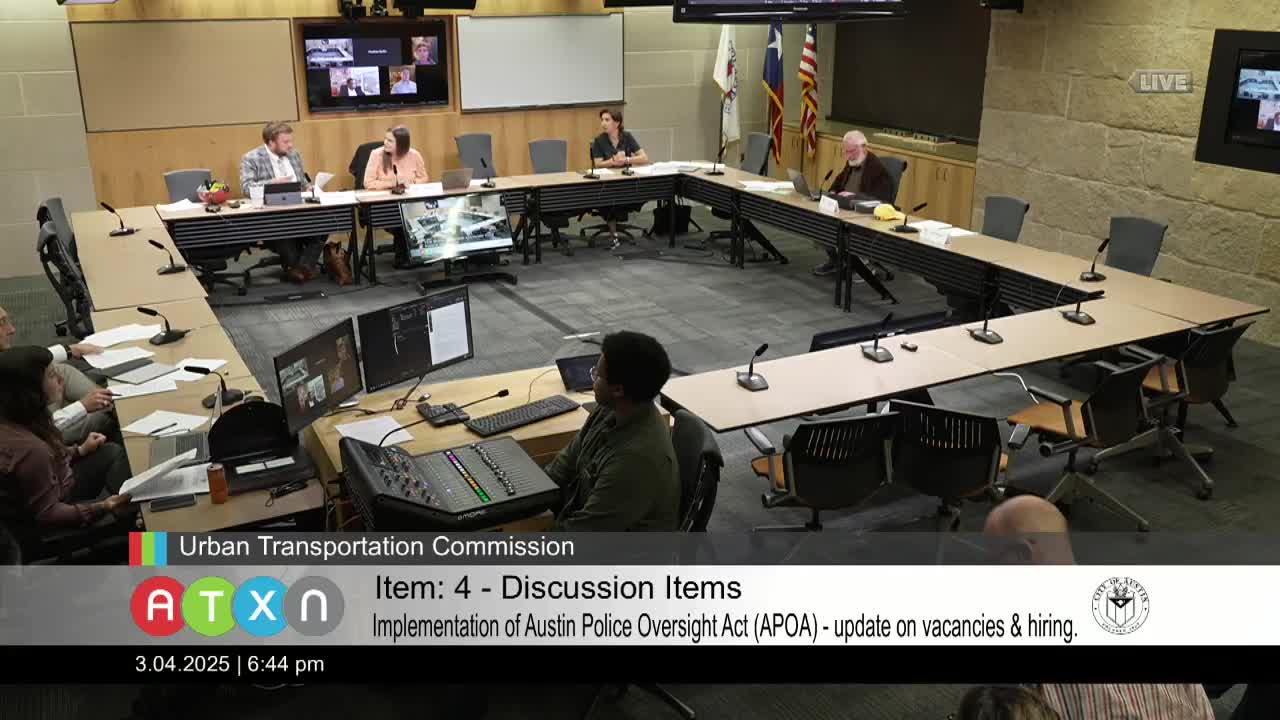
The Urban Transportation Commission on March 4 passed a recommendation urging that frontage roads and any “cap” over I‑35 be designed as city streets rather than wide, high‑speed roadways.
The recommendation asks that average speeds be kept at or below typical safe urban limits (no higher than 30 mph), that frontage roads be limited to a maximum of two travel lanes in each direction with generally 10‑ to 11‑foot lane widths, and that designers include street trees and parking on both sides of the corridor. The UTC also recommended raised crosswalks, pedestrian bulb‑outs at every intersection along the proposed East Avenue, and active curb uses so the cap edges are easy to cross and usable by people.
Commissioners framed the recommendation around public‑space activation. In a public comment the advocacy group Safe Streets Austin said, "we should absolutely be insisting on city streets next to this highway, not another highway next to the highway," arguing that wide, fast frontage roads would undermine the usability of any future cap or park. The commission’s motion explicitly referenced projects the City and consultants have cited as models — Dallas’s Clyde Warren Park and Boston’s Rose Fitzgerald Kennedy Greenway — saying those built‑over freeways function as city parks because the edges are human‑scaled and easy to cross.
Why the commission acted: The I‑35 corridor project and the City’s "cap and stitch" concepts have raised intense public interest about whether the street-level frontage roads adjacent to the freeway will function like conventional highway frontage roads or like slower, urban, pedestrian‑oriented streets that connect to new caps and parks. UTC members said wide, high‑speed frontage roads would create barriers to crossing and undercut the park‑over‑freeway concept.
Implementation guidance included in the recommendation:* Keep average speeds at or below 30 mph;* Limit frontage road travel lanes to two lanes per direction;* Use 10–11 foot lane widths where feasible;* Provide street trees and green infrastructure along medians and sidewalks;* Provide on‑street vehicle parking on both sides to help activate edges;* Allow emergency/service vehicle access to any cap;* Place raised crosswalks and pedestrian bulb‑outs at intersections and crosswalks on streets with more than one through lane in a direction.
The commission approved the recommendation unanimously and instructed staff to forward it to council and other project stakeholders. Commissioners emphasized the recommendation applies whether or not a cap is ultimately built, because wide, high‑speed frontage roads would pose a safety and accessibility problem even without a cap.
Ending: The UTC said its recommendation is intended to preserve the possibility that any future cap, park or stitched urban fabric over I‑35 will connect to downtown neighborhoods and be usable by pedestrians and cyclists, rather than being surrounded by a multi‑lane, high‑speed edge.