Get Full Government Meeting Transcripts, Videos, & Alerts Forever!
Get email alerts on the Bond Priorities topic
No spam. Unsubscribe anytime.
TPW outlines equity, safety and sustainability as guiding principles for 2026 bond prioritization
Summary
Transportation & Public Works presented a draft set of guiding principles and technical evaluation criteria for capital projects that could shape a possible 2026 bond, emphasizing equity, safety, sustainability and programmatic delivery alongside large corridor projects.
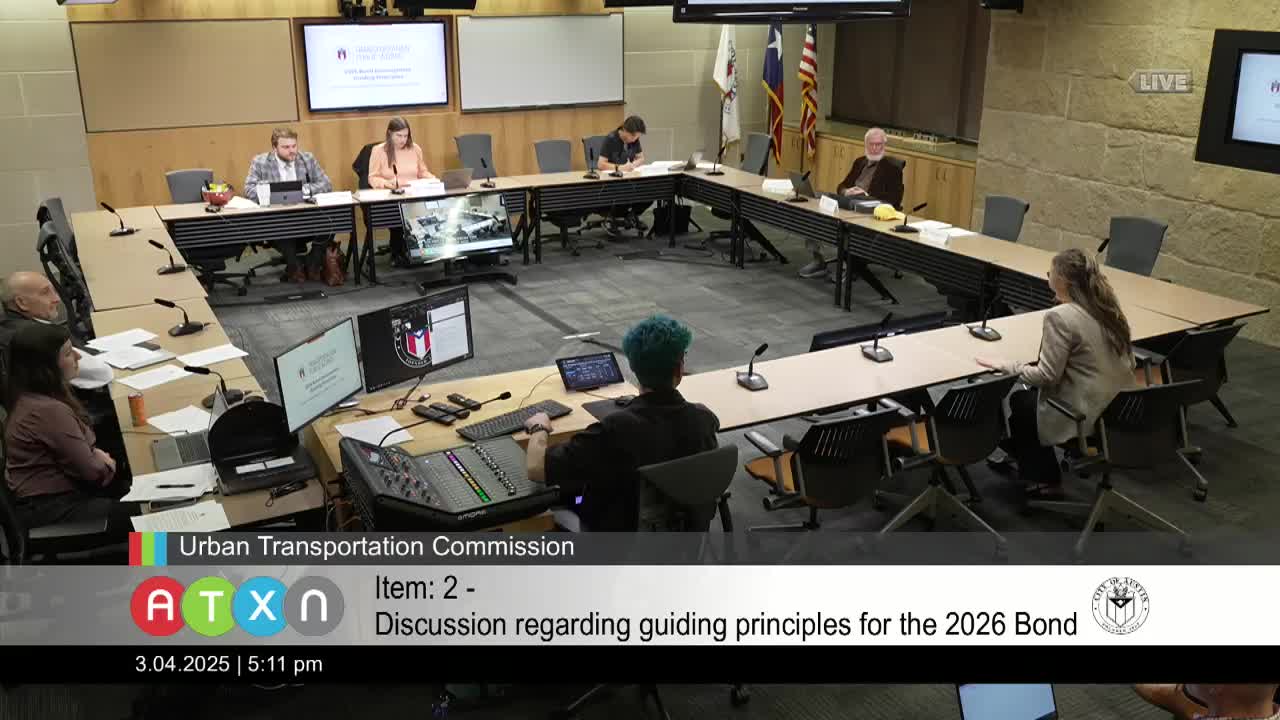
Transportation & Public Works staff on March 4 gave the Urban Transportation Commission a preliminary picture of the evaluation criteria it plans to use to identify capital project priorities for a potential 2026 bond.
The presentation, delivered by Michelle Marks of Transportation & Public Works, said the department is crosswalking those criteria with the Austin Strategic Mobility Plan and the City’s strategic-plan “anchors” — equity, affordability, innovation, sustainability and resilience, proactive prevention, and community trust — and intends to use the city’s Equity Analysis Zones and other data-driven tools in project selection.
Marks said the guidance applies to capital spending and not routine maintenance, which is driven largely by asset condition. "We're going to continue, to use our EAZs as, a guiding tool for investment dollars moving forward," she told commissioners, referring to the Equity Analysis Zones developed during previous outreach.
Why it matters: City staff said the criteria aim to make bond-funded projects reflect multiple policy goals rather than prioritizing any single objective. In particular, Marks and TPW staff tied prioritization to the Austin Strategic Mobility Plan (ASMP) targets, transit-access measures and the city’s Vision Zero safety priorities.
How staff framed the criteria: TPW organized evaluation factors under the strategic anchors and suggested measuring or scoring projects on each. Examples discussed included: - Equity: directing investment to EAZs and Title VI transit routes that serve low-income communities; - Affordability: projects that improve low-cost mobility (sidewalks, access to transit); - Innovation: incorporation of smart infrastructure (transit signal priority, integrated signal systems) and cross-program delivery opportunities; - Sustainability & resilience: green infrastructure, street trees, low-carbon materials and protecting critical corridors for emergencies; - Proactive prevention: projects on the city’s high-injury network and safe routes to school; and - Community trust: meaningful public engagement and attention to populations and employment density served by projects.
Marks said TPW presently plans to weigh those objectives "more or less evenly" because outreach to the public during ASMP and the Austin Strategic Mobility Plan process emphasized multiple, near-equal priorities: equity, affordability, sustainability and safety. She said the department will perform sensitivity testing on the scoring to see how different weightings change project rankings.
Commission questions focused on two themes: project size/readiness and program versus project funding. Commissioners cautioned that large, transformative corridor reconstructions may check more boxes than smaller, faster-to-deliver projects such as sidewalks, and asked how the scoring system will avoid bias toward large projects. Marks said programmatic funding — flexible, smaller-dollar safety and mobility programs — will be considered alongside large capital projects and that TPW intends to include programs in the prioritization framework so smaller projects are not undervalued.
On project readiness, commissioners pressed how TPW will ensure the bond favors deliverable work. Marks said delivery capacity will be treated as a "gateway" criterion: projects must be feasible within a financing and delivery timeline and should be sufficiently advanced in scoping and engineering before construction funding is proposed.
What remains unresolved: staff said the criteria are preliminary. They did not present a final project list, stating they are still testing weightings and continue to refine the scoring methods ahead of bonding decisions. Marks asked for commission feedback as the department completes the sensitivity analyses.
The commission did not take formal action on the bond-guiding principles; the item was a staff briefing and discussion.
Ending: TPW will continue refining numerical criteria and share results of sensitivity testing with the commission and other advisory groups as the city moves toward any formal bond proposal in 2026.