Get Full Government Meeting Transcripts, Videos, & Alerts Forever!
Get email alerts on the Threats To Institutions topic
No spam. Unsubscribe anytime.
Committee advances bill to close a gap that can impede prosecutions for threats to locations such as schools and houses of worship
Summary
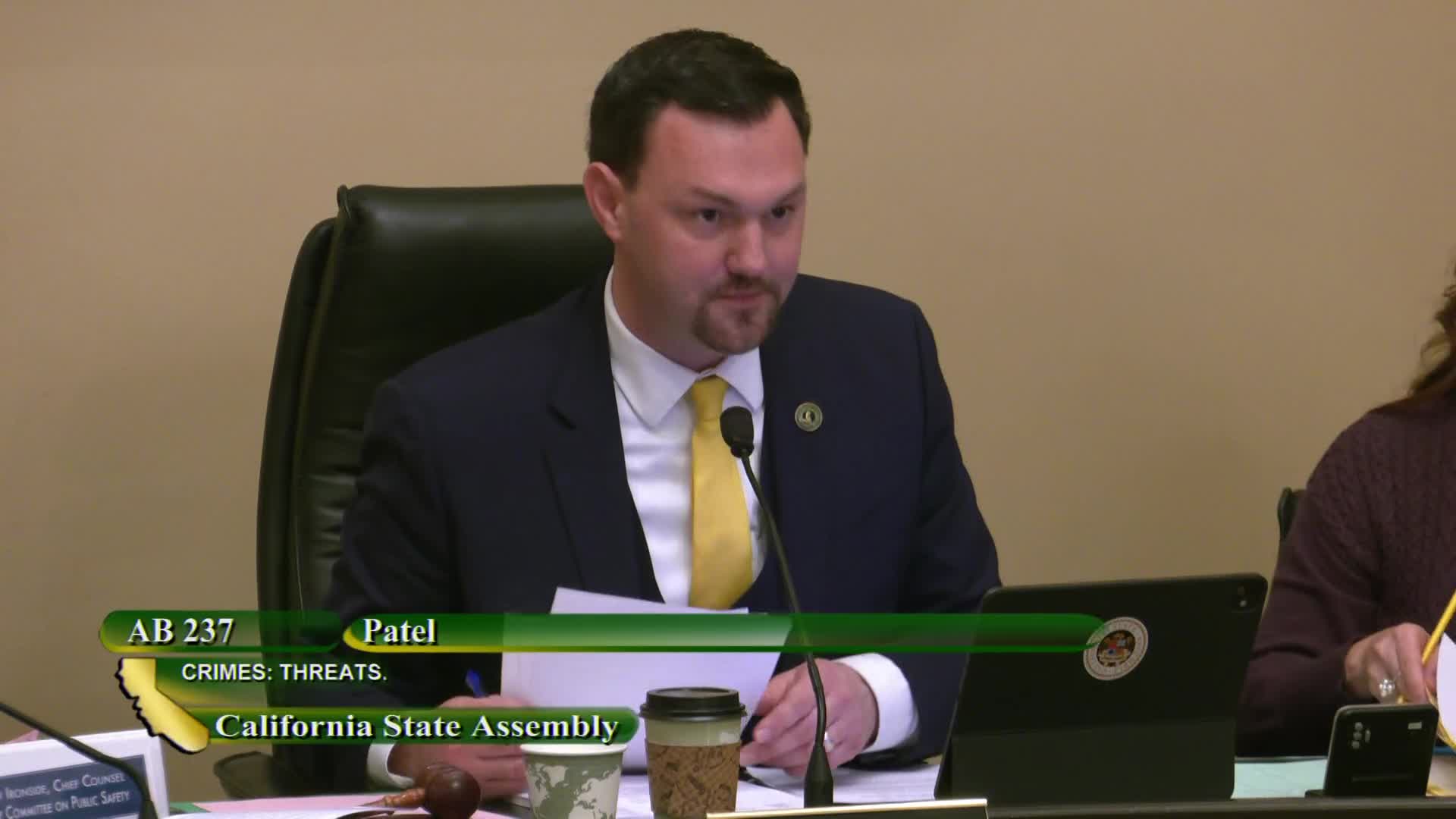
AB 237 would clarify Penal Code section 422 to cover threats aimed at locations (schools, places of worship, voting centers) where threats may not name specific individuals; the committee advanced the bill after witnesses described disruptive, targeted threats and the author accepted committee amendments.
Assemblymember Patel introduced AB 237 to close what she described as a prosecutorial gap in Penal Code section 422 (criminal threats). The bill would clarify that threats targeting locations where people gather—airports, voting centers, places of worship, daycares, hospitals, and schools—constitute criminal threats even if an individual is not named.
Pat Espinosa of the San Diego County District Attorney’s Office and multiple school‑safety and police organizations supported the bill. Espinosa and parents described incidents where threats to a school or an assembly caused significant alarm and operational disruption, and where prosecutors were hampered by statutory language that some judges read as requiring a named individual as the target.
Opponents, including ACLU California Action and public-defender groups, warned about overcriminalizing provocative speech and the risk of prosecuting juveniles and people with mental-health conditions; they urged robust due-process and narrowly tailored language. ACLU counsel highlighted that section 422 does not require intent or ability to carry out the threat and that the statute has sometimes been applied to age-appropriate student conduct.
The author accepted committee amendments aimed at narrowing protected conduct and retaining judicial discretion; following discussion, the committee passed AB 237 to Appropriations. Members encouraged continued work with civil‑liberties groups on the statutory language to avoid sweeping in constitutionally protected speech while ensuring prosecutors and investigators have tools to address credible location‑based threats.