Get Full Government Meeting Transcripts, Videos, & Alerts Forever!
Get email alerts on the Implementation Bhsa topic
No spam. Unsubscribe anytime.
State lays out BHSA implementation steps: integrated county plans, new reporting, and workforce investments
Summary
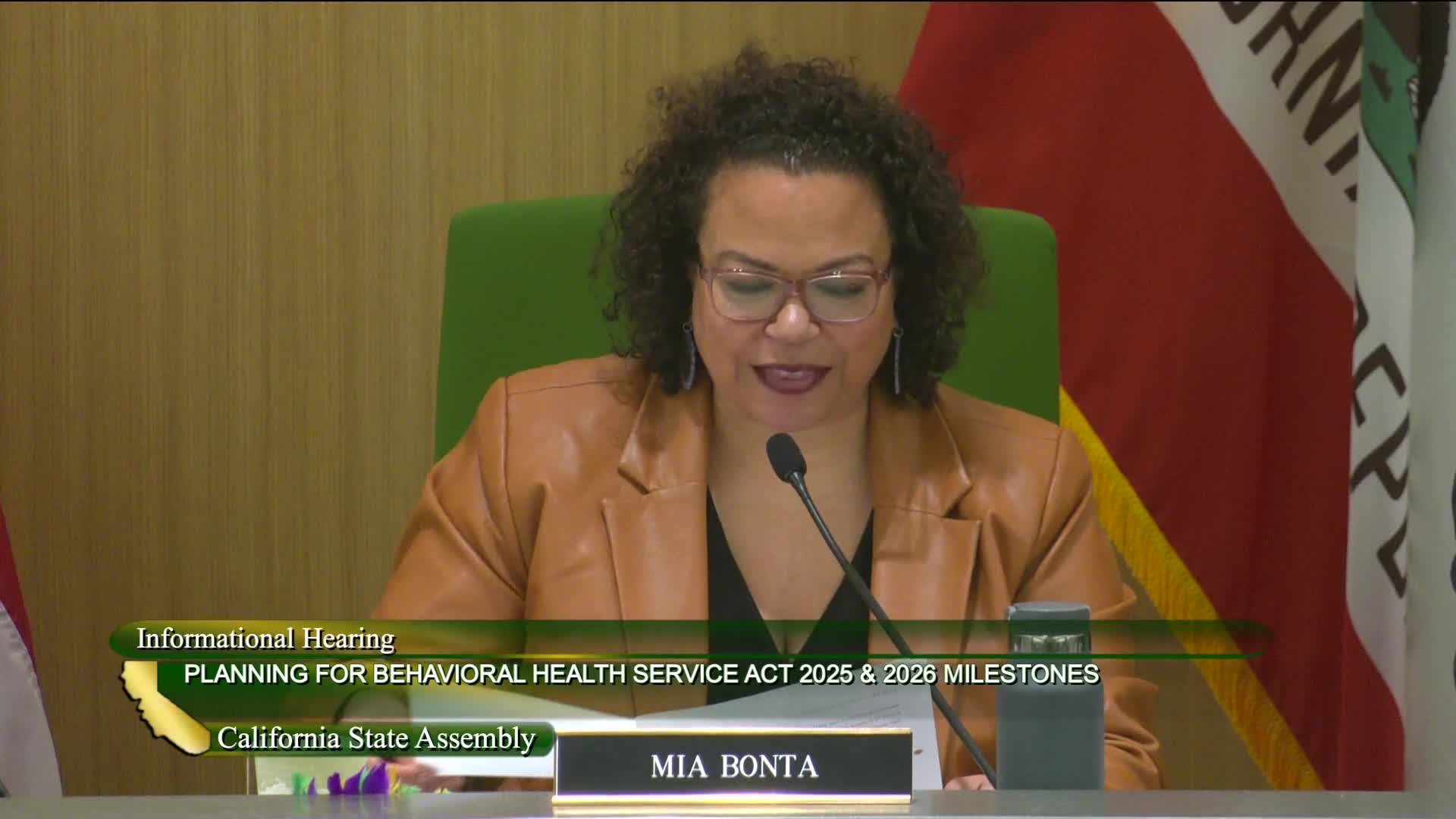
State officials and county representatives told the Assembly Health Committee they are building technical tools and timelines for Behavioral Health Services Act implementation: counties must file three‑year integrated plans by June 2026, a digital policy manual and county portal will be released in modules during 2025, and new state workforce and
State officials described concrete implementation steps for the Behavioral Health Services Act (BHSA) and related Proposition 1 requirements, emphasizing new planning and reporting workflows, data improvements and workforce initiatives.
Stephanie Welch, deputy secretary for behavioral health at California Health and Human Services Agency, told the Assembly committee the state is sequencing guidance and investments to align BHSA changes with Medi‑Cal waivers and other reforms. She said the administration intends the BHSA to strengthen the full continuum of care, including prevention, early intervention, acute inpatient capacity, community supports and housing.
Integrated plans and reporting: Marlyce Perez of the Department of Health Care Services said counties are required to submit a three‑year integrated plan by June 2026 that describes how they will use BHSA and related funds. DHCS has begun publishing a digital policy manual (first module released) and will publish additional modules through 2025; the department is building a county portal for electronic submissions to replace lengthy paper plans. Perez said counties will also contribute to a Behavioral Health Outcomes and Accountability Transparency Report (a voter‑mandated report) with a draft due January 2028 and a first final report due January 2029.
Data, IT and accountability: Perez and agency witnesses acknowledged counties’ current behavioral health data systems are fragmented and aged. DHCS said it will redesign data systems to reduce duplication, make reporting easier for counties and enable greater public transparency about service and expenditure outcomes. Both state and county speakers emphasized that increased transparency brings new administrative burdens and that the state will provide technical assistance.
Workforce and state actions: Welch and other panelists said BHSA channels new ongoing state funds (three percent of the millionaire’s tax share assigned to workforce under the state share) to workforce development programs administered by HCAI and other state partners. Examples cited include certified wellness coaches (about 1,200 certified) and other allied health profession development. Panelists emphasized that physical facilities must be matched with service dollars and trained staff to be effective.
County perspective and next steps: Michelle Cabrera of the County Behavioral Health Directors Association said counties are modeling budget impacts and preparing stakeholder planning bodies, but she warned counties will have less flexibility in some funding categories and will confront administrative reporting requirements. County leaders asked for sustained, targeted technical assistance from the state and the legislature as guidance modules and the county portal are rolled out.
Attribution: Summaries and timelines in this article are drawn from Stephanie Welch (California Health and Human Services Agency), Marlyce Perez (DHCS), Michelle Cabrera (County Behavioral Health Directors Association) and other panelists in the March 4 hearing.
Implication: The state’s digital policy manual, an integrated plan template and a new public reporting cadence are intended to centralize BHSA rules and make county performance and spending more transparent; counties will need additional technical assistance and time to adapt.