Get Full Government Meeting Transcripts, Videos, & Alerts Forever!
Get email alerts on the County Case Study topic
No spam. Unsubscribe anytime.
Fresno behavioral health director: county sought nine BCHIP awards, received none after technical and site setbacks
Summary
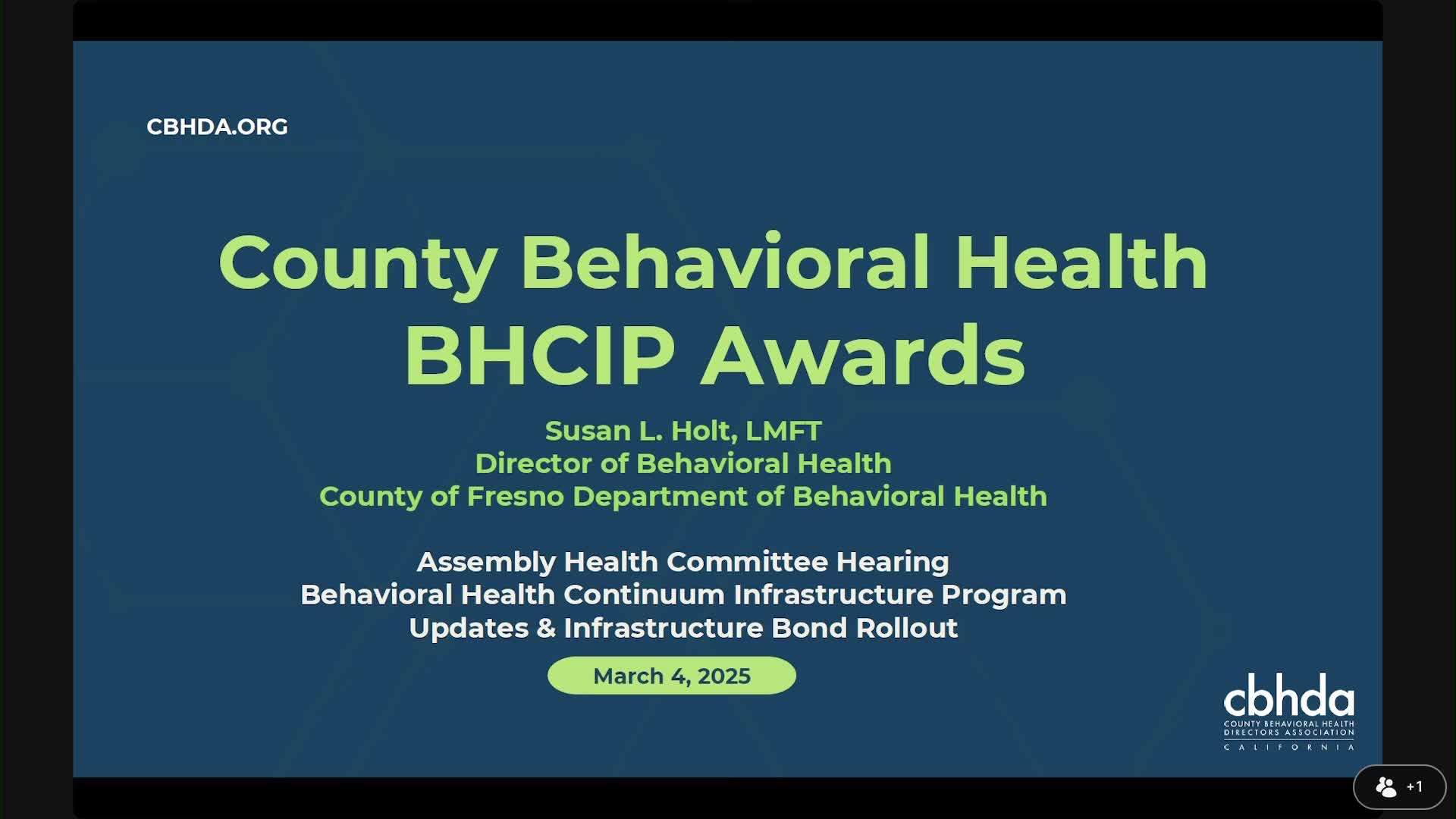
Fresno County Behavioral Health Director Susan Holt told the Assembly committee her agency submitted nine BCHIP applications totaling about $105 million but received no final awards after a tentatively awarded project encountered a fire, title problems and revised cost estimates that made renovation infeasible.
Fresno County Behavioral Health Director Susan Holt described an experience that highlights barriers smaller or poorer counties face in competitive BCHIP rounds: her department submitted nine applications across grant rounds 3–5 requesting about $104.7 million but ultimately accepted no awarded BCHIP funds.
Holt said seven of the Fresno applications — about $68.3 million — sought acute care capacity such as psychiatric health facilities and crisis stabilization units for the Southern San Joaquin Valley, an area RAND and counties had identified with high unmet need. Holt said the county did receive a tentative award in round 5 for a renovation, but the building later burned; the title for the property introduced complications, and refined cost estimates showed the renovation would far exceed the tentative award. For those reasons Fresno declined the tentative award.
Holt's account: She told the committee her team believed the applications were competitive and that the projects matched documented regional need. She also described structural barriers: counties without owned sites, high upfront application costs, tight timelines favoring launch‑ready projects, and the complexity of meeting BCHIP’s strict documentation and underwriting requirements. She warned that awards that are substantially less than requested can leave counties unable to execute projects unless they find additional local or private funding.
Why it matters: Holt’s testimony underscores LAO’s and DHCS’s conclusions that launch‑ready scoring, site readiness and upfront costs favor better‑resourced applicants and that smaller counties can be shut out even when need is high. Her remarks illustrated how project‑level contingencies (fire, title issues, revised budgets) can convert tentative awards into no awards.
Attribution: Quotes and project numbers in this article come from Susan Holt, Fresno County Behavioral Health Director, during her presentation and Q&A at the March 4 Assembly Health Committee hearing.
Forward look: Fresno’s experience was one reason lawmakers and LAO committee members pushed DHCS on additional technical assistance, more flexible scoring for small or tribal applicants and on monitoring geographic distribution of awards as the Proposition 1 bond is disbursed.