Get Full Government Meeting Transcripts, Videos, & Alerts Forever!
Get email alerts on the Bchip Program topic
No spam. Unsubscribe anytime.
LAO finds BCHIP grants built infrastructure but unevenly targeted; DHCS readies $4.4 billion bond rollout
Summary
The BCHIP program built behavioral health facilities statewide but awarded grants unevenly by region and favored ready‑to‑build projects, the Legislative Analyst’s Office told Assembly members on March 4.
The Behavioral Health Continuum Infrastructure Program (BCHIP) has produced hundreds of projects statewide but, according to the Legislative Analyst’s Office, its prior grant rounds were unevenly targeted and favored launch‑ready projects — trends that could repeat unless the state adjusts the bond rollout.
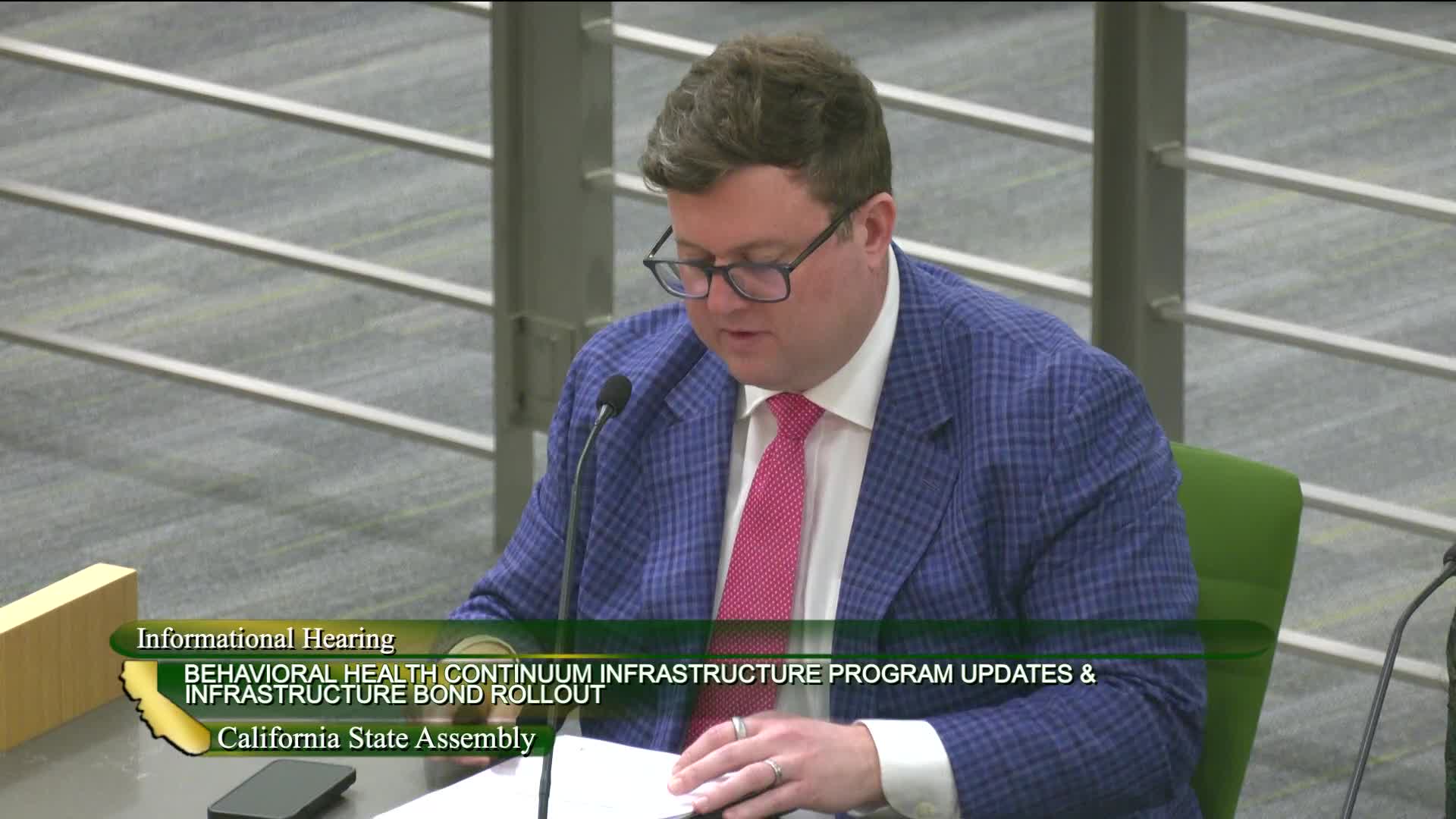
Ryan Miller of the LAO presented an assessment of BCHIP’s $1.7 billion in awards (2022–2023) and of how Proposition 1’s $4.4 billion bond will be folded into the program. Miller said over half of BCHIP projects were estimated to serve at least 80 percent Medi‑Cal enrollees — a strength — but that award patterns did not consistently track regional need. He said some regions that LAO’s methodology projected would receive more awards did not, and that the Southern San Joaquin Valley (Fresno, Inyo, Kern, Kings, Tulare) received no awards for some adult inpatient bed types despite having the highest need in LAO’s assessment.
LAO’s concerns: Miller told the committee the department used a regional set‑aside model with fixed regional funding amounts based largely on historical services, not a uniform needs‑based formula. That approach, LAO said, correlates with per‑capita award differences across regions. The LAO also warned that scoring preferences for “launch‑ready” projects — which are quicker to spend funds but require significant upfront planning and resources — can disadvantage small or less resourced counties and nonprofit providers and make it harder to site harder‑to‑build facilities.
DHCS response and bond rollout: Marlyce Perez of the Department of Health Care Services said DHCS designed a regional model with reserved discretionary funding and tribal set‑asides to reach underserved communities and that it has funded projects across facility types, including 71 projects aimed at children and youth (about $772 million). Perez said DHCS expanded mobile crisis capacity with earlier BCHIP rounds, funded over 400 mobile crisis teams and that, for the proposition 1 bond, DHCS planned to release awards rapidly — aiming to allocate three‑quarters of bond dollars by May 2025 and all awards by 2026. DHCS also said it has added technical assistance, is publishing a digital policy manual and will require conditional awardees to receive contracts and execute them within 90 days to reduce delays.
Small counties and application barriers: Both LAO and DHCS noted mixed performance for small counties. LAO found funding concentrated in 11 of 30 small counties, with 19 small counties receiving no funding in the main rounds; DHCS replied that 16 of the small counties that did not receive funds had not applied and that the department has increased outreach and technical assistance and seen increased applications from rural areas for the bond round.
What was not decided: No formal policy changes or new appropriations were voted on in the hearing. The LAO offered questions for legislative oversight and DHCS described administrative changes it has adopted for the bond.
Sources and attribution: Findings and quotes are drawn from Ryan Miller (Legislative Analyst’s Office) and Marlyce Perez (Department of Health Care Services) during the March 4 hearing.
Implication: The LAO assessment and DHCS’s corrective steps frame a policy question for the legislature and administration: how to balance rapid award and implementation timelines with equitable targeting and support for small, rural, and tribal applicants so bond dollars reduce capacity gaps where need is highest.