Get Full Government Meeting Transcripts, Videos, & Alerts Forever!
Get email alerts on the Firefighter Health topic
No spam. Unsubscribe anytime.
Firefighters press legislature for screening pilot, PFAS-free gear and reimbursements after cancer diagnoses
Summary
Wallingford firefighter David Pirelli and fire-service groups urged support for House Bill 7,120 — proposing PFAS-free turnout gear for at-risk firefighters, a pilot cancer-screening program and grants to remove PFAS foam from apparatus — while chiefs warned the new gear's inner liners are not yet widely available or fully battle-tested.
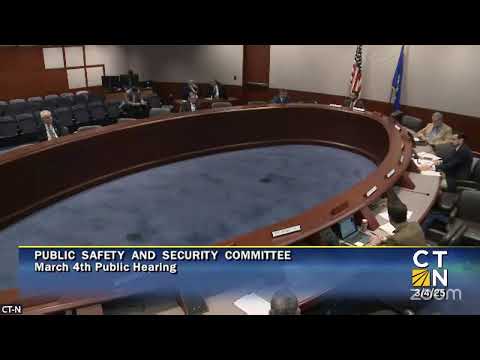
A firefighter who recently survived kidney cancer and a coalition representing fire departments testified March 4 that Connecticut should adopt a pilot cancer-screening program, increase access to PFAS‑free turnout gear and reimburse departments that already removed PFAS foam from apparatus.
The hearing focused on House Bill 7,120, which would: require municipalities to provide PFAS‑free turnout gear to qualifying firefighters, create a cancer-screening pilot program, and fund removal of PFAS firefighting foam from apparatus. Proponents described human and financial costs of late cancer diagnoses and urged early screening and equipment changes.
Wallingford firefighter David Pirelli, who described his diagnosis and treatment to the committee, said he had no symptoms before an October 2023 checkup led to surgery. He testified: “By September of that year, I had half of my right kidney removed along with a 2 inch tumor and it was classified as stage 3 renal cell carcinoma.” He described months of follow-up treatment and large medical costs: “I have about a half million dollars worth of IV drugs in my body right now.” Pirelli said his department procured 1 PFAS‑free set for him as a demo but that his backup set still contained PFAS; he argued that “2 sets of PFAS free turnout gear needs to be available for every member of the fire service.”
Fire-service groups supported the bill but identified practical problems. The Joint Council of Connecticut Fire Service Organizations, speaking through Chief Michael Thurs and others, said manufacturers have introduced PFAS‑free outer shells but the moisture barrier — the layer closest to the skin — remains a concern and has exhibited seam failures in early versions. The council called the proposed mandate an “enormous unfunded mandate” if implemented immediately and urged clearer definitions and realistic timelines. Chief Thurs asked that the state fire administrator, not the Joint Council, retain statutory lead responsibility for model-plan development.
The Connecticut Fire Mechanics Association and the Joint Council urged the legislature to reimburse departments that removed PFAS foam from apparatus before the previous reimbursement deadline; several departments reported multi‑thousand‑dollar cleanup costs. Chief Jay Kelly said his city had spent about $21,000 to remove foam; West Hartford reported $16,000 and other municipalities similar amounts. The joint council asked the legislature to reimburse departments that acted early.
Lawmakers asked for more precise drafting. Some committee members proposed a phased approach that focuses first on replacing inner moisture barriers for firefighters who already have elevated cancer risk or documented diagnoses, rather than immediately requiring two full PFAS‑free sets for every firefighter. Representatives and senators also pressed for a clear definition of “PFAS‑free” that matches available products and for a realistic implementation date; several witnesses said the October 1 effective date in the draft might be infeasible.
Supporters also recommended a pilot cancer-screening program tailored to firefighters’ risk profile. Physician and volunteer firefighter Jeffrey Bond presented screening proposals that begin certain tests earlier than general-population guidelines (for example, earlier colonoscopy screening) and described data from a private screening provider that found elevated-risk findings in roughly 16 percent of screened firefighters at Connecticut screening centers.
No formal action was taken; committee members asked stakeholders to narrow definitions, quantify costs and consider a phased approach that pairs screening and equipment reimbursement with vendor testing and state grants to help municipalities absorb initial costs.