Get Full Government Meeting Transcripts, Videos, & Alerts Forever!
Get email alerts on the Medical Licensing Internationally Trained Physicians topic
No spam. Unsubscribe anytime.
Committee advances SF509 to create supervised-practice licensing pathway for internationally trained physicians
Summary
The Minnesota Senate Committee on State and Local Government on March 4 recommended SF509, which would remove a blanket residency requirement for internationally trained physicians and replace it with documentation, exam and supervised-practice criteria; an amendment allowing alternatives to a letter of recommendation was adopted.
The Minnesota Senate Committee on State and Local Government on March 4 recommended Senate File 509 as amended to pass and re-refer to the Senate Finance Committee. The bill would change licensing for physicians who trained and practiced outside the United States by replacing an automatic requirement to repeat residency with a supervised-practice pathway and other documentation requirements.
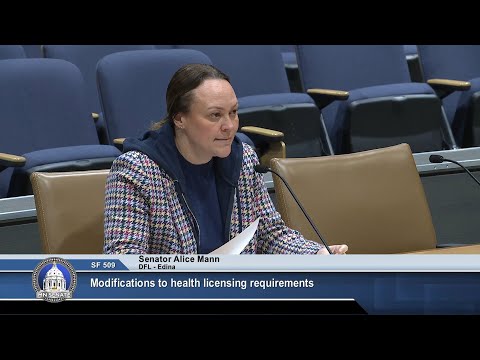
Senator Mann, the bill sponsor, told the committee SF509 "is the bill to change how we license internationally practicing physicians," and described a pathway that would allow experienced foreign-trained doctors to obtain a Minnesota license without repeating a full residency if they meet specified requirements.
Under the bill as explained in committee, an internationally trained physician would be eligible for the pathway if they graduated from medical school, practiced medicine for at least five of the previous 12 years, have passed all three U.S. medical licensing Step exams, and complete two years of supervised practice in a rural or underserved area under the supervision of a licensed physician. The bill also requires multiple letters of recommendation and periodic check-ins with the Minnesota Board of Medical Practice; proponents said documentation requirements would be comparable to those required of residents.
An A3 amendment offered during the hearing and moved by Senator Carlson was adopted. Senator Mann said the amendment responds to board and Minnesota Department of Health feedback that "there are certain scenarios where a letter of recommendation may not be possible" and allows "other forms of ways to demonstrate good standing" where letters are unavailable.
Doctor Azar Maloki, a physician who trained in Iraq and has worked in Minnesota in research and as a medical interpreter, testified in support. Maloki told the committee he "passed all the US assembly steps on my first attempt and acquired the ECFMG certification" but still faced long waits and expense to secure a residency position. He said the bill would provide clinical exposure to U.S. practice, increase use of existing experienced physicians, and help address physician shortages in underserved areas.
Committee members pressed for clarifications. Senator Barr questioned the language about letters and whether the bill requires attestations specifically from the physician who directly supervised the candidate under a collaborative agreement; committee counsel and Senator Mann responded the intent is to require letters from physicians who participated in the collaborative agreement and supervised the applicant, but Barr asked staff to tighten that language before the next committee stop. Senator Lang asked whether the proposal applies to other professions; Senator Mann said SF509 is limited to M.D. and D.O. physicians though discussions about other practitioner groups were ongoing. Senator McQuade voiced support and said the bill is a "good first step" toward returning skilled physicians to practice.
After discussion, Senator McQuade moved that SF509 as amended be recommended to pass and re-refer to the Finance Committee; the motion carried on a voice vote with no recorded opposition.
Votes at a glance
- A3 amendment (moved by Senator Carlson): adopted (voice vote). - SF509 as amended (moved by Senator McQuade): recommended to pass and re-refer to Finance (voice vote; no recorded opposition).
What the bill would change
- Remove a blanket requirement that internationally trained physicians repeat a full U.S. residency. - Require: a medical school diploma; at least 5 of the last 12 years practicing medicine; passing all three U.S. medical licensing Step exams; two years of supervised practice in a rural or underserved area; multiple letters/attestations and check-ins with the Board. - Allow alternatives to a letter of recommendation where a letter is not possible (A3 amendment).
Context and next steps
Supporters argued the change could expand the physician workforce, diversify clinicians, and free residency slots for newly graduating U.S. medical students. Critics or cautious members sought clarifying language on who must provide attestations and whether comparable safeguards and supervision would be enforced; staff were asked to tighten the bill draft before its next committee stop. The committee recommended the bill to pass and re-refer to Finance for further consideration.