Get Full Government Meeting Transcripts, Videos, & Alerts Forever!
Get email alerts on the Healthcare Reinsurance topic
No spam. Unsubscribe anytime.
Minnesota committee advances reinsurance bill, debate centers on how to pay for it
Summary
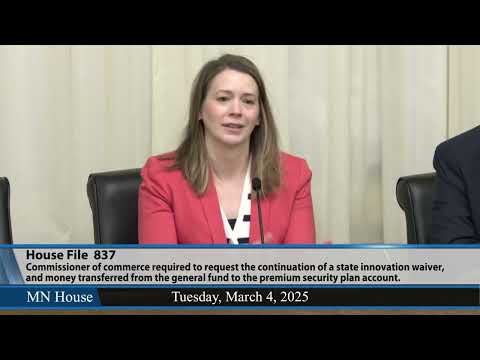
Rep. Driscoll's House File 837 to extend Minnesota's reinsurance program was advanced out of the House Commerce, Finance and Policy Committee on March 4, 2025, with the committee voting to refer the bill, as amended, to the Health Finance and Policy Committee.
Rep. Driscoll's House File 837 to extend Minnesota's reinsurance program was advanced out of the House Commerce, Finance and Policy Committee on March 4, 2025, with the committee voting to refer the bill, as amended, to the Health Finance and Policy Committee.
The bill's author, Representative Driscoll, presented the measure and an A1 amendment that updates the bill's fiscal numbers. The committee heard more than a dozen testifiers representing insurers, labor, business groups and providers, and engaged in extended discussion about several competing financing options for continuing reinsurance, including a governor-backed industry assessment that would levy fees on health insurers.
The reinsurance program reimburses a portion of very large claims in Minnesota's individual market to reduce premiums for enrolled consumers. Supporters said the program has reduced premiums substantially and stabilized the market; opponents said directing roughly a half-billion dollars through the general fund to insurers is a poor long-term solution and pressed for an industry assessment to fund the program instead.
Dan Andreessen, with the Minnesota Council of Health Plans, told the committee that "Minnesota's reinsurance program has been a resounding success in stabilizing the market and reducing premiums on average by 20%." Andreessen said reinsurance currently supports about 187,000 Minnesotans in the individual market and that without the subsidy premiums and market participation would worsen.
Julia Dreyer, Deputy Commissioner of Insurance at the Minnesota Department of Commerce, explained the assessment model the administration proposed in an A2 amendment. She said the assessment would be administered through members of Minnesota's comprehensive association for health carriers and assessed proportionally based on written health-related premiums, noting roughly 300 member organizations could be included.
Representative Elkins presented the A2 amendment as a discussion item that mirrored the governor's recommendation; he later withdrew it after committee discussion, saying he wanted it priced out among alternatives. Representative Driscoll and others described several financing paths that remain under consideration and said the bill would move next to the Health Finance and Policy Committee and ultimately to Ways and Means to settle funding.
Labor and provider witnesses urged the committee to fund reinsurance through an insurer assessment rather than general fund dollars. Gayle Larson, representing SEIU Healthcare Minnesota and Iowa, said she opposed House File 837 as drafted and told the committee, "We will not solve the problem by giving over $500,000,000 to the very people who profit most from the current system." Devin Bruce of MAPE and Dr. Alita Borud, a physician from Rochester, also urged alternatives to using general fund revenue.
Business and provider groups urged continuation of reinsurance but disagreed about the preferred funding source. Anne Newbrindley of the Minnesota Business Partnership and Bentley Graves of the Minnesota Chamber of Commerce said reinsurance stabilizes the individual market and protects providers from uncompensated care; both warned that finance choices could raise costs if assessments are passed through to consumers.
Committee members repeatedly raised the same trade-offs: reinsurance can blunt an "insurance death spiral" that occurs when higher premiums drive out healthier enrollees, further increasing costs for remaining members; but paying insurers through general fund dollars uses scarce state resources that some members said may be needed for other priorities. Several members asked nonpartisan staff to produce integrated analyses of existing assessments, taxes and the full list of charges that apply to insurers.
Procedurally, the committee approved an A1 amendment to update the fiscal tracking language in the bill; Representative Driscoll described the amendment as replacing an earlier fiscal figure ($413,000,000) with updated numbers (as presented in committee materials). Representative Elkins's A2 amendment, which would have created the administration's insurer assessment, was introduced for discussion and subsequently withdrawn for further analysis.
At the close of the hearing, Representative Driscoll renewed his motion that House File 837, as amended, be referred to the Health Finance and Policy Committee; the motion prevailed. Committee members said they expect the next steps to include detailed fiscal work in Ways and Means and further negotiation on funding mechanisms.
Votes at a glance: the committee approved the minutes for the Feb. 27 meeting, passed the A1 amendment to House File 837, and referred House File 837, as amended, to the Health Finance and Policy Committee. The A2 amendment was withdrawn by its sponsor and therefore was not adopted.
The committee hearing record shows broad agreement on the policy goal of stabilizing the individual market but no agreement on the financing mechanism. Lawmakers and witnesses signaled that the issue will be reconsidered in Health Finance and Policy and Ways and Means with requests for additional fiscal analyses and modeling of alternative funding options.