Get Full Government Meeting Transcripts, Videos, & Alerts Forever!
Get email alerts on the Capital Investment Bonding topic
No spam. Unsubscribe anytime.
House Capital Investment Committee hears 17 informational bonding requests for water and sewer projects
Summary
At its March 4 hearing the Minnesota House Capital Investment Committee heard 17 informational presentations on proposed capital projects — mostly water and sewer upgrades — from cities and townships across the state. No committee actions were taken on the bills; the committee approved minutes from its Feb. 27 meeting at the start of the session.
St. Paul — The Minnesota House Capital Investment Committee on March 4 heard informational presentations on 17 proposed capital projects from local governments seeking state support for water and sewer infrastructure, ranging from sewer-main extensions in St. Joseph to treatment upgrades to address manganese, radium and PFAS in drinking water. Committee Chair Frandsen opened the hearing and members emphasized that the session was informational only; no bonding decisions were made.
The requests presented to the committee largely sought bonding or grant assistance to avoid steep local assessments and to align construction with other imminent public works. "This project will open up 2,100 acres for new economic development," David Murphy, city administrator for St. Joseph, said of a sewer-main expansion that the city says will support commercial, industrial and residential growth. St. Joseph asked the committee to consider a bonding amount the city is prepared to match; the city noted that its earlier ask increased from $5.7 million to $6.2 million and could rise further.
Why it matters: Committee members repeatedly cited growing costs, public-health drivers and the timing advantages of pairing municipal utility work with planned state road projects. Local officials said without state help some communities would face per-household assessments that could exceed tens of thousands of dollars or steep utility-bill increases for residents.
Major project summaries presented
- St. Joseph (Rep. Bernie Perryman): A sewer-main extension intended to open roughly 2,100 acres for development; bonding request previously $5.7 million, now described as $6.2 million; city offered to provide a local match. Testifier: David Murphy, City Administrator; technical backup: Randy Sabar, City Engineer.
- Laketown Township (Rep. Nash): Replacement/phase 1 of an aging community wastewater system that serves roughly 35% of township households (209 connections); engineering estimate presented at about $25.4 million for full project with a phased approach and DE amendment discussed that would reduce the immediate ask (underlying ask cited at $13 million with a draft amendment reducing it to $6.4 million for phase 1).
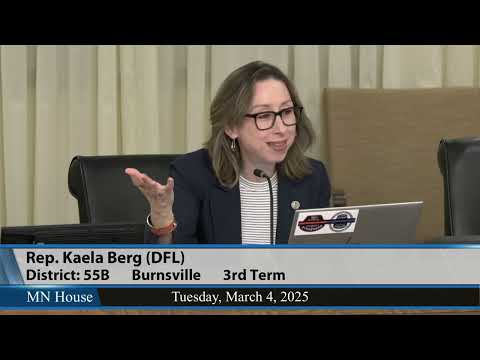
- Burnsville (Rep. Kayla Berg): Request for $8.55 million for surface-water treatment technologies, ion exchange and membrane filtration to remove contaminants including radium, plus line and electrical replacements; city leaders said the plant serves Burnsville and Savage and that the city is prepared to meet local match requirements. Testifier: Elizabeth Couts, Mayor of Burnsville.
- Mound and Minnetrista (Rep. Myers): Mound described an ongoing response to new health-guidance limits for manganese and a remaining construction need on the order of $30 million for later phases; the city expects roughly $3 million from an emerging-contaminant grant this year but still a multi‑million gap. Minnetrista described a $26.755 million project to build a treatment plant (site prepared, wells being drilled), with earlier phases complete and a 2027 completion target; city said the project can be phased.
- Blue Earth (Rep. Olsen): A reverse-osmosis plant needed after MPCA compliance requirements accelerated the schedule; Blue Earth is seeking approximately $7–7.5 million (about 35% of project cost) with the city prepared to cover the remainder; managers said household combined water/sewer charges have already risen as the city phased rate increases.
- Lewisville (Rep. Olsen): Small city seeking up to $10 million for citywide sewer, water and road reconstruction after a failed initial wastewater project and contractor bankruptcy; officials said residents currently face one of the state's highest combined utility bills and the city requested state assistance to avoid much larger rate increases.
- Dayton (Rep. Nadeau): Two requests: a wellhead treatment plant to address iron and elevated manganese (project estimates increased from $2.5 million in 2020 to roughly $8.5 million by 2023) and a water tower to provide pressure and fire suppression in the Historic Village; city officials said the wellhead treatment should meet standards for at least 20–25 years for that isolated area.
- Waseca (Rep. Sexton): Two bills: sanitary sewer inflow/infiltration work and a replacement water tower. City officials said heavy rains cause I&I that can overflow into Clear Lake, and that the tower replacement is phased and estimated at about $7.5 million over time; Waseca cited higher regional rates and ongoing federal and CDS funding already secured.
- Brooklyn Park (Rep. Vang): A $4.5 million request for a water-main river crossing to serve a Biotech Innovation District near the Highway 610/169 corridor; city leaders called it critical for catalyzing local development and jobs and said the crossing requires larger steel casing and upsized mains to avoid multiple crossings of MnDOT facilities.
- Newport (Rep. Hansen): Two inflow/infiltration bills for older sewer systems near the Mississippi River. Mayor Lori Elliott said a 3.1-inch rainfall once produced nearly 3 million gallons treated as sewage, and Metro Wastewater cited the city as a high-priority compliance concern; officials said the local special-assessment impact could be roughly $10,000 per property without state aid.
- South St. Paul (Rep. Hansen): A $3 million request for pressure-control valves and related work deferred since 2019; city administrators described earlier work to treat elevated radium at a well that drove sharp utility-bill increases and noted a separate study and potential multi-million-dollar cost to treat PFAS at another well.
- Saint Francis (Rep. Lawrence): A $3 million request toward an $8 million water and wastewater trunk-line replacement timed to match an upcoming MnDOT Highway 47 reconstruction; city leaders said matching schedules prevents tearing up a newly rebuilt state roadway.
- Scandia / Bliss neighborhood (Rep. Hill): A wastewater-treatment upgrade to meet MPCA nutrient removal requirements for an 89-home (transcript: 79-home) Bliss system; city testimony estimated project costs at about $2 million and said without state help Bliss residents' monthly sewer bills could rise from roughly $142 to $565 per month.
Committee process and procedural action
At the start of the hearing, the committee approved minutes from the Feb. 27 meeting. Representative Zhang moved to approve the minutes; the minutes were adopted by voice vote with no opposition recorded. The chair and members reiterated that every bill on the agenda was being heard on an informational basis with a five-minute presentation limit and that no committee votes on bonding were taken at the hearing.
What the committee and presenters emphasized
Presenters repeatedly asked the committee to consider phasing options where possible and to recognize the financial limits of small or low‑income communities that would face steep per-household assessments otherwise. Several cities said projects were time‑sensitive because of parallel state road work (Saint Francis and MnDOT) or because regulatory deadlines or health-guidance changes accelerated timetables (manganese, radium, MPCA compliance).
Next steps
Committee members noted the March 6 meeting will include additional bills; the March 4 hearing record will inform future deliberations but no formal committee action occurred on the day's bills. Local officials said they will continue pursuing other funding avenues (PFA, federal grants, phased construction) while seeking state bonding support in the regular session.
Sources and evidence: Committee hearing transcript, March 4, 2025; testimony from city officials and mayors as recorded in the committee record.