Get Full Government Meeting Transcripts, Videos, & Alerts Forever!
Get email alerts on the Como Park Appropriation topic
No spam. Unsubscribe anytime.
Senate committee hears $1.75 million legacy appropriation request for Como Park Zoo and Conservatory
Summary
Senate File 1152 requests $1.75 million in each fiscal year 2026 and 2027 for Como Park Zoo and Conservatory. Lawmakers heard from Senator Amover Baton and interim director Erica Prosser about visitor demographics, programs funded by legacy dollars and capital requests; the committee laid the bill over for possible inclusion.
Senate File 1152, a request for $1,750,000 in fiscal year 2026 and $1,750,000 in fiscal year 2027 for Como Park Zoo and Conservatory, was presented to the Minnesota Senate Committee on Environment, Climate, and Legacy by Senator Amover Baton and staff from the Como Park Zoo and Conservatory.
Senator Amover Baton told the committee the appropriation would support the Como Park Zoo and Conservatory’s operations and programs and noted the site’s statewide draw. "Como is free to visit. It is inclusive. It provides access to all," the senator said, and cited annual attendance figures of as many as 2.2 million visitors and a geographic mix that includes Saint Paul, the Twin Cities metro, Greater Minnesota and out‑of‑state visitors.
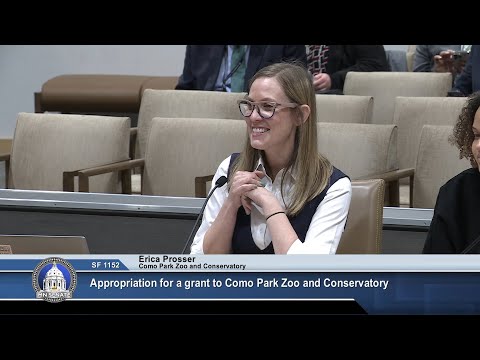
The request was described in more detail by Erica Prosser, introduced to the committee as the deputy director and interim director of Como Park Zoo and Conservatory. Prosser summarized how legacy and arts-and-cultural-heritage funding has been used for exhibits, habitat renewal, garden preservation and public programming aimed at improving access. She said the zoo reaches a diverse audience and detailed programs funded in part by legacy dollars: a summer concert series and winter conservatory concerts, sensory‑friendly mornings developed with Autism Society of Minnesota, ASL-interpreted sessions for the Little Explorers program, senior strolls, a SAFE (Saving Animals From Extinction) education program, bilingual community outreach, an apprentice program for paid training in zookeeping and horticulture, and special exhibits such as glass sculpture displays, a safari maze and monarch/milkweed installations.
Prosser described completed habitat renewal at the marine and mammal building and ongoing garden preservation work at features such as the Lily Reflection Pool and the Marjorie McNeely Conservatory. She said some projects were finished and others will continue into 2025.
Senator Mark Green asked whether the request represented an increase from prior years; Prosser said the biennial ask is a slight increase—about $25,000 more than previous requests—and that inflation and higher costs were part of the change. Green also asked whether funds would go to acquire animals. Prosser said zoos accredited by the Association of Zoos and Aquariums regularly review and update their collection plans; the zoo is due to update its plan and has a separate bonding request for improvements to the cat (Katz) building that would enhance the visitor experience for that collection.
Committee members also asked about other funding sources. Prosser said Como leverages legacy funds with private support from Como Friends (the nonprofit partner), revenue from rentals and earned income, and occasional bonding or other state requests, and noted a geothermal proposal under consideration in the energy committee.
After questions and brief closing remarks from Senator Amover Baton, the committee chair announced that Senate File 1152 "will be laid over for possible inclusion." No formal roll-call vote was recorded in the transcript.
Why it matters: Como Park Zoo and Conservatory is among Minnesota’s most visited cultural sites and the appropriation would support access, preservation and outreach programs that state legacy dollars have previously helped fund. The committee’s action to lay the bill over keeps it alive for potential inclusion in omnibus proposals.
Notes: All quotes and attributions in this report reflect the committee transcript. The appropriations figure and program descriptions were taken from testimony and committee discussion.