Get Full Government Meeting Transcripts, Videos, & Alerts Forever!
Get email alerts on the Childcare topic
No spam. Unsubscribe anytime.
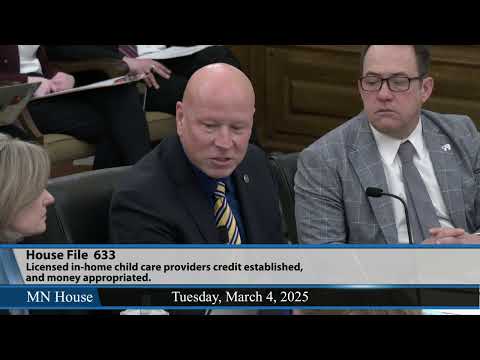
House Tax panel lays over bill to exempt half of in-home childcare property market value
Summary
The House Tax Committee laid over House File 633, a proposal to create a 50% market-value property tax exclusion for licensed in‑home family child‑care providers, after extended questioning about auditability and county revenue impacts.
The House Tax Committee on Feb. 27 laid over House File 633 for possible inclusion in the omnibus tax bill, a proposal that would create a new property‑tax market‑value exclusion for licensed in‑home family child‑care providers.
Representative Nadeau, the bill’s author, told the committee House File 633 “is a simple direct bill that lowers costs for family care providers. It reduces childcare wait times and it builds child care early learning system capacity.” The bill would reduce the taxable market value of qualifying properties by 50 percent, the author said.
The proposal drew sustained questions from committee members about whether the exclusion would actually lower childcare prices and how the state would prevent abuse. Representative Hansen asked, “what about in this bill is gonna guarantee that the people receiving this benefit are going to reduce the cost of childcare by receiving this particular benefit?” Representative Nadeau responded, “I can't guarantee that… All this bill does is… create a better environment for in home family care providers to function.”
Committee members repeatedly pressed on auditability and minimum‑service standards. Representative Hansen and Representative Elkins said the bill contains no minimum‑enrollment requirement and suggested adding limits or audit controls; Elkins noted his work on a fraud prevention committee and said “we need some way of being able to audit are these people really providing childcare that they're applying for.” The author said licensure remains the responsibility of the department and “the auditability component is outside of that.”
Members also asked about local government impacts. Representative Hewitt raised concerns that the exclusion would shift property‑tax burden onto other taxpayers and asked whether counties would need to cut services. The author acknowledged the share shift and said the fiscal note estimates there are about 5,400 licensed in‑home providers who could be affected and that he would consult Hennepin County to provide a local impact analysis.
The committee record includes the bill’s fiscal and programmatic claims cited by the author: state counts of licensed providers declined from more than 12,000 in 2011 to roughly 5,782 active licenses as of the first of the year; a cited market‑rate example said infant care averaged $16,164 per year in 2021; and the author estimated the exclusion would lower provider costs by about $9.8 million and reduce state paid property‑tax refunds by about $2.9 million. The bill text also references Minnesota Statutes 272.02 in explaining existing property tax classifications and cites a court case, Rainbow Early Education Center v. Goodhue County, in past exemption precedent.
After discussion the author renewed a motion to lay over House File 633 for possible inclusion in the omnibus tax bill; the motion was laid over. The committee did not adopt amendments or take a final vote on enactment. The author said he will follow up with county impact information and other clarifications as the bill moves through committee.
Votes at a glance: House File 633 — laid over for possible inclusion in omnibus tax bill (motion renewed by the author and carried by voice vote).